


The end of certainty: The post-war world order is unravelling
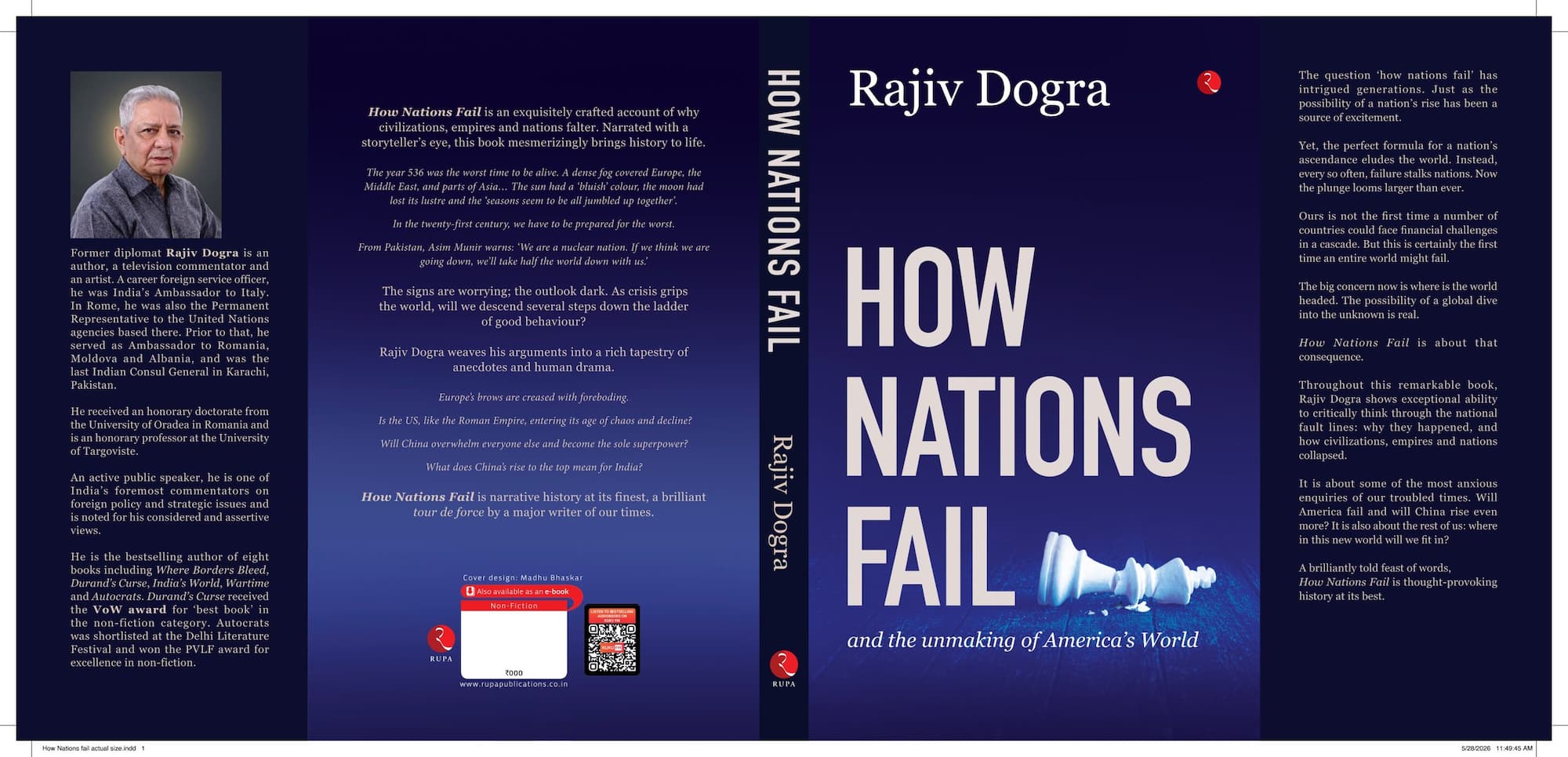
Ambassador Rajiv Dogra’s book 'How Nations Fail and the Unmaking of America’s World' examines the unravelling post-war order amid US overreach, China’s rise, and fading global ideologies. Below are edited excerpts from the book

At first, there was some hope as fairness, reciprocity, justice and responsibility formed a reasonable symmetry in the post-war global affairs.
This began to crumble bit by bit as the Cold War ended and the US assumed that its shoulders were big enough to support the entire world and keep it in balance. That crushing burden of responsibility was heady, and parts of the world were unruly—two contradictory pulls that led to conflict. A second development was the rise of China. As a challenger to the US monopoly, it now had a skin in the global game.
But China’s end game is not clear yet.
Does China wish to shape a new international order or merely make some adjustments to the current one, advancing discretely its interests and preferences without fundamentally transforming the global system?
It is this ambiguity of China’s intentions that will result in contrary pulls and pressures. For example, the ‘China threat’ for the US could mean China’s existence as a challenger to it. The monopolistic US will not tolerate the ascendance of a state that cannot be intimidated by it. On the other hand, the authoritarian axis of Russia and China currently is united largely by what it opposes, American power.
 More from Opinion
As for the Global South, the injustices of the past and the lingering racism of the present hurt as a reminder that the existing global order was formed to entrench racism as a norm of the world.
But the dispossessed are waking up and times are changing, slowly but surely, for the Global South.
Till recently, it was too deeply trapped in the slush of poverty to be concerned with intellectual aggrandisement. It was not able to carry its message beyond national borders. Like eggshells, some of these countries broke easily under economic headwinds or through misgovernance. But if these countries were once viewed as stuck in a time warp, the East Asian countries among them are now seen as representing the future.
Where does India fit in?
Will India find its place in this new world, or will it have to constantly wiggle to keep out of China’s way? Can it say that it has truly risen? Or is there the risk that its premature confidence curdles into national complacency—when it mistakes projecting strength for possessing it.
There is frustration among some at India’s slow pace, but even those who are uncomfortable know that what it has is something special.
They know that it has chosen not to be overwhelmed by the dizzying pace of technology. It has instead opted to absorb what it can assimilate of the new without upsetting its tradition.
India finds happiness in its deliberation, where other countries court crisis in their impatience. They usher in the new before beginning to defang it somehow. That does not always work out smoothly.
There is wisdom in constant dialogue with the past to avoid the overload of change. For once, the wider world too should give deliberation, rather than a frantic pace, a chance.
Ironically, in this otherwise frantic pace, the West has yet to acknowledge the urgency for a new world order. This despite the fact that the ideas we have so far lived with have more or less been discarded and that we are poised in a limbo where fresh ideas to lead the world are hard to come by.
Before the financial crisis of 2008, it was easier to imagine the end of the world than to imagine the end of capitalism. That is no longer the case. Communism is past its use-by date. Capitalism is a flavour that experience has staled. Liberalism is on faltering crutches. Now, there is no new ‘ism’ in sight. The picture is not promising at a practical level either.
Partnerships that prevailed during the Cold War—between the US, Western Europe and some Asian countries, including Japan, South Korea and Australia—are no longer adequate. These countries lack the resources and often the will to manage most of the world’s problems. The superpowers of tomorrow will need a new set of partners, and these will be the rising powers like South Africa, Brazil and India.
In this churn, at almost every level we are entering an era of unprecedented change and uncertainty. The old rules will not apply for much longer, whether in culture, society or, inevitably, the world that surrounds them all. The attempt to usher change in it will be venturing into uncharted territory.
Still, change is the necessity of time, and as an optimist, one must keep looking at the end of the tunnel even if that light is so faint that you can barely see it. In that remodelled world order, some of the essentials could be 'Sovereignty—rather than obeisance to the more powerful—should be the defining theme in the twenty-first century.' A stable, well-functioning and inclusive world order is necessary as an end in itself. There is more to the rules-based world order than transactions and trade. The new order will do well or badly according to the choices the world makes. At the very least, this means the end of rule-making by the US. It also means that the new order must not be shaped by China’s whims.”
In this remodelled world, the difference of opinion between people and between countries should not be an issue. It is the poverty of thought that fractures societies and, ultimately, the world. Therefore, we should expect and encourage the flourishing of intellectual energy in ideas.
Ultimately, as in the case of any new policy, the test for the new world order will not be how it begins but how it carries on fairly for all.
When new countries join the ranks of global decision-makers, they are likely to question many of the norms and institutions of the existing international order. If they succeed in the effort, they will try to impose their own new order on the world.
However, this is easier said than done. Countries like France and the UK, which currently share the global summit at the UNSC, keep resisting efforts at change because of the fear that they may not be accommodated at the high table in a remodelled world. Other countries like Argentina, Kenya, Egypt and Pakistan are vehement that they must be leaders in a new world framework. The result of this envy, and the consequent squabble, is stasis.
(Edited extract from Ambassador Rajiv Dogra’s book 'How Nations Fail and the Unmaking of America’s World' (Rupa Publications), published with the author’s permission. Views expressed in the above piece are personal and solely those of the author. They do not necessarily reflect Firstpost’s views.)

When Manila and Tokyo draw a line, Beijing draws a red line
Bangladesh gets a new envoy to reset its India ties
Escalation trap to an exit strategy: How can the Iran war end?
India must seize its demographic dividend before it fades
Bangladesh’s instability has sharpened India’s ‘Chicken Neck’ challenge