


Why are courtroom sketches still used in US trials?
As Elon Musk’s legal battle with OpenAI unfolds, courtroom sketches — not cameras — continue to document proceedings. Rooted in legal restrictions, privacy concerns, and tradition, this decades-old practice remains central to how high-profile US trials are visually reported

The ongoing courtroom battle between Elon Musk and OpenAI is drawing attention for the implications it will have on artificial intelligence.
But it also puts into the spotlight a uniquely American legal tradition which is the continued reliance on courtroom sketch artists instead of cameras.
Musk is scheduled for the witness stand on Wednesday, in a federal courtroom in California as part of a lawsuit he initiated against OpenAI.
The dispute centres on his allegation that the organisation deviated from its founding principles of operating as a responsible, nonprofit entity serving humanity, and instead shifted toward profit-driven motives.
During testimony on Tuesday before a nine-member jury, Musk criticised the 2019 restructuring led by Sam Altman and Greg Brockman, which introduced a for-profit arm under the broader organisational structure.
 More from Explainers
"If we make it okay to loot a charity, the entire foundation of charitable giving in America will be destroyed," Musk testified.
The lawsuit carries enormous financial stakes, with Musk seeking $150 billion in damages from OpenAI and its major backer, Microsoft.
Any compensation awarded, according to the claim, would go to OpenAI’s charitable division. Musk is also pushing for the organisation to revert entirely to nonprofit status and has called for the removal of Altman and Brockman from leadership positions, including Altman’s role on the board.
OpenAI, for its part, has defended its structure as necessary for raising capital, securing computing resources, and attracting leading researchers in an increasingly competitive AI sector.
The company currently operates as a public benefit corporation, with both nonprofit oversight and investor participation. The case unfolds against the backdrop of OpenAI’s potential initial public offering, which could reportedly value the company at around $1 trillion.
At the same time, it faces heating competition from firms such as Anthropic, as well as scrutiny over internal performance benchmarks. Yet, despite the technological sophistication of the issues at stake, the courtroom itself remains strikingly analog.
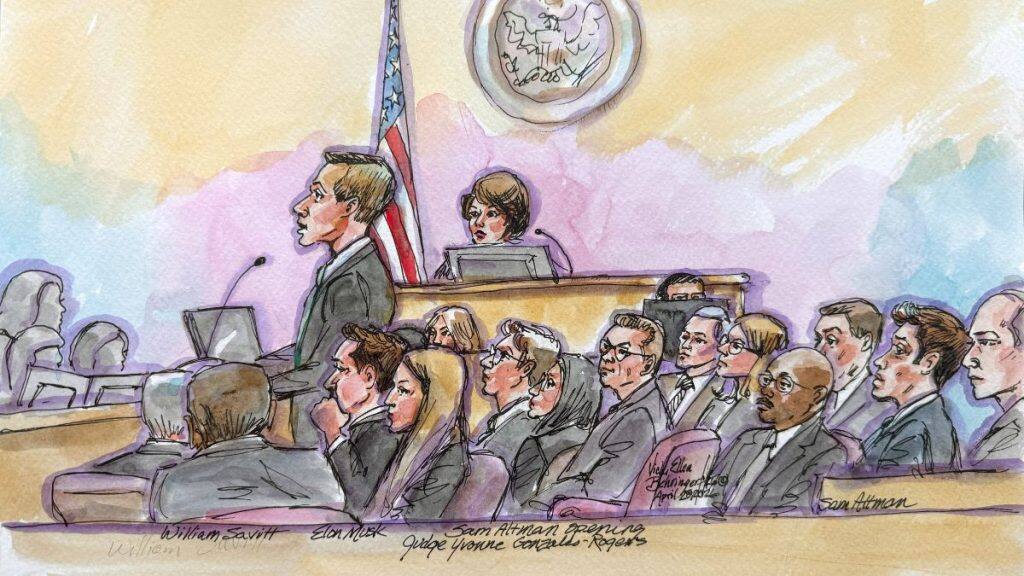
There are no live video feeds, no photography, and no televised coverage. Instead, the visual record of the proceedings is being created by artists with sketchpads.
Why cameras are absent in most US courtrooms
The reason for this absence lies in a long-established legal framework governing US federal courts.
At its core is Rule 53 of the Federal Rules of Criminal Procedure, introduced in the mid-20th century, which prohibits the use of cameras and broadcasting equipment during judicial proceedings in criminal cases.
Although this rule technically applies to criminal matters, federal courts have broadly extended its underlying principles to civil trials as well.
The Judicial Conference of the United States, which sets administrative policy for the federal judiciary, has historically maintained a cautious approach toward allowing cameras in courtrooms.
This cautious stance is rooted in historical experience. The origins of the prohibition can be traced to the 1935 trial of Bruno Richard Hauptmann, who was accused of kidnapping and murdering the infant son of aviator Charles Lindbergh.
The proceedings became a media frenzy, with hundreds of journalists and over a hundred photographers crowding the courtroom. Reports from the time describe photographers climbing over furniture, shining flashbulbs into witnesses’ faces, and competing aggressively for images.
The chaotic environment raised serious concerns about the dignity of the judicial process and the fairness of trials.
In response, the American Bar Association moved to restrict courtroom photography through its ethical guidelines in the late 1930s. This eventually led to the formalisation of restrictions in federal law in the 1940s, embedding the prohibition into the legal system.
Although technology has evolved significantly since then, the core rule remains intact. Cameras are still banned in federal criminal trials and in proceedings before the US Supreme Court.
While some federal courts have experimented with limited pilot programmes allowing cameras in civil cases, such efforts have not resulted in a permanent shift in policy.
Recent developments have allowed for some flexibility in audio access. By 2024 and 2025, certain civil proceedings permitted live remote audio streams, providing the public with greater access without introducing the visual element that courts remain wary of.
However, video coverage continues to be largely excluded, reflecting a deliberate choice by the judiciary to prioritise control over courtroom conditions.
Why privacy is crucial in courtrooms
A major argument against introducing cameras into courtrooms is the potential impact on behaviour. Judges and legal scholars frequently contend that the presence of a camera alters how participants conduct themselves.
The experience of the 1994 trial involving OJ Simpson is often cited as a turning point. Widely broadcast and followed by millions, the trial became a media phenomenon. While it increased transparency, it also raised concerns about the proceedings turning into a spectacle.
Observers noted that attorneys sometimes appeared to address the television audience rather than the jury, crafting arguments with public perception in mind. Witnesses, aware of the global attention, could become more guarded or performative.
In contemporary cases such as the Musk-OpenAI dispute, these concerns are amplified by the complexity and sensitivity of the subject matter.
The case involves proprietary artificial intelligence systems, corporate governance issues, and high-value financial claims. Courts are particularly cautious about exposing such matters to real-time global broadcasting.
Another critical issue is juror privacy. Unlike photographs or video footage, courtroom sketches can depict the general composition of the jury without revealing identifiable features.
This helps protect jurors from external pressure, harassment, or attempts at influence — risks that could compromise the fairness of a trial.
The presence of cameras also raises concerns about witness intimidation. Individuals called to testify may feel uncomfortable knowing their image is being broadcast worldwide, potentially affecting the quality and candour of their testimony.
Why courtroom sketches are essential in sensitive proceedings
Courtroom sketches serve as a compromise between transparency and restraint. They allow the public and the media to visualise key moments without introducing the risks associated with cameras.
In high-stakes cases like Musk’s lawsuit, where technical documents and confidential information may be discussed, sketches offer a level of abstraction. Artists focus on the people in the room — their expressions, gestures, and interactions — rather than the detailed content of exhibits or screens that could contain sensitive data.
This distinction is particularly relevant in cases involving cutting-edge technology. High-definition video could inadvertently capture proprietary material displayed in court, whereas sketches avoid reproducing such details.
Moreover, sketch artists provide a unique interpretive layer. Rather than offering a literal recording, their work reflects the atmosphere of the courtroom. Subtle elements — such as tension between opposing parties or the demeanour of a witness — can be conveyed in ways that static camera angles might not capture.
Artists are also able to create composite images, depicting multiple participants in a single frame even if they are seated in different parts of the courtroom.
How the tradition predates photography
The use of artists to document courtroom proceedings in the United States has deep historical roots. Long before the advent of photography, sketches were the primary means of visually recording trials.
One early example often cited is the Salem witch trials, where artists produced visual representations of proceedings for public consumption. These early efforts established a tradition that would continue into the modern era.
Even after photography became widespread in the early 20th century, courtroom sketches remained relevant, particularly when restrictions on cameras were introduced. The transition from photography to illustration in courtrooms was not a technological limitation but a deliberate policy choice.
Over the decades, courtroom artists have captured some of the most dramatic and memorable moments in American legal history. These include depictions of Charles Manson during his trial, Tupac Shakur appearing in court following a shooting, and Lindsay Lohan entering custody.
More recently, artists documented proceedings involving US President Donald Trump, including his arraignment on multiple felony counts related to business records.
In that case, only a small number of approved sketch artists were permitted to visually record the proceedings, underscoring the continued reliance on this medium even in cases of immense public interest.
Publications have also embraced courtroom sketches as a form of visual storytelling. In 2023, a prominent magazine featured a courtroom sketch on its cover for the first time.
Legislative efforts to expand camera access, often referred to under proposals like the “Sunshine in the Courtroom” Act, have been discussed for years. However, these initiatives have yet to produce a comprehensive change in federal policy.
As of now, the decision to allow or prohibit cameras in most federal courtrooms remains largely in the hands of judges, who tend to favour established practices, especially in complex or high-profile cases.
With inputs from agencies
Inhaling global affairs on a daily basis, Anmol likes to cover stories that intrigue him, especially around history, climate change and polo. He has far too many disparate interests with a constant itch for travel. You can follow him on X (_anmol_singla), and please feel free to reach out to him at anmol.singla@nw18.com for tips, feedback or travel recommendations

Military drones & police check-ups: How Sri Lanka is fighting against worst dengue outbreak in a decade
How Facebook job ad lured 2 Karnataka men into Myanmar cyber scam camp
Why is India seeing 95% cloud cover despite a Super El Niño?
What is CJP’s fourth demand to the government as protests in Delhi intensify?
The new geography of war: Why the Houthis can no longer be ignored