


Sagrada Família nears completion: Why the world’s tallest church took 144 years to build
Work on Spain’s famed Sagrada Família began in 1882. Now, 144 years later, the basilica has finally reached its full structural height with the completion of the central Tower of Jesus Christ

Work on Spain’s famed Sagrada Família began in 1882.
Ever since then, generations of tourists and locals in Barcelona have looked skywards at its soaring spires and wondered if it would ever be finished.
Now, 144 years later, the famed basilica has finally reached its full structural height, though work is still ongoing. This comes with the completion of the central Tower of Jesus Christ.
But what happened? Why did the world’s tallest church take 144 years to build?
Let’s take a closer look.
What we know
The church reached its full structural height after the central Tower of Jesus Christ, which rises to 566 feet, was completed. This came after a 55-foot cross weighing around 100 tonnes was installed on the structure, which is the 18th and final tower of the basilica imagined by architect Antoni Gaudí, who would be known as 'God's architect'.
 More from Explainers
Ironically, the development came on the centenary of the Catalan architect's death. Yet, many will wonder why the church took more than 140 years to build.
As per Bloomberg, Gaudí joined the project the year after it had begun. Starting out, the idea was to put up a relatively modest structure based on a basilica in Italy. However, Gaudí wasn’t satisfied. Instead, Gaudí devoted much of the rest of his life to the construction of the Sagrada Família.
The outlet describes his plans as the “culmination of his experiments in Art Nouveau” and a totally unique example of sacred architecture. It added that the project called for the size and complexity of a Gothic cathedral but with virtually no right angles. Gaudí essentially saw the basilica as a “Bible in stone”, combining religious symbolism with natural forms and advanced geometry.
According to the BBC, he drew inspiration from ancient engineering, particularly the catenary arch, a naturally stable curve that distributes weight efficiently. Rejecting traditional Gothic buttresses, Gaudí designed branching, tree-like columns that could support the massive structure. The result was an organic, almost living architecture that blurred the line between engineering and art.
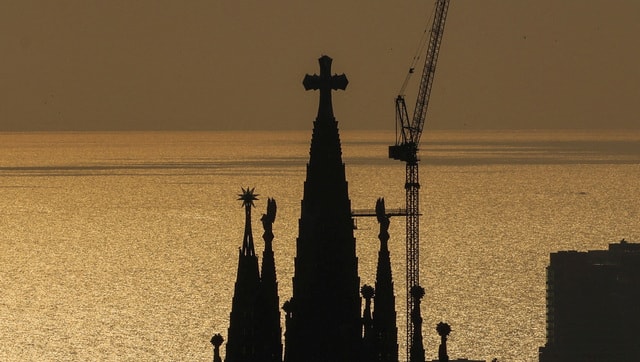
"He was clearly somebody who was mathematically fascinated, but it was always because it was the work of the Creator," Gijs van Hensbergen, an art historian and biographer of Gaudí, told BBC. According to van Hensbergen. Gaudí thought ravity and the catenary arch were divine inventions. "That, for him would have made it a wonderful leitmotif, as it were, nodding to God as the great architect."
Gaudí knew from the beginning that he would not live to see the project completed. He devoted over 40 years of his life to the basilica, but when he died in 1926 — after being struck by a tram — only a small portion had been built.
Just one of the church’s iconic towers had been completed at the time, and the project lost momentum after his death. However, Gaudí had anticipated this and created detailed models to guide future architects. Even so, progress slowed dramatically. Soon, an even greater setback followed.
War and destruction
The Spanish Civil War in 1936 dealt a devastating blow to the Sagrada Família. According to CNN, anarchists burned parts of the basilica and destroyed many of Gaudí’s original plans and plaster models. This loss forced later architects to reconstruct his vision from fragments such as photographs, notes and partial models. The process was painstaking and often required interpretation rather than direct replication.
Despite this, Gaudí’s design philosophy endured. As chief architect Jordi Faulí explained to the outlet, understanding the geometric logic behind Gaudí’s work allowed modern architects to interpret his intentions even without complete plans.
“He created a method of designing a system,” Faulí told the outlet. “When we analyse his (surviving fragments of) models, or photos of the models, we can interpret them easily, because we understand the surfaces that Gaudí used in the project and how they intersect.”
Funding and engineering issues
Another major reason for the delay has been funding. The Sagrada Família is an “expiatory temple”, meaning it relies entirely on donations and visitor revenue. This model has made construction highly dependent on external conditions. During the Covid-19 pandemic, tourism collapsed, halting progress. CNN reported that construction slowed significantly as ticket sales, the primary source of funding, dried up.
However, the project regained momentum as tourism rebounded. By 2025, nearly 5 million visitors were returning annually, providing a financial boost that helped speed up work.
Even without the many disruptions, the basilica’s complexity would have made it a long-term project. Gaudí’s design pushed the limits of structural engineering, particularly in building the towering spires. According to the BBC, one of the biggest challenges was the immense weight of the towers.
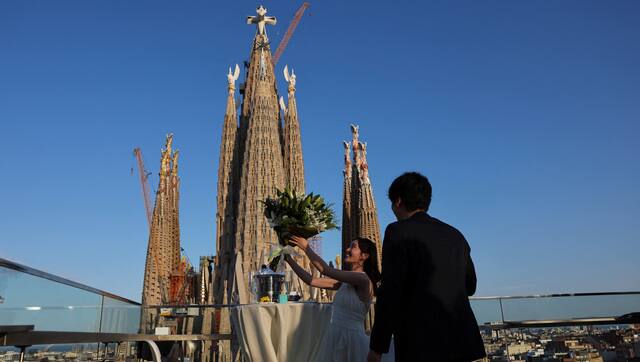
Engineers had to develop innovative solutions, such as pre-stressed stone panels reinforced with steel tendons, to ensure stability. This method keeps the stone under compression, making it stronger and less prone to cracking under wind pressure. It represents a major evolution from traditional construction techniques.
Modern technology has also played a crucial role. According to CNN, digital modelling, computer-controlled stone cutting and industrial fabrication have significantly sped up construction in recent decades.
The completion of the Tower of Jesus Christ highlights the balance between preserving Gaudí’s vision and using modern techniques. The tower’s crowning cross — weighing around 100 tonnes — was prefabricated in sections using stainless steel and concrete, then assembled on-site and lifted into position. According to CNN, this approach reflected the need to meet modern engineering standards while staying faithful to the original design.
Such compromises have been essential throughout the project. Materials like stainless steel, which were not available in Gaudí’s time, have been used to reduce weight and improve durability.
Despite reaching its full height, the Sagrada Família is not yet complete. Interior work and finishing details are expected to continue for several more years. Attention has now shifted to the Glory Façade, the basilica’s intended main entrance. However, this phase too has sparked controversy.
CNN reports that proposed construction could require demolishing nearby residential buildings, leading to resistance from local residents. According to the BBC, modern technologies such as drones and artificial intelligence are now used to monitor the structure and detect cracks.
“My client is not in a hurry,” Gaudí famously said when asked about when the Sagrada Família would be finished. Gaudí was referring to God. Now, 144 years later, his dream is on the verge of being completed.
FAQs
1. Why did the Sagrada Família take so long to build?
The long construction period is due to Gaudí’s complex design, his death in 1926, the destruction of plans during the Spanish Civil War, funding constraints, and the use of evolving construction technologies.
2. Is the Sagrada Família fully completed?
No. While it has reached its full structural height, interior work and parts such as the Glory Façade are still under construction.
3. How tall is the Sagrada Família now?
The basilica stands at 566 feet, making it the tallest church in the world.
With inputs from agencies

Military drones & police check-ups: How Sri Lanka is fighting against worst dengue outbreak in a decade
How Facebook job ad lured 2 Karnataka men into Myanmar cyber scam camp
Why is India seeing 95% cloud cover despite a Super El Niño?
What is CJP’s fourth demand to the government as protests in Delhi intensify?
The new geography of war: Why the Houthis can no longer be ignored