


How a Gaza hospital maintains its accounting and patients amid the Israel-Hamas war
The escalating humanitarian crisis is forcing health-care workers in Gaza to engage in critical emergency planning, reviewing staffing and other resources, dealing with current health demands on top of gruelling new ones, and keeping their own safety in mind

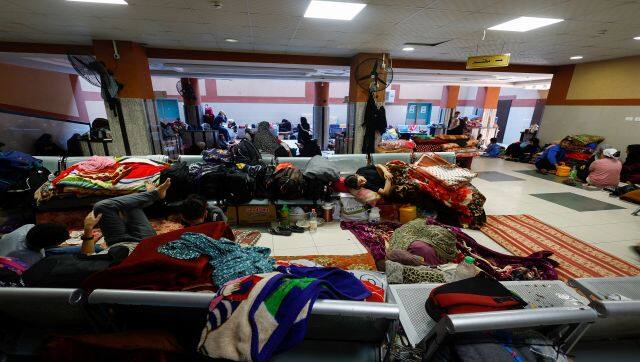
Displaced Palestinians, who fled their homes amid Israeli strikes, take shelter at Nasser hospital, in Khan Younis in the southern Gaza Strip. Reuters[/caption]Using the information supplied, employees of the office of patient management fill out a file with the details of each "martyr" before adding the information to the computer database."People who die of natural causes are not taken to the morgue to be examined by pathologists, unless the death seems suspect," Dr Taaema says.On 26 October, the health ministry of the Hamas-run government in Gaza published the names of some 7,000 Palestinians killed since the outbreak of war with Israel on 7 October.The Palestinian death toll from constant Israeli bombardment of the besieged territory has since risen to more than 8,300, the majority of them civilians.Also Read: How Israel is struggling to identify the victims of Hamas attacksBy publishing its list, the ministry intended to prove its credibility, after the veracity of death tolls in Gaza was questioned by US president Joe Biden.Horror at the cafeUS support for Israel has been unwavering since the beginning of the war, sparked by an unprecedented attack by Hamas that left more than 1,400 people dead in Israel, mostly civilians, according to Israeli authorities.Some victims of air strikes on Gaza are registered as "unknown", and their files are updated later when the bodies are identified by families.For Rizk Abu Rok, a 24-year-old paramedic with the Palestinian Red Crescent, transporting those killed and wounded by Israeli bombardment to the hospital has become a daily routine.But nothing could prepare him for the horror he experienced on 22 October.After receiving a report that the Rio Cafe in Khan Yunis had been hit, Abu Rok rushed to the scene in an ambulance, gripped with fear in the knowledge that his father and other relatives had been sheltering there."I was convinced that I was about to carry out the bodies of people I love very much," he said.Arriving at the site of the bombing, he treated a seriously wounded person and gave him first aid before taking him back to the Nasser hospital."When I arrived, I rushed to the emergency room and found my father there. He had a head wound. I knew immediately that he was dead."I collapsed and lost my nerve. The nurses brought me outside to calm me down."When he came back to his senses, Abu Rok went back inside to the emergency room to see if any more of his relatives were there.Also Read: How Gaza's ministry of health is calculating the death toll during the Israel-Hamas war"I found them all, one after the other: Ajnad, Jamal and Talal Abu Rok, Mohammed Abu Rjeileh and Ahmad Qodeih. They were all killed in the cafe along with another 10 people."The bodies were taken to the morgue to be examined by the pathologist, adding yet more numbers to the Nasser hospital's grim accounting system.Healthcare workers warn of rising illness According to an anaesthesiology doctor at al-Shifa, there are concerns about an increase in illnesses as a result of a lack of clean water and electricity to desalinate the water supply. He told the Washington Post that he's already seeing an increase in infections, diarrhoea, and fevers, and he's concerned about increased dehydration in children.Shortage of the fuel adds to the challenge."When the fuel runs out, that may mean operating with flashlights or taking care of people with medications that don't require refrigeration, and certainly not having lab services," said John Broach, director of the division of emergency medical services and disaster management at UMass Memorial in Worcester, Massachusetts, as reported by the Washington Post.The struggle to care for patients injured in a war or disaster, according to Broach, is exacerbated by the escalation of routine medical issues that are suddenly left untreated, such as people with well-managed diabetes who are now unable to take insulin spoiled when refrigerators lose power and chronically ill patients who are unable to fill prescriptions at shuttered pharmacies.Working 24/7 with limited resources during disasters has grave effects, according to David Callaway, chief medical officer for veteran-led Team Rubicon, a Los Angeles-based charity group that works closely with the WHO to offer help in humanitarian emergencies.He told the Post, "Soon, the entire team is burned out, their empathy is gone, and they are not making the best decisions."With inputs from AFP

Explorers discover wreckage of plane 72 years later. Will this help in finding MH370?
Cruise missiles, drones and more... The deadly arsenal of the Houthis
Why India may not witness a medal rush at 2026 Commonwealth Games
Delhi Police asks personnel to wear uniform: What the law says on cops in plainclothes during protests
Military drones & police check-ups: How Sri Lanka is fighting against worst dengue outbreak in a decade