


Delhi Police asks personnel to wear uniform: What the law says on cops in plainclothes during protests
The Delhi Police has instructed all its personnel to wear uniforms when they report for duty at Jantar Mantar for crowd control. This comes after outrage grew over videos of men in civilian clothes or without name tags hitting protesters in the Capital. Is it legal for the police to ditch uniforms during protests?

The protests in Delhi continue unabated. The Cockroach Janta Party (CJP) and its supporters continue to camp out at Jantar Mantar, demanding the ouster of Education Minister Dharmendra Pradhan over the Neet exam leak.
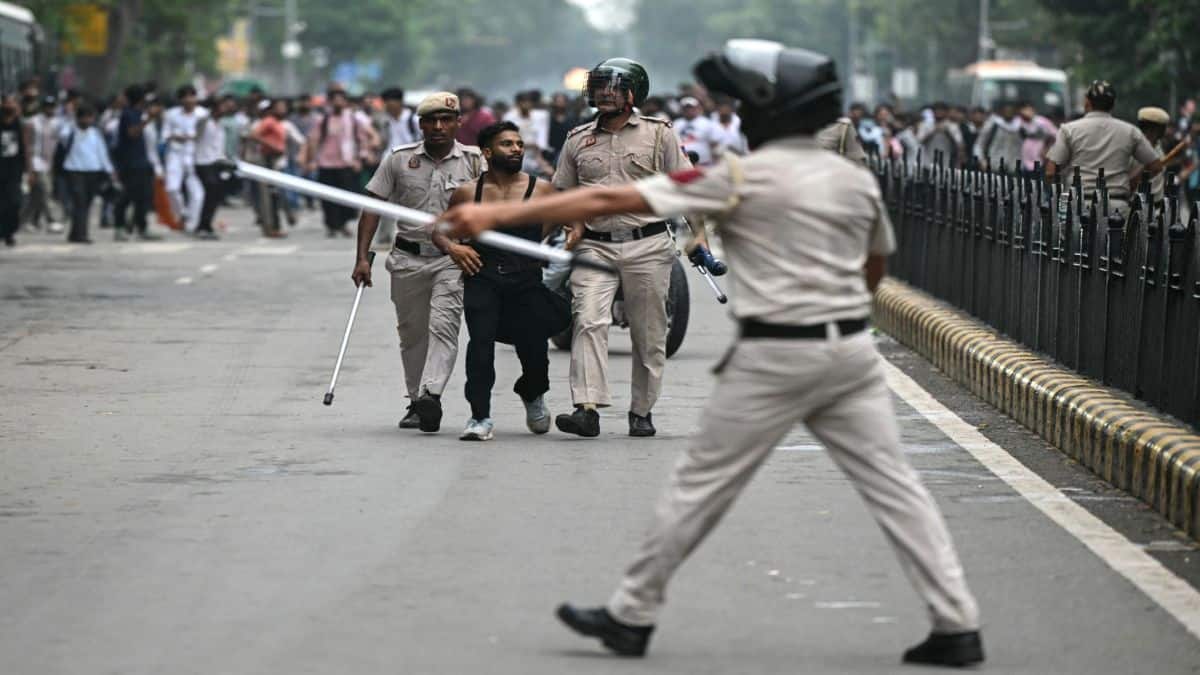
Amid this charged environment, on Wednesday (July 22), the Delhi Police ordered all of its personnel deployed at the protest site to report in their uniforms. The diktat from Delhi Police Headquarters came after videos and many protesters claimed that a section of policemen — some in civilian dress and others in uniform but with name tags removed — targeted protesters brutally during the ‘Sansad Chalo’ march.
- Catch the latest from the Delhi protests here
Following this, many have asked: What does the law say on identification for the police?
What is the diktat issued by Delhi Police?
On Wednesday evening, the Delhi Police directed all personnel deployed to maintain law and order at the protest site to report for duty in uniform.
According to officials, the instructions were communicated to all concerned units, directing officers and personnel to wear uniforms while performing law-and-order duties at the protest site.
 More from Explainers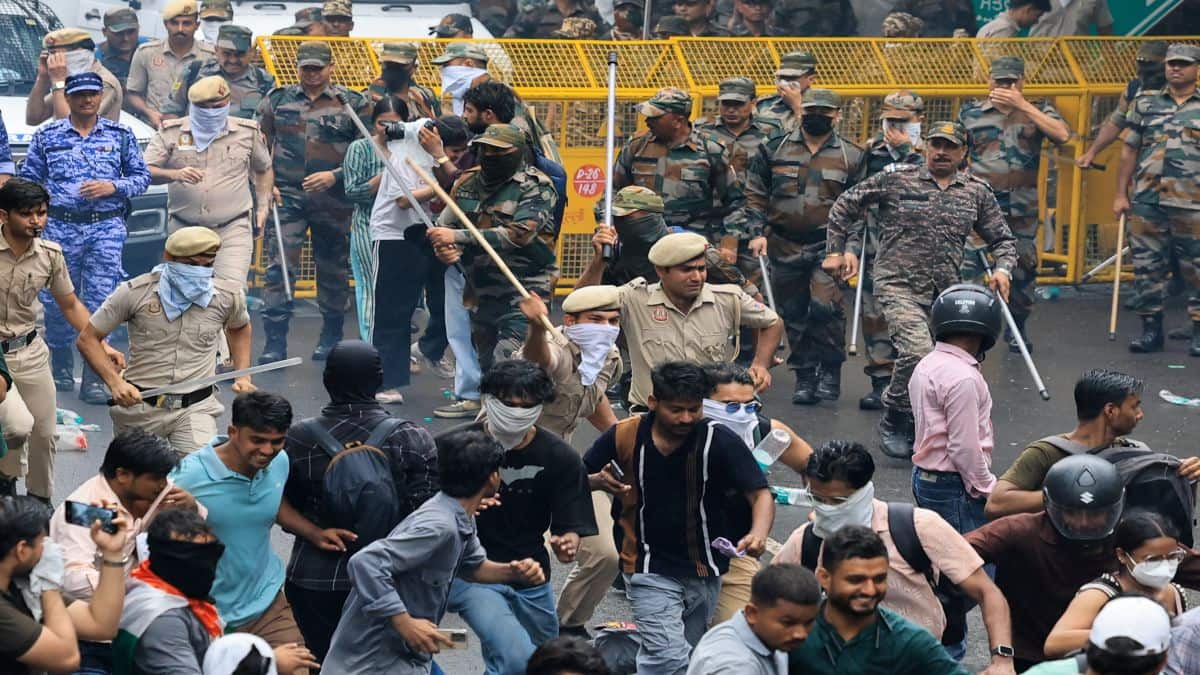
The directives came after several videos went viral on social media showing men in plain clothes wielding police lathis and assaulting demonstrators on Monday (July 20) during the march to Parliament. The Cockroach Janta Party (CJP) questioned Delhi Police in a social media post, asking: “Who are these lathi-armed goons in plainclothes? Who have you hired to beat us up?”
In another instance, a journalist is seen on camera being assaulted by a man in plainclothes while being accompanied by a Delhi Police havildar. The individual was in civilian clothes and refused to identify himself or explain under what authority he was acting.
What do cops say about this?
The Delhi Police hasn’t responded to these allegations. They have, however, claimed that protesters attacked several personnel with stones and vandalised police vehicles.
Meanwhile, serving and retired police officials note that deploying personnel in civilian clothes during protests is neither new nor exceptional. “Police personnel in plainclothes are deployed to gauge the mood of the crowd, get a sense of the de facto leadership and act, if needed be,” said a retired officer who served with Delhi Police to India Today.
Another explained that cops in plainclothes are deployed to collect information, and to do so they need to operate covertly. “For these officers, the absence of a uniform is a professional necessity. They even keep a beard and wear T-shirt and jeans because of their work profile, which includes undercover operations and activities like gang infiltration, the official told Times of India.
A former Maharashtra Director General of Police added that in some protests, the cops in uniform are lynched by protesters. “Policemen in civil clothes are part of deployment at such places. Their role is, however, limited,” he added.
What does the law say about cops and uniform?
There is no clear law on police officials deployed in crowd control or protests and their uniform. In certain situations, such as those involving intelligence collection, they are permitted to hide identification or even impersonate.
Some legal minds believe that while Chapter XI of the BNSS doesn’t specifically mention whether police personnel are required to identify themselves during a law and order situation, the law clearly states that only a magistrate or a “police officer” to disperse a crowd implies identification. As one criminal lawyer told the Indian Express, “If a police officer is unidentifiable, his command to disperse cannot carry statutory weight.”
The Supreme Court has also set some precedent on the issue of cops and their identity. In the matter of DK Basu vs State of West Bengal in 1997, the apex court issued detailed safeguards for arrests and detention, including the requirement that the arresting officer bear clear and visible identification.
The court also added that the particulars of all officers involved in interrogation be recorded in a register. However, it doesn’t refer to the issue of cops during a protest.
In 2025, the Andhra Pradesh High Court also touched upon the matter of cops in plainclothes. Responding to a petition filed by YSRCP MLA Nallapareddy Prasanna Kumar Reddy, the judges asked how citizens are expected to recognise people in plainclothes as police officials who are trying to discharge their duty.
It seems that the issue remains a grey matter with many from the police force — retired and serving — noting that in some cases hiding their identity is a must, while human rights advocates note that it’s a tool used to evade accountability.
With inputs from agencies
Tags

Military drones & police check-ups: How Sri Lanka is fighting against worst dengue outbreak in a decade
How Facebook job ad lured 2 Karnataka men into Myanmar cyber scam camp
Why is India seeing 95% cloud cover despite a Super El Niño?
What is CJP’s fourth demand to the government as protests in Delhi intensify?
The new geography of war: Why the Houthis can no longer be ignored