


Gus, the T rex, is most expensive dinosaur ever sold: Why the fossil auction has made scientists unhappy
On Tuesday (July 14), the fossil of a Tyrannosaurus rex, nicknamed 'Gus', was sold at a New York auction for a whopping $50.1m (around Rs 482.16 crore), making it the most expensive dinosaur fossil ever sold. However, palaeontologists warn that the auction is harming research

The fearsome Tyrannosaurus rex, nicknamed "Gus", was sold at a New York auction for $50.1m (around Rs 482.16 crore). It was purchased by a mystery bidder.
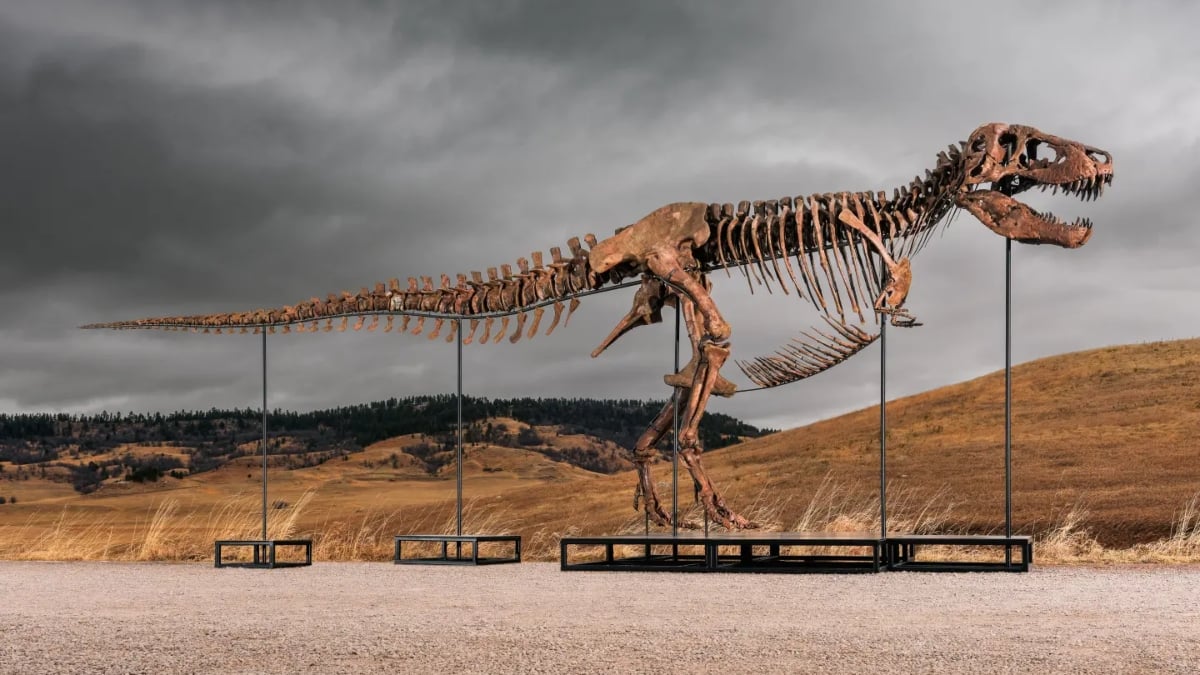
The nearly 38-foot-long fossilised T rex set a new record after being sold at Sotheby's in New York on Tuesday (July 14), making it the most valuable dinosaur fossil sold at auction.
Gus, a 67-million-year-old T rex fossil, was first discovered about five years ago on a privately owned ranch in Harding County, South Dakota, in the north-central US. It's named Gus after the late cattle rancher Gary Licking, who owned the land.
As Gus becomes a huge find, it's undoubtedly adding to a growing debate about whether a dinosaur like this, sold at auction, should be loaned or donated to accredited museums and research institutions.
 More from Explainers
Scientists argue that there's "little that museums or universities or scientists can do" as it is not placed in a public museum.
We take a look.
Why Gus' sale is a headache for scientists
The record-breaking sale has upset scientists.
Professor Richard Butler, a vertebrate palaeontologist at the University of Birmingham, noted: "The current trend towards dinosaur fossils being marketed and sold like rare artworks at vast prices by auction houses is very concerning, as is the idea of buying dinosaur fossils as a status symbol or a commodity," the Guardian reported.
Making a significant point, Butler argued that a fossil staged not in a recognised museum collection "cannot be studied", which is why Gus will be lost to research.
"Fossils have been bought and sold for hundreds of years, but prices are increasingly out of the reach of museums, much to the detriment of science.”
Agreeing with Butler's argument, Professor Stephen Brusatte of the University of Edinburgh said that this dinosaur was discovered in America, and in this country one can do with what one finds on this soil.
According to Brusatte, the auction appears legal; however, as a scientist, he is still concerned.
“If a dinosaur like this fetches tens of millions of dollars at auction, then there’s little that scientists or museums or universities can do. Those prices can only be paid by the super-rich,” the professor noted his concern.
Dr Thomas Carr, a vertebrate palaeontologist and associate professor at Carthage College in Wisconsin, US, said there is no guarantee that a fossil in a private collection will remain there for all time. Carr pointed out, in contrast, that a public trust is dedicated to preserving, conserving, and carefully curating its collection.
“Fossils need to be available to test previous observations and to make new insights; the fossils are the data, so they must always be available for study," the Guardian quoted a palaeontologist as saying.
Hoping that Gus would eventually be donated to a public trust, he said: “A fossil in a public trust is a win for science and society all around rather than being hoarded in some McBillionaire’s living room.”
Sarcastically responding to the craze for buying dinosaur fossils, Brusatte said that if he were a billionaire, he would buy one too; however, he would donate it to a museum where it could be researched and displayed.
How T rex got the name, Gus
The Gus story started in 2021 on a ranch in Harding County, South Dakota.
A team of researchers had just finished one excavation and chose to spend a few days prospecting unfamiliar terrain. Within hours, a metatarsal bone emerged from the ground, making the first discovery in what would later prove to be one of the most complete T rex skeletons ever unearthed.
Discovering a dinosaur on strange ground was rarely a clean extraction. Following the initial finding, the work took five years and involved excavation, mapping, and restoration.
The completed skeleton measured 38 feet in length and is considered 63 per cent complete, with the recovered bones accounting for an estimated 75 to 80 per cent of the dinosaur's total body mass.
With its dagger-like teeth, the T rex was named Gus in honour of Gary Licking, the aforementioned rancher on whose land the initial bone was unearthed. Gary passed away before the five-year project was completed and could not witness the finished mount.
According to reports, Dana, his widow, has stayed close to the project. The team ensures she witnesses Gus' pieces as they are prepared to connect the fossil back to the man it was named for.
With inputs from agencies
Tags

Military drones & police check-ups: How Sri Lanka is fighting against worst dengue outbreak in a decade
How Facebook job ad lured 2 Karnataka men into Myanmar cyber scam camp
Why is India seeing 95% cloud cover despite a Super El Niño?
What is CJP’s fourth demand to the government as protests in Delhi intensify?
The new geography of war: Why the Houthis can no longer be ignored