


Forget snow, there is a water shortage in Kashmir. What is going on?
A prolonged dry spell amid harsh cold weather has resulted in many water bodies hitting the bottom in the Kashmir Valley. This is due to the missing snow, which recharges Jhelum River, its tributaries, and other wetlands

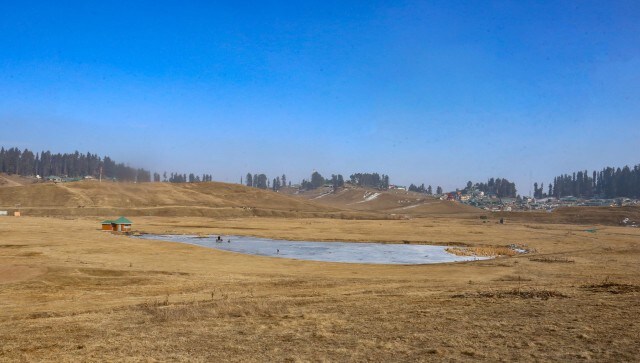
Deserted ski resort at Gulmarg, in Baramulla district, Sunday, Jan. 7, 2024. A large number of tourists, who arrived here on the New Year's Eve in the hope of enjoying skiing and other snow-related activities, had to go back disappointed due to the lack of snowfall. PTI[/caption]Numerous water supply plans that depend on wells, springs, and other water sources have either dried up or are seeing a sharp drop in water levels. This is the Jhelum River's lowest water level in recent years. The last time it dropped to his level at Sangam was in November 2017, as per PTI.No snow, no rain in the ValleyAdditionally, Kashmir has seen very little to no snow or rain in December 2023.According to PTI, the valley has had a 79 per cent rainfall deficit in the past month and a 100 per cent deficit in January 2024 so far.Normally blanketed in snow at this time of year, the Gulmarg ski resort is now dry. The majority of Kashmir's plains have not seen any snowfall, while the upper valley has had less snowfall than normal.The Forest Department has even issued an advisory to the forest people due to the high number of bushfires recorded from the mountainous parts across the valley due to the dry weather, reported PTI.The maximum temperature in Srinagar, the capital of Jammu and Kashmir, was recorded at 15 degrees Celsius on Sunday, according to India Today.The situation has been akin to that in Himachal Pradesh’s Shimla and Manali, where there has been no snowfall. Not even Auli in Uttarakhand has had any snowfall yet. Ladakh and Kargil, among other locations, saw warmer-than-normal temperatures. Kargil's Drass reached 9.5 degrees Celsius on Sunday, which was practically the same as the maximum temperature in Jammu, which lies on the lower ridges of the Shivalik.To put an end to the region's shortages, people in different regions of the Kashmir Valley are currently holding special prayers and seeking divine intervention.Shrinking glaciersWith high temperatures in the valley, glaciers, too, are shrinking.Ahmad, who spoke with Wion News, said, “Glaciers are shrinking, the temperature is high during the Chillai Kalan (harsh winters), and dry spells will lead to the shrinking of glaciers.”Mahesh Palawat, vice president of metrology and climate change at Skymet, told India Today, “Due to less or no snowfall, the glaciers won’t get recharged, so the glaciers will melt at a faster pace.”According to Ahmad, melting glaciers will also have long-term implications, like groundwater recharge and overall glacier recharge, and agriculture and horticulture will be impacted as well. It will also affect power production.“The situation in the coming summer will turn dire as there might not be enough water to feed the rivers," Ahmad said in a separate interview with India Today.The reason for the dry spellExperts believe that El Nino and the absence of a strong western disturbance may be to blame for Kashmir's prolonged dry weather."This anomaly could be linked to El Nino, the climatic phenomenon characterised by the warming of sea surface temperatures in the central and eastern Pacific Ocean, which in turn has a far-reaching impact on global weather patterns," IMD scientist Soma Sen Roy told India Today’s Open-Source Intelligence (OSINT) team.Another reason for the snowless winter, she added, “The disturbance brings moisture from the Arabian Sea and causes snowfall in the mountains.”Kashmir’s tourism in limboThe missing snow has hit tourist hotspots like Gulmarg, Sonmarg, and Pahalgam.The hospitality industry and adventure sports have been hit the hardest, with many cancelling their hotel bookings.According to The Economic Times, Gulmarg has seen a 70 per cent drop in tourists this year.Rouf Tramboo, the Travel Agents Association of Kashmir president, told ET that the 2024 edition of the Khelo India Winter Games might get postponed or cancelled if there is no substantial snowfall in the coming days.The Khelo India Winter Games were co-hosted by Gulmarg and Leh in Ladakh in 2021 and 2022.In a separate interview with The New Indian Express, he said, "So we foresee that we may have to reschedule the games. If everything goes well as per our inputs, we are expecting good snowfall between 10 to 15 February, so we may be able to hold the Games in the middle of February.”Will there be any relief?"Models are indicating that a strong western disturbance may approach the western Himalayas by 25 or 26 January, which may eventually increase the intensity of and bring rain," Palawat told India Today."Slight precipitation is likely on Tuesday (January 16)," Ahmad told the new channel, adding, "There could be some rainfall or snowfall after January 25," the IMD expert said, citing weather models.The MeT department has said there is no major prediction of any wet spell in the coming days.“Weather has been dry for the last 45 days and we are expecting that after 16 January there could be some respite in North Kashmir, like Kupwara and Baramulla. The other areas will also receive some rain and snow, although no major wet weather is expected in the coming days. "Until the 24 January, the weather will mostly stay dry, and after 25 January there are chances of wet spells,” Mukhtar Ahmad, MeT director told Wion News.With inputs from agencies

Explorers discover wreckage of plane 72 years later. Will this help in finding MH370?
Cruise missiles, drones and more... The deadly arsenal of the Houthis
Why India may not witness a medal rush at 2026 Commonwealth Games
Delhi Police asks personnel to wear uniform: What the law says on cops in plainclothes during protests
Military drones & police check-ups: How Sri Lanka is fighting against worst dengue outbreak in a decade