


Bayeux Tapestry returns to England after nearly 1,000 years. Inside the secret journey to move it from France
After almost 1,000 years in France, the Bayeux Tapestry, the priceless medieval artwork depicting the Norman conquest of England, was delivered to the UK in a complicated, secretive overnight operation. A climate-controlled truck and police officials were involved in transferring this 230-foot-long masterpiece

It’s coming home!
No, we are not talking about the FIFA World Cup 2026 but the Bayeux Tapestry, which is considered the most celebrated artwork to have survived from the Middle Ages. After 1,000 years, this incredible piece of art has made its way back to England from France after a complicated journey.
Now, the Bayeux Tapestry will go on display at the London museum from September 10 until July 2027.
Until its arrival in England overnight on Friday, no one even knew that the tapestry was making its way to British soil. This secret was blown just a couple of hours before the truck’s arrival, in a social media post from French President Emmanuel Macron: “The Bayeux Tapestry is heading for London. This age-old treasure that tells our shared history is crossing the Channel.”
 More from Explainers
What is the Bayeux Tapestry?
Before we deep dive into the secret mission to bring the Bayeux Tapestry, let’s understand what this artwork is.
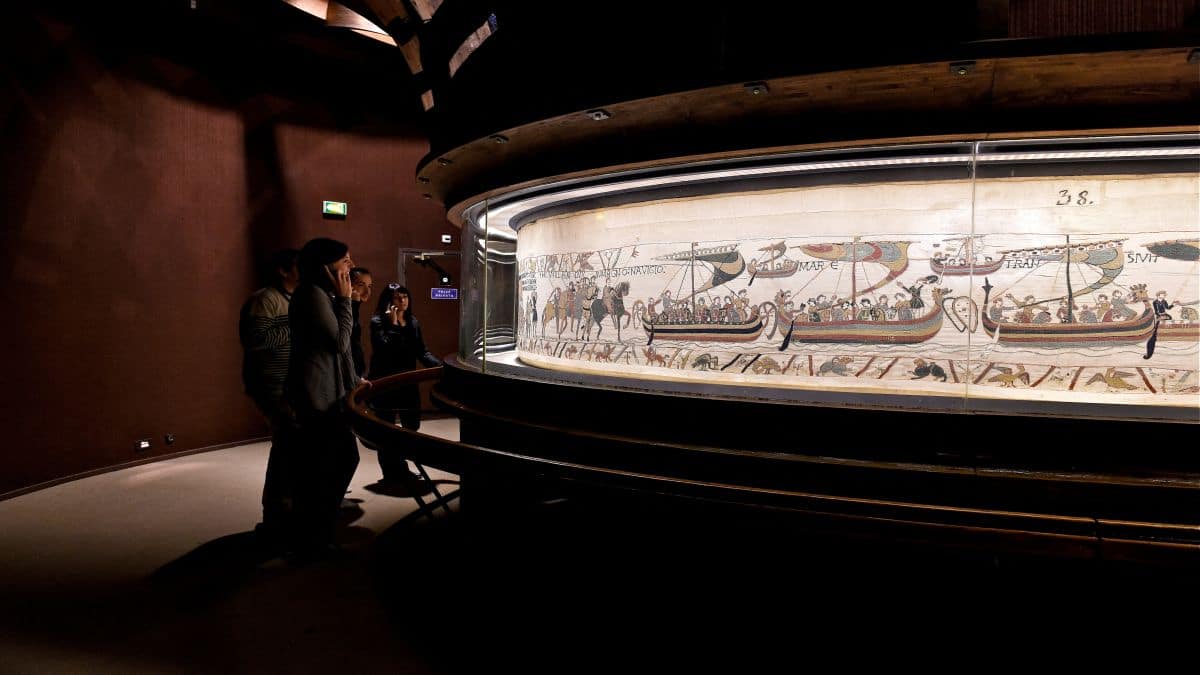
The 70-metre (230-foot) tapestry depicts events leading up to the Battle of Hastings in October 1066, when William, Duke of Normandy, defeated King Harold’s Anglo-Saxon army. The invasion ended Saxon rule, made William the Conqueror the first Norman king of England, and bound Britain and France more closely together.
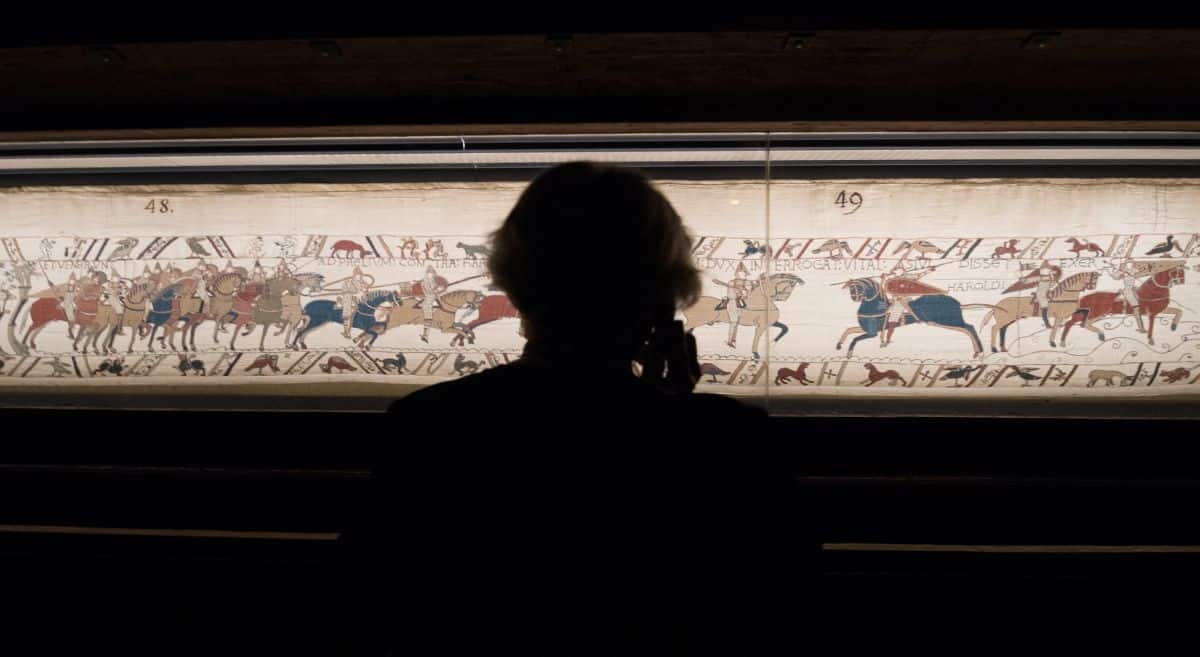
The origins of this art are shrouded in mystery. While some claim it was designed and made in England, others say Bishop Odo of Bayeux commissioned the work in 1077. Odo was the half-brother of William the Conqueror. He is said to have done so to decorate a newly-constructed cathedral in Bayeux, a town within France’s Normandy region.
Some believe that the tapestry was sewn by women in England — possibly nuns — before being taken across the Channel. It has spent most of the last millennium in the town of Bayeux in northwest France, apart from two short periods at the Louvre in Paris.
The Bayeux Tapestry features nine panels, more than 620 people, and 737 animals. It tells its story in vivid and sometimes gory detail. There are scenes of hand-to-hand combat, mutilated bodies, and the unlucky Harold, felled by an arrow through his eye.
As Millie Horton-Insch, project curator for the British Museum exhibition, told the Associated Press, “The Bayeux Tapestry has an emotional richness that is really difficult to get from written sources. It just brings people closer to this history than any other object can. It’s not the same as reading a text. You are looking at something that was handled by the people who lived through it and felt compelled to record these events in this way.”
Nicholas Cullinan, director of the British Museum, compared it to Mount Rushmore. “It’s something that is inscribed on everyone’s consciousness as being part of the nation’s history,” he told National Geographic, “and you kind of can’t imagine the nation without it existing somewhere.”
How did France send the Bayeux Tapestry to England?
For the first time since its creation, the Bayeux Tapestry is in London, and the operation to bring this valuable piece of art has been a truly complicated and difficult one.
In scenes like a heist movie in reverse, the priceless medieval artwork was spirited into the British Museum on Friday in the dead of night, after a tight security operation.
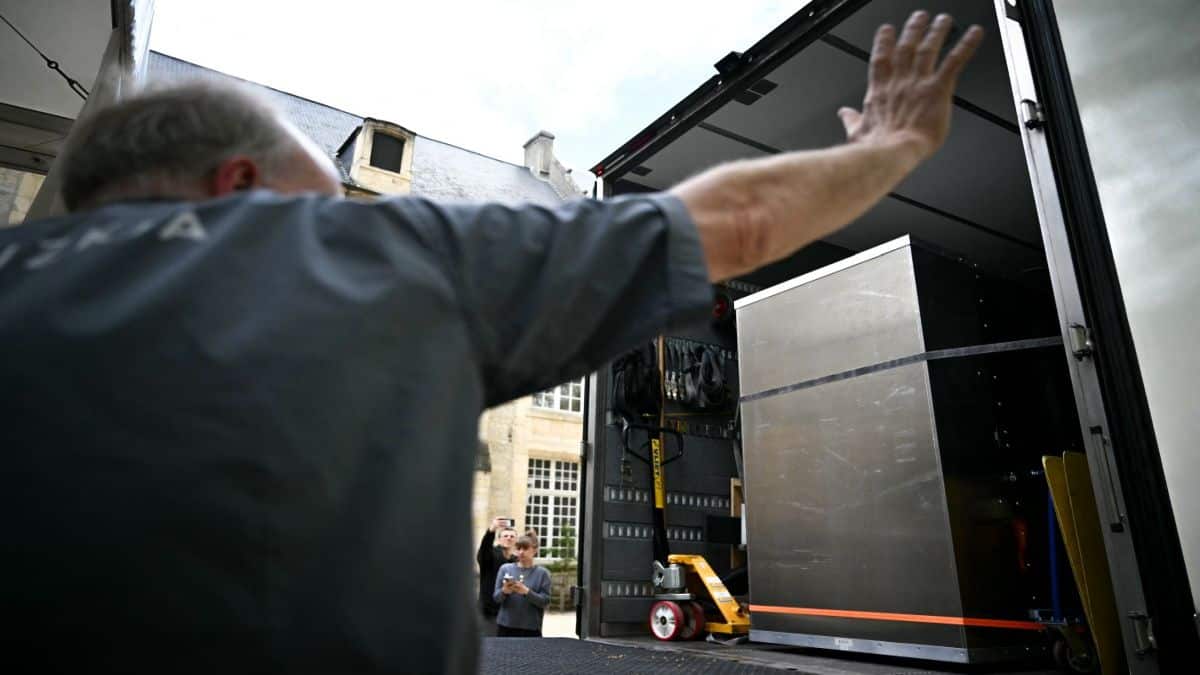
It all began with the 70-metre tapestry being gently folded like an accordion into a climate-controlled case. It was effectively folded 28 times, interspersed with various kinds of lining and padding, meticulously placed to stabilize and protect it. The scheme was “pure innovation,” said Cécelia Gauvin, CEO of Science and MechAnics in Conservation of Heritage, which helped devise it.
The next step was to transport the tapestry to England. Sending it by airplane or boat was ruled out early as it was fraught with risks. Hence, it was decided that the tapestry would be placed inside a shock-absorbing cradle that went into a truck that crossed from France on a vehicle shuttle train through the Channel Tunnel.
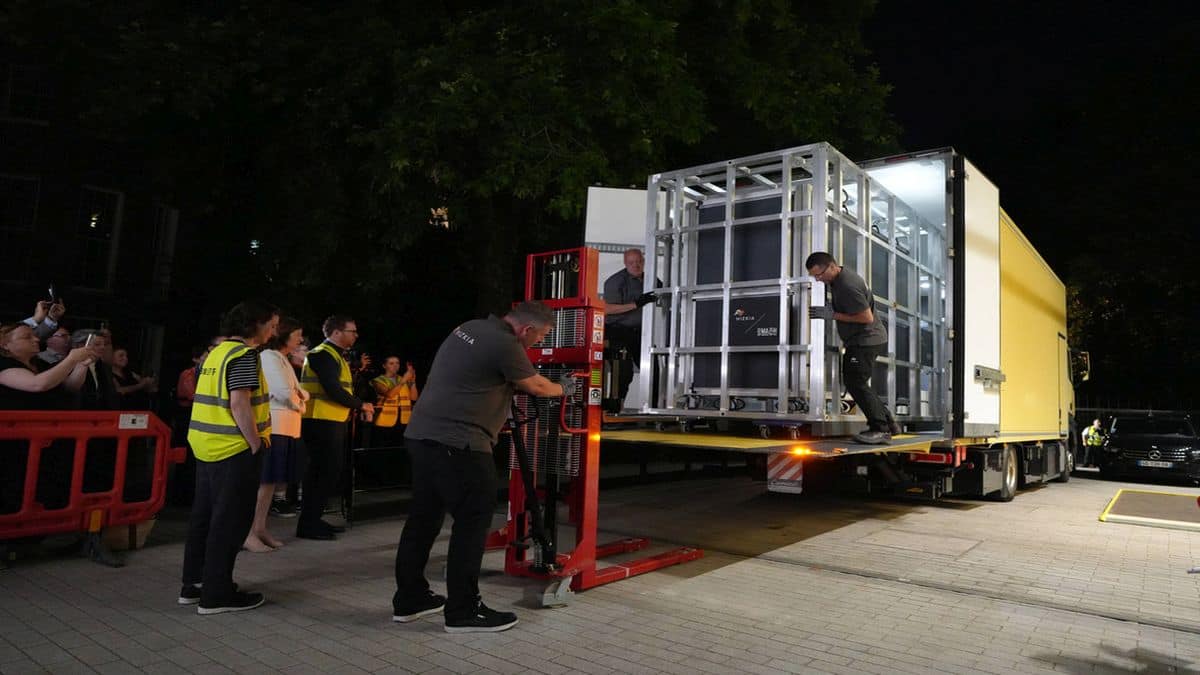
However, the truck chosen wasn’t any ordinary one. International art logistics firm Hizkia was roped in to provide a customised crate as well as a truck for the journey. “They have the best truck ever,” Gauvin told National Geographic. “Absolutely amazing, the quality of the truck in terms of climate control… And the structure is reinforced, meaning the truck itself already damps the vibration.”
And after an 11-hour, 560-kilometre trip, escorted by police, the truck backed slowly into a loading bay at the museum, where workers gingerly eased the container, the size of a small car, to the ground. Museum staff and British and French diplomats who had been watching in hushed silence broke into applause.
The priceless artwork will spend the next few days acclimatising before it is carefully unpacked and unfolded for an exhibition that the museum expects to be one of the most popular in its 267-year history.
Some 100,000 tickets have already been sold in their first day on sale this month. As museum director Nicholas Cullinan told AFP, “It’s been very special to have witnessed the arrival of the Bayeux Tapestry, and especially for it to be back on these shores for the first time in probably a thousand years.”
What led to the Bayeux Tapestry to come to England?
The tapestry has taken 1,000 years to come to England — a really long time.
The British have long been trying to get France to loan the artwork — five times since 1931, including for the coronation of Queen Elizabeth II in 1953 and the 900th anniversary of the Battle of Hastings in 1966. All five times, French custodians have refused, citing its fragility.
In fact, a study of the tapestry conducted by French experts a few years ago found that it had sustained damage — 24,204 stains, 16,445 wrinkles, 9,646 gaps in the cloth or the embroidery, 30 non-stabilised tears, and more significant weakening in the first few metres of the work.
The first sign of France agreeing to give it to England came in 2018 when Macron hinted at it during a summit with then British Prime Minister Theresa May. But then everything went quiet, mainly because of Brexit and all the difficult politics around that and Covid.
Then at the Cannes Film Festival in 2025, the idea got an impetus during a meeting between then British Culture minister Chris Bryant and his counterpart, the French minister Rachida Dati.
Then last September, French President Emmanuel Macron and UK Prime Minister Sir Keir Starmer finalised an agreement for the Bayeux Tapestry to be loaned to Britain.
At the time the loan was announced, former Chancellor George Osborne, chair of the British Museum Trustees, said: “Once in a generation there’s a British Museum exhibition that eclipses all others. Think in previous ages of Tutankhamun and the Terracotta Warriors. The Bayeux Tapestry will be the blockbuster show of our generation. I know it will capture the imagination of an entire nation.”
In return for the Bayeux Tapestry, the British Museum is loaning treasures, including items from the Sutton Hoo hoard as well as the Lewis chess pieces, made from walrus ivory in the 12th Century.
Before the operation to move the tapestry, Macron, in an article in The Times, noted, “This loan from France means much more than simply moving an artwork: it is a gesture of trust, a tangible expression of a long-standing friendship and a sign of our shared desire to see France and the United Kingdom build their future together.”
He concluded the article by writing, “The Bayeux Tapestry is an unfinished story. Its conclusion eludes us; its final scene does not bring the story to a close. Perhaps that is where its most contemporary strength lies. It is our job to write the next chapter, in a spirit of respect, trust, and renewed alliance. This is the fundamental message we shall be sending together to the many visitors who will come to admire the tapestry in London. It is also the message we shall reiterate in 2027, during the European Year of the Normans.”
With inputs from agencies

Military drones & police check-ups: How Sri Lanka is fighting against worst dengue outbreak in a decade
How Facebook job ad lured 2 Karnataka men into Myanmar cyber scam camp
Why is India seeing 95% cloud cover despite a Super El Niño?
What is CJP’s fourth demand to the government as protests in Delhi intensify?
The new geography of war: Why the Houthis can no longer be ignored