


Why rural India needs a priority in women-led development
Nearly three-fourth of economically active women are involved in agriculture and allied activities, and most of them work as unpaid family helpers in rural areas

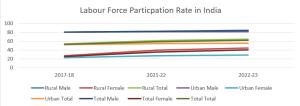
In India rural working women are majorly involved either in agriculture or NREGA activities. In 2023-24, nearly three-fourth of economically active women are involved in agriculture and allied activities and most of them work as unpaid family helpers (working in household business without getting any payment) in rural areas. While the number of women in the workforce increased, the share of those working in casual wage employment declined substantially in rural areas. Casual work denotes the daily wage work which includes public works in construction and work under Mahatma Gandhi National Rural Employment Guarantee Act (MGNREGA). However, casual work is dominated by non-public works rather than MGNREGA which suggests that the number of person-days created were significantly lower than the norm of 100 days per household, leading perhaps to the PLFS missing out such workers in their sample. In 2017-18, 46 days of employment was provided per household which substantially reduced to 39 days in 2023-24. MGNREGA was designed as a demand driven wage employment scheme but gaps exist between the number of households demanding employment and those receiving it. Nevertheless, women break new ground in NREGA as the proportion of women's employment under NREGA has touched a ten year high in the ongoing financial year.Along with a gendered division in workforce participation, women who are working face a strict wage gap which continues to hinder economic gender parity in India. Women working as regular and casual wage workers faced a higher gender wage gap in rural areas compared to urban ones. Additionally, self-employed women receive less than half of men’s earnings indicating a higher gender income gap as compared to other categories of workers which further deteriorated during recent times in rural areas.In spite of women’s critical role in agriculture, the Agriculture Census (2015-16) stated that only 14.7 per cent of the operational landholdings were operated by women along with a concentration of operational holdings (57 per cent) by women in the marginal and small holding categories. Likewise, the Socio-Economic Caste Census (2011) data depicts that only 23.2 million rural households are headed by female and among them only 20 percent own irrigated land while only 7 per cent of them have irrigation inputs. Only 2 per cent female headed households have facility of the Kisan Credit Card with the credit limit of Rs. 50,000 and above.Gender inequality in land ownership along with the increasing marginalisation of land holding often reduces women’s access to other productive resources like credit and extension services and translates into little or no access to different agricultural schemes, compensation and relief measures announced by the government.Despite agriculture being the largest employment provider, it gets only 3 per cent of the total budget of the Union government in 2023-24 and recently, there has been a shift in Union government’s expenditure from input support to income support and risk management through crop insurance. Several schemes such as Pradhan Mantri Kisan Samman Nidhi (PM-KISAN) and Pradhan Mantri Fasal Bima Yojana (PMFBY) are introduced by the Union government under the ‘Income Support and Risk Management’ category whose expenditure has increased from 13 per cent in 2015-16 to 73 per cent in 2023-24 and allocations for agriculture in the Union budgets have signalled a high importance for these two schemes particularly. But only 15 per cent women farmers received financial support from PMFBY in 2023 and only 25 per cent women farmers received financial benefit under PM-KISAN.There are many possible interventions that are needed if we want to expand women’s opportunities in agriculture including: equal application of law, access to land rights and other productive resources along with inclusion of landless, marginal women farmers in government agricultural schemes to combat gender inequality in rural areas. On the top of all these there is a need to recognise, reduce, and redistribute unpaid care work of Indian women in agriculture and overall, and reward and represent their paid work equally. The inclusive and visionary nature of the G20 Delhi Declaration to close gender gaps by promoting women’s participation in the economy and shifting the focus for the first time from women’s development to women-led development is definitely a timely move in this direction.The writer is Senior Research Officer, Centre for Budget and Governance Accountability (CBGA), New Delhi. Views expressed in the above piece are personal and solely that of the author. They do not necessarily reflect Firstpost’s views.Read all the Latest News, Trending News, Cricket News, Bollywood News,India News and Entertainment News here. Follow us on Facebook, Twitter and Instagram.

When Manila and Tokyo draw a line, Beijing draws a red line
Bangladesh gets a new envoy to reset its India ties
Escalation trap to an exit strategy: How can the Iran war end?
India must seize its demographic dividend before it fades
Bangladesh’s instability has sharpened India’s ‘Chicken Neck’ challenge