


Why China’s construction of dual-use infrastructure in the Himalayan borders should alarm India
A major cause for concern is that the infrastructure on the Indian side has yet to catch up, while on the Chinese side, it is far more advanced

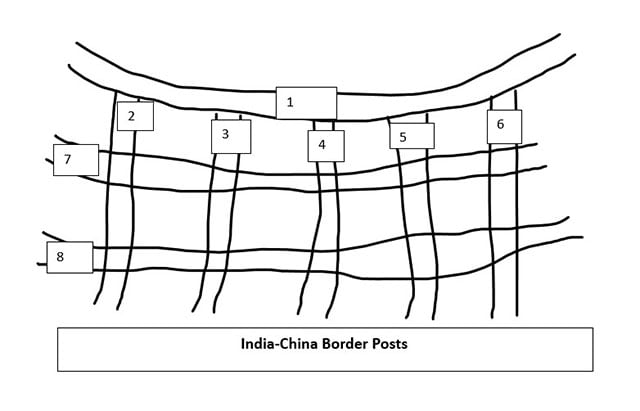
In the figure above, road number 1 is the main highway that runs along the border. The central highway/expressway is connected to the border with arteries marked as 2,3,4,5 and 6. Then, there are roads marked as 7 and 8 connecting the arteries. This is a broad pattern; however, there is no precise information about the number of arteries and connecting roads and their locations. This pattern has immense utility in the war from a tactical point of view. China has wheeled equipment, including radars and artillery guns, which can quickly move through these roads. With such a labyrinth of multiple approaches, arteries and connecting roads, they can harness the full potential of their weapon systems and equipment. Secondly, if the advancing Indian military blocks one artery, then the Chinese troops can reach the border posts through the other roads and arteries. Hence, blocking one or two arteries or connecting roads will be futile. Thirdly, this pattern enables the Chinese army to have an element of surprise in the war situation.On the other hand, the infrastructure on the Indian side is yet to catch up. There is only one major road. If the primary access is blocked, it will be difficult for the armed forces to reach the other border areas. These limitations will be a significant hurdle in offensive and defensive strategy. Secondly, in the Tibet region, China has set up a network of 5G towers, whereas India continues with a scattered network of 3G and 4G towers. The author witnessed communication hurdles through poor phone and internet networks. In China, the government companies establish the communication infrastructure; hence, the strategic considerations are supreme. However, mostly private companies in India are involved, for whom economy, viability and profitability are the most critical concerns.Border welfare villagesReportedly, China is building 400 border defense/ welfare villages with India in the eastern border sector. However, the author’s interlocutors informed that China intends to make a much higher number of border villages, approximately 628. The local Tibetans are being offered various incentives for employment, housing, and finance to settle in those villages. Previously, the local Tibetans lived in scattered settlements in the mountains. Since they were made to settle in the new border welfare villages, the mountains are now accessible to Chinese mining companies. The Ladakh and Tibet regions are enormous storehouses of rare earth minerals.These villages are like containment areas. By settling the local Tibetans in these villages, China is controlling the local population. The whole process is aimed at the ideological indoctrination and destruction of the indigenous Tibetan cultural and religious heritage, values, and practices and sinicize them in a significant way. Also, China recruits and trains the more vulnerable individuals as spies and assets. These villages also have high-quality concrete accommodation for Chinese military officers and soldiers. This arrangement can be helpful during wartime, and the local population can work as porters.Long term implicationsIn addition to the military use and strategic edge, this massive infrastructural development will benefit China in many ways. With such enormous transport and communications infrastructure development and well-equipped border villages, the industrial and tourism economy will ultimately flourish, generating jobs, markets and economic growth. Detrimental to the indigenous culture, this rapid industrial and economic growth will be instrumental in mainstreaming and sinicizing the local population, ultimately strengthening China’s claim to the region. It will help in pro-China narrative building, indoctrination of the local people and the development of pro-CCP sentiments.The infrastructural developments discussed above create a sense of alarm and serious concern in the Indian strategic establishment. The general perception among the Indian strategic experts is that China can unleash a full-scale war or a significant military offensive on India as a last resort, as it has advanced asymmetric capabilities. A discussion on them is not the key focus of this piece. However, China can initiate a military offensive with India to restore credibility in the eyes of its domestic constituency, for example, if Xi Jinping faces a major credibility crisis or loss of political capital within the country. Secondly, if Beijing cannot move things in the Taiwan straits, they might want to compensate it with adventure in the Himalayan heights. Also, suppose India initiates some action on the Pakistan front to evict Pakistani troops from Pakistan-occupied Kashmir. In that case, China will likely come to Pakistan’s rescue by opening a front or heating the borders in Ladakh and Arunachal region. In a war situation, at the maximum, the US will share intelligence, weapons and equipment, albeit strictly for its own strategic convenience. The intelligence will be crucial; however, deploying the equipment and weapon systems will be challenging in the rugged Himalayan terrain. Most likely, there will be procurement delays. Hence, the war will most likely be over by the time the weapon systems reach.The writer is the founder and CEO of Usanas Foundation, a foreign policy and national security thinktank. A Cornell University grad in public affairs, and the author of Radicalisation in India: An Exploration. Views expressed in the above piece are personal and solely that of the author. They do not necessarily reflect Firstpost’s views.Read all the Latest News, Trending News, Cricket News, Bollywood News,India News and Entertainment News here. Follow us on Facebook, Twitter and Instagram.

When Manila and Tokyo draw a line, Beijing draws a red line
Bangladesh gets a new envoy to reset its India ties
Escalation trap to an exit strategy: How can the Iran war end?
India must seize its demographic dividend before it fades
Bangladesh’s instability has sharpened India’s ‘Chicken Neck’ challenge