


Was Karna really humiliated for being a Suta?
Far from being a marginalised community, the Sutas served as trusted charioteers, ministers, warriors and custodians of royal tradition

One topic that comes up often while discussing the Mahabharata is the injustice done to Karna because of his Suta jati. Being addressed as Sutaputra is treated as an insult, even an abuse. The inference is flawed, because the very understanding of who the Sutas were is flawed. Let us consider who the Sutas really were.
In Mahabharata Unravelled I: Lesser Known Facets of a Well Known History, I had briefly clarified this. Here, I am reproducing that write-up and expanding upon it.
Sutas in the Epics
The narrator of the Mahabharata as we know it is Rishi Ugrashrava Sauti. He was the son of Rishi Lomaharshan and belonged to the Suta community; hence. the appellation ‘Sauti’. The community was considered a mixed jati, born of a Brahmin mother and Kshatriya father. Sutas were considered expert sarthis (charioteers).
 More from Opinion
The role of the charioteer was significant in ancient India. Charioteers were usually close friends and confidants of the person they served. Their role became even more important in war; they were not just steering the chariot but ensuring the warrior stayed safe and motivated. They were guides in battle. The importance of the charioteer becomes evident from the fact that Arjuna asked Krishna himself to be his charioteer. To match Krishna, Karna asked Shalya, the old king of Madra, to ride his chariot.
In addition, Sutas were engaged as storytellers, keepers of royal genealogies and traditional lore and ministers in royal courts. Many were also warriors and commanders.
Famous Sutas in the Mahabharata:
1. Sanjay: narrator of the Bhagavad Gīta and the Kurukshetra war to Dhritarashtra. He played the role of charioteer, friend, trusted messenger and mentor to Dhritarashtra.
2. Sudeshna: queen of King Virata of Matsya desha, sister of Keechaka, mother of Uttara and mother-in-law of Abhimanyu. She was the maternal grandmother of Parikshita.
3. Keechaka: commander of King Virata of Matsya desha, brother of Sudeshna, and among the most powerful men in Matsya.
4. Karna: though born to Kunti, he was raised in the Suta family of Adhiratha and Radha. He married within the Suta community and his children were raised as Sutas. Duryodhana crowned him King of Anga desha. A great warrior considered equal to Arjuna in archery, he was the commander of the Kaurava army after the death of Dronacharya. His foster brothers were also trained warriors who fought on the side of the Kauravas.
5. Rishi Bandi: a great sage whose story is narrated in the Vana Parva of the Mahabharata.
In the Ramayana, one of the closest confidants and an important minister of King Dasharatha of Ayodhya was Sumantra, who belonged to the Suta community.
Mixed Jatis: What the Smritis Actually Say
The Smritis, including Manusmriti, Yajnavalkya Smriti as well as the Shanti Parva of Mahabharata, go to considerable lengths in classifying mixed jatis — communities that arose from inter-varna/inter-jati unions. These are classified broadly as anuloma (father of higher varna, mother of lower) and pratiloma (father of lower varna, mother of higher). The Smritis generally regarded anuloma unions as more acceptable and pratiloma unions as more problematic — but both categories exist, are named, and are given defined social and professional roles. Some examples given below.
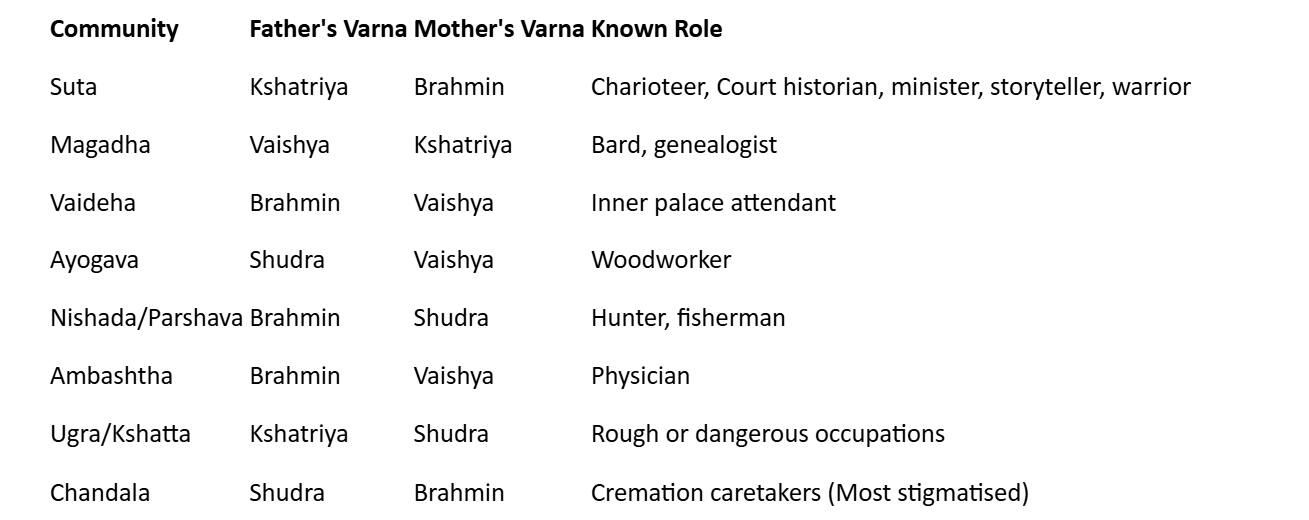
The very existence of this taxonomy tells us that while the Smritis were deeply invested in endogamy as an ideal, they also acknowledged the existence of communities that had clearly formed outside those boundaries. The mixed jatis were not theoretical constructs; they were communities with acknowledged identities, occupational niches and social standing.
Sutas appear among the relatively higher-status mixed jatis despite being classified as a pratiloma community, as their parentage combined Brahmin and Kshatriya lineage. They were closely associated with the Kshatriya ruling class, not regarded as low-born. Their roles — as charioteers to kings, court ministers, keepers of royal genealogies and narrators of epics — placed them in close proximity to power and learning, not servitude.
Interestingly, mixed jatis were encouraged to practise endogamy within their own community. Karna, for instance, married within the Suta community. When it came to Vidura’s marriage, a bride of matching mixed origin — Kshatriya-Shudra — was specifically sought out for him.
The Mahabharata itself reflects this social complexity. It contains examples of marriages across community and cultural boundaries, such as Bhima's marriage to Hidimba and Arjuna's marriage to Ulupi. Their sons did not occupy the same position within the Kuru lineage as the sons of Draupadi or Subhadra, yet they were neither shunned nor portrayed as inferior. Instead, they inherited and led the communities of their mothers.
This suggests that while inter-varna unions did occur, endogamy remained the preference even for those born outside the classical varna boundaries. That preference hardened further during the Gupta era; a shift that recent ancient DNA research also supports, showing a marked decline in inter-community marriages through the first millennium CE.
Karna was Drona’s student
I have extensively explained the Karna conundrum in Mahabharata unravelled 1, as well as in various podcasts. I will not go into it in detail here. Interested readers may read the book. However, one related myth is worth mentioning. If Sutas were not ‘low-born’, why did Dronacharya refuse to accept him as his student?
This, however, is not correct. The Adi Parva itself presents Karna as having studied under Drona along with the Kuru princes. He subsequently goes to Parashurama specifically to learn the Brahmastra. Karna himself, in at least three places in the text, acknowledges being a student of Kripa, Drona and Parashurama.
Sutaputra Is Not an Insult
Sanjay is addressed as Sutaputra in the Mahabharata. So is Keechaka. Ugrashrava Sauti is identified by his community affiliation from the very first lines of the epic. In almost every instance, it is an address — an identification, not a slur. Much as someone might be addressed as Rishiputra, or Rajputra, Sutaputra simply told you who someone was and where they came from. The term itself carries no inherent pejorative connotation. Even Sumantra, a close confidant, minister and charioteer of Dashratha, is addressed as Suta in the Ramayana.
A parallel worth noting: Vidura is addressed multiple times as Kshatta — a reference to his own mixed jati status (born of a Kshatriya father per Niyoga rules and a Shudra mother). It is used across the text not as an insult but as an identifying address. The Mahabharata itself is not embarrassed by these designations.
Sutaputra began to sound like an abuse largely because of how it has been depicted on television, where it is delivered with a sneer, weaponised in scenes of public humiliation. That is a dramatic choice of the creators, not a textual reality.
Almost all the Puranas are narrated by a Suta. Many orthodox commentators, however, distinguish these Puranic Sutas from the mixed-jati Sutas of the Smritis, describing them instead as having a special yajna-born origin.
What this tells us about the Mahabharata society
This write up is not intended either to defend or to condemn the varna-jati system. That is a much larger discussion. What it does show is this: Sutas were not a marginalised or stigmatised community. They were not considered low-born. They occupied positions of real consequence — as warriors, ministers, charioteers to kings, keepers of royal genealogies and traditional lore.
It also shows that Mahabharata-era society was not as jati-rigid as it is sometimes portrayed. Jati was not invisible; it mattered, and the text does not pretend otherwise. Endogamy was the norm, social identities were recognised, and birth could influence marriage, status and social interactions. This was not a fluid utopia. At the same time, neither was it the closed, calcified structure that both ultra-left readings and ultra-orthodox defences tend to project onto it.
The very existence of numerous mixed jatis, each with recognised identities, occupations and often positions of considerable responsibility, suggests that social reality was more complex — and in some respects more fluid — than it became over the last 1,500 years.
(Ami Ganatra is the author of ‘Mahabharata Unravelled’, ‘Ramayana Unravelled’, ‘Why Are We This Way’ and multiple books for children. The views expressed are personal and do not necessarily reflect the views of Firstpost.)

When Manila and Tokyo draw a line, Beijing draws a red line
Bangladesh gets a new envoy to reset its India ties
Escalation trap to an exit strategy: How can the Iran war end?
India must seize its demographic dividend before it fades
Bangladesh’s instability has sharpened India’s ‘Chicken Neck’ challenge