


War in Our Times | Misreading Chinese intentions can prove costly: Remembering the build-up to 1962
Mao’s role in the 1962 conflict with India was underplayed for years and it was only in the 1990s that a series of good writing from China emerged, revealing Mao’s impatience and irritation with Nehru’s growing influence in the developing world, and India’s unwillingness to let go of Aksai Chin

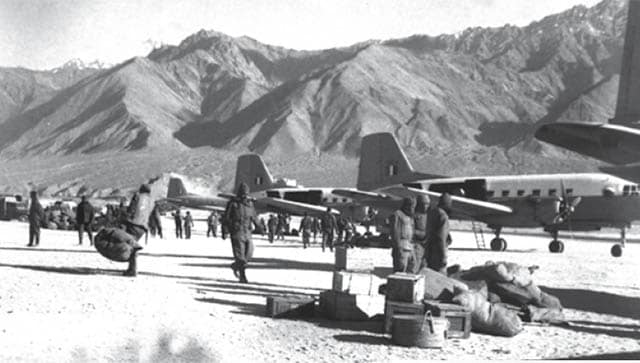
IAF reinforces Chushul. Image courtesy Arjun Subramaniam[/caption]No amount of posturing by Nehru and India in the years ahead with respect to championing non-alignment would change Patel’s opinion. He wrote: "It is impossible to imagine any sensible person believing in the so-called threat to China from Anglo-American machinations in Tibet. Therefore, if the Chinese put faith in this, they must have distrusted us so completely as to have taken us as tools or stooges of Anglo-American diplomacy or strategy. This feeling, if genuinely entertained by the Chinese in spite of your direct approaches to them, indicates that, even though we regard ourselves as friends of China, the Chinese do not regard us as their friends. With the Chinese mentality of ‘whoever is not with them being against them’, this is a significant pointer of which we have to take due note."Mao Versus NehruNehru did not pay heed to Patel’s warnings and continued to bank on his international stature and perceived leadership of the developing world as being enough to stave off any hostility from China. Mao, with his increasing disdain for Nehru as the 1950s went by, assumed control of China’s strategy to ‘teach India a lesson,’ while the consummate Zhou Enlai, China’s Prime Minister, was entrusted with keeping India guessing about China’s actual intentions with deft but argumentative diplomacy. Despite undocumented swap offers by Zhou that it would be in India’s interest to meet China half-way and understand its strategic fears about Aksai Chin in return for China’s acceptance of the McMahon line in the east. India and Nehru stuck to their guns that Aksai Chin was an intrinsic part of Ladakh and that the McMahon line was inviolable in the east.The year 1957 was a defining year in India-China relations. The unveiling of the Tibet-Sinkiang highway through Aksai Chin completely spooked India. Not only was it a blatant display of aggressive strategic posturing and admirable high altitude infrastructure engineering, it was also a very accurate recognition of India’s inability to respond based on its scanty deployment of armed forces in Ladakh and the near absence of any operational infrastructure worth the name. Apart from a display of an indignant ‘you stabbed me in the back’ and ‘how could you do this to us — your partners in the fight against colonialism’ kind of statements, India could do very little in terms of physically contesting the road construction through territory it claimed.Mao’s role in the 1962 conflict with India was underplayed for years and it was only in the 1990s that a series of good writing from China emerged, revealing Mao’s impatience and irritation with Nehru’s growing influence in the developing world, and India’s unwillingness to let go of Aksai Chin. Mao also made some fundamental errors by wrongly assessing that after granting asylum to the Dalai Lama, India wanted to seize Tibet from China. Mao is also said to have been particularly incensed at some covert support from India to the Khampa rebellion in Eastern Tibet in 1959.The road to warAfter the Dalai Lama fled to India via Tawang in March 1959, the People’s Liberation Army (PLA) commenced aggressive patrolling, citing Indian forays into Aksai Chin and along the McMahon Line in NEFA as having forced its hand. The first armed incident of significant importance was reported at Longju on the NEFA border where India had set up a post right on the McMahon line and just south of the Tibetan village of Migyitun. Longju was conveniently placed on the Tsari River and allowed good visibility into Tibet. However, according to the Chinese, India had transgressed two miles north of the McMahon line and asked it to vacate the post. This face-off in August, 1959, which resulted in a small but fierce firefight broke out between the PLA and the Indian Army. This can be considered as the first serious encounter with ‘gloves off’ as a prelude to the 1962 war.Pushed into a corner by China and faced with an election in a couple of years, Nehru had no other option but to harden his stance vis-à-vis China without the wherewithal to convert it into any tangible strategic game plan. The inexperienced and strategically naïve political opposition within India too played its part in allowing the situation to deteriorate by badgering Nehru and accusing him of cowing down to Chinese bullying — they demanded, without realising the skewed military balance between the two countries, that ‘not an inch of Indian territory must be bartered with the Chinese’. Nehru had to come up with some security policy to combat China. The Forward Policy was a result of this relentless pressure on the Indian government, both from the Chinese, and the domestic constituents comprising the opposition parties, media and the public at large.Convening a Central Military Commission meeting in late 1961, Mao compared India’s Forward Policy to a strategic move across the centreline in a game of chess. He remarked: "Their (India’s) continually pushing forward is like crossing the Chu Han boundary. What should we do? We can also set out a few pawns on our side of the river. If they don’t then cross over, that’s great. If they do cross, we’ll eat them up." He likened India’s Forward Policy to can shi zheng ce, or a ‘nibbling policy’ and asked his border troops to secure China’s claim over Aksai Chin by weaving an interlocking pattern around Indian troops without seeking a fight unless provoked and fired upon.The Forward Policy was a poorly conceived and politically driven military posture with almost no coercive potential against a much stronger adversary. How the Indian Army went along with Nehru and VK Krishna Menon, the mercurial and acerbic defence minister, is a story by itself. It envisaged creation of small static enclaves of troop positions of a maximum of a platoon strength in ‘no mans’ land very close to where the Chinese were occupying similar positions in larger numbers. The strategy was tactically unsound and though field commanders like Lt Gen Daulat Singh, the Western Army Commander, and Lieutenant General Umrao Singh, the top field commander in the east, expressed serious apprehensions about sustaining such a policy, they fell in line once the Army chief insisted on implementing the directive. Instead of coercing or deterring the Chinese, it provoked them into responding with brute force and strength.The author is a former fighter pilot from the IAF and an accomplished military historian. He is the author of two defining books on contemporary Indian military history, ‘India’s Wars: A Military History 1947-1971 & Full Spectrum: India’s Wars 1972-2020. Views expressed in the above piece are personal and solely that of the author. They do not necessarily reflect Firstpost’s views.Read all the Latest News, Trending News, Cricket News, Bollywood News,India News and Entertainment News here. Follow us on Facebook, Twitter and Instagram.

When Manila and Tokyo draw a line, Beijing draws a red line
Bangladesh gets a new envoy to reset its India ties
Escalation trap to an exit strategy: How can the Iran war end?
India must seize its demographic dividend before it fades
Bangladesh’s instability has sharpened India’s ‘Chicken Neck’ challenge