


The emperor’s wars: How Trump’s ego took America from tariffs to Tehran
A new book reveals how one man’s obsession with power reshaped American policy and unsettled the world

There is an old saying: strong rulers go to war for national interests, but insecure rulers go to war for personal interests.
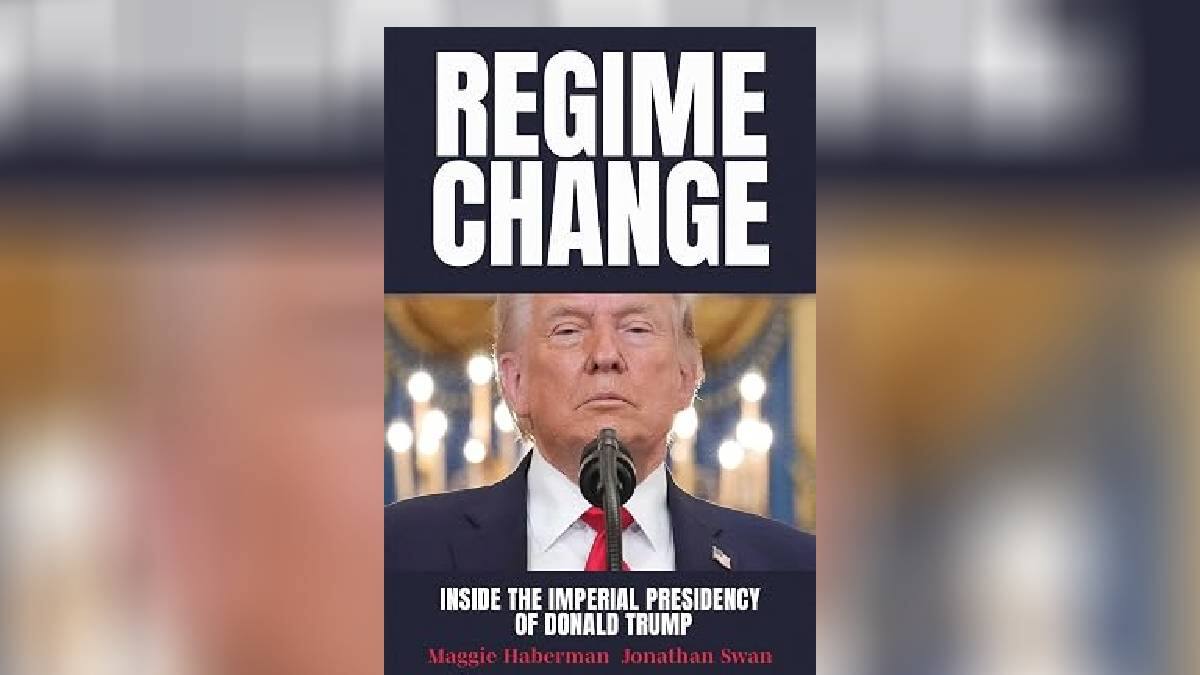
If the just-published book, Regime Change: Inside the Imperial Presidency of Donald Trump, by Maggie Haberman and Jonathan Swan, is to be believed, Donald Trump’s second presidency is less a story of American power than of one man’s insatiable obsession with it. It is the story of a President who increasingly saw the world not through the prism of national interest, strategic calculation or institutional wisdom, but through the far narrower lens of personal grandeur. The result was predictable. America found itself fighting two wars simultaneously — one military against Iran, the other economic against much of the world.
Neither was inevitable. Both bore the unmistakable imprint of Trump’s personality.
The most revealing episode in the book is also the most absurd. During one of their interviews, Trump proudly produced what he described as a two-page note written by “a historian”. It compared him with figures ranging from Genghis Khan and Napoleon to Hitler, Stalin and Mao. Trump explained that these men had “maintained power through fear”, but “had no global reach”. They “didn’t have aeroplanes, right? You couldn’t travel around”. The note concluded triumphantly: “Donald Trump is, without question, the most powerful man that the planet has ever known — by a long way.”
 More from Opinion
Ironically, all through, Trump appeared entirely comfortable placing himself “in the company of Mao, Hitler and Stalin”. More strikingly, “he drew no distinction between those who built and those who destroyed, between those who liberated and those who enslaved. What mattered was that they had had huge power — and that he had more.”
Lo and behold, the story didn’t end there. As it turned out, the “historian” was not a historian at all. He was the caddie of one of Trump’s golfing companions.
Nothing better captures the intellectual ecosystem surrounding Trump’s presidency. Expertise had become optional. Flattery had become evidence. Once that bubble of infallibility had been created, policy itself became hostage to presidential instinct.
The tariff war is perhaps the clearest example. Trump had convinced himself that America had been systematically cheated by countries such as China and India. “China tariffs us over 150 to 200 per cent, India 175 per cent,” he thundered in one of the meetings with the President’s economic team on tariff strategy on March 26. There was no empirical basis for arriving at these numbers. He thought they were true simply because they felt true to him.
When he was confronted by some of his officials, including Commerce Secretary Howard Lutnick, barely a week before Trump launched his global tariff offensive, Trump exploded: “Nobody has fucking given me any numbers. Hard facts of how much China tariffs us, how much India tariffs us. You give me bullshit numbers.” When Lutnick responded by producing official data, Trump barely looked at them, saying: “No, these are bullshit numbers… These are fucking bullshit.”
This exchange deserves to be remembered because it illustrates something profoundly disturbing. The President was not demanding facts. He was demanding facts that confirmed what he already believed.
According to the book, Lutnick warned that markets would collapse if exemptions were not granted. Trump’s response was breathtaking in its indifference: “Okay, fine, I’ll own it. So what?”
Those six words may well define the governing philosophy of Trump’s second term: evidence was negotiable. Presidential certainty was enough.
If the tariff war demonstrated how one man’s instincts could destabilise the global economy, the Iran saga reveals how the same psychology can drag a superpower towards military conflict. The book argues that Israeli Prime Minister Benjamin Netanyahu understood Trump perhaps better than anyone else.
The Trump-Netanyahu relationship had broken down after the Israeli PM had congratulated Joe Biden following the 2020 election — something Trump mistakenly believed Bibi had done before every other world leader. Haberman and Swan recount how Netanyahu painstakingly repaired the relationship by arriving with a list proving that numerous leaders had congratulated Biden before he did. It was, they write, “the sort of detail that Trump found irresistible”.
Once Trump returned to office, Netanyahu reportedly intensified the courtship, beginning with the Israeli PM posting, soon after Trump’s victory, a congratulatory message on social media that “was so over-the-top that even some of his closest allies cringed”.
The authors describe how Israel’s Hezbollah operation “at once enthralled and horrified” Trump. Then came perhaps the most surreal symbol of all: a gold-plated pager. The same device that had become synonymous with one of Israel’s most audacious covert operations against Hezbollah was presented to Trump as a gift.
Haberman and Swan recount the extraordinary scene. “Don’t push the button,” Trump joked as he handed the pager to Elon Musk, while later recounting in graphic detail the devastation the explosions had caused. It was diplomacy tailored not to strategic reasoning but to personal fascination.
Yet, making Trump admire Israel was only half the task. The harder objective was persuading him that America should join Israel’s war with Iran. Here, too, Trump’s worldview proved remarkably susceptible to simple narratives. American military officials and experts warned repeatedly that “an air campaign alone was highly unlikely to topple the regime”. But Trump preferred another scenario. He envisioned what the authors call “a Venezuela-type situation emerge in Iran — all the benefits of regime change without having to go to the trouble of changing the whole structure of the country”. Post-Maduro, Trump had an easy solution for Tehran: “Take out the top guy and install a fearful apparatchik who would be deferential to Trump.”
Netanyahu’s team reportedly reinforced precisely this illusion. Protests would erupt. Israeli intelligence would help foment unrest. Precision bombing would collapse the regime. Victory would come swiftly.
It all sounded so neat, so elegant, so perfect. And so easy. Several military officials objected to this theory; even Vice President JD Vance questioned several of these assumptions and challenged Israel’s optimistic assessments. But Trump had already chosen his path. Once again, institutional expertise collided with presidential certainty. And certainty won.
The tragedy, as the book suggests, is that Trump’s second administration no longer possessed the institutional antibodies that had restrained him during his first. “Trump’s information loop in his second term was much tighter than in the first,” the authors write. “Trump rarely heard from sceptics.” Instead, he was “surrounded by flatterers”, both inside the White House and among wealthy admirers at Mar-a-Lago who enthusiastically encouraged military action against Iran.
This is where the book has an important lesson for modern democracies: for a nation, strong leaders are important, but strong institutional antibodies are paramount. Checks and balances are not obstacles to governance; they are insurance against human fallibility.
The moment a nation’s policies begin reflecting one person’s ego rather than the collective wisdom of its institutions, democracy ceases to be self-government. It becomes government by personality.
History has shown, repeatedly, where that road leads.
(The writer is the author of ‘Bharat Rising: Dharma, Democracy, Diplomacy’ and ‘Eminent Distorians: Twists and Truths in Bharat’s History’. Views expressed in the above piece are personal and solely those of the author. They do not necessarily reflect Firstpost’s views.)
The author is Opinion Editor, Firstpost and News18. He can be reached at: utpal.kumar@nw18.com

When Manila and Tokyo draw a line, Beijing draws a red line
Bangladesh gets a new envoy to reset its India ties
Escalation trap to an exit strategy: How can the Iran war end?
India must seize its demographic dividend before it fades
Bangladesh’s instability has sharpened India’s ‘Chicken Neck’ challenge