


India’s fertility rate drops below replacement level: Do we need to panic?
The claim is that India’s population will reach a maximum of 1.6 billion in 2048 before falling ‘sharply’ to ‘just over 1 billion’ by 2100. However, this projection is based on fertility assumptions for the 2050s–2080s, which depend on the childbearing plans of women who have not yet been born

Did India’s fertility rate just fall below the level required to sustain the population at a constant level? No. That happened in 2017.
But don’t tell India’s newspapers, or its worried political commentators.
They all get their news from The Economist magazine, and The Economist just ran a story under the incendiary headline "India’s Population Will Soon Be Falling—Probably Quite Fast". How soon? Around 2050, according to the University of Washington research cited by The Economist.
Theek hai, alarmism is the stock in trade of the media industry. But what about the claim that India's fertility has dropped below the population replacement rate?
India’s total fertility rate was last measured at 1.885, according to official government data. The official report rounds this off to 1.9, with the data pertaining to calendar year 2024. That is indeed below the replacement rate of 2.21.
 More from Opinion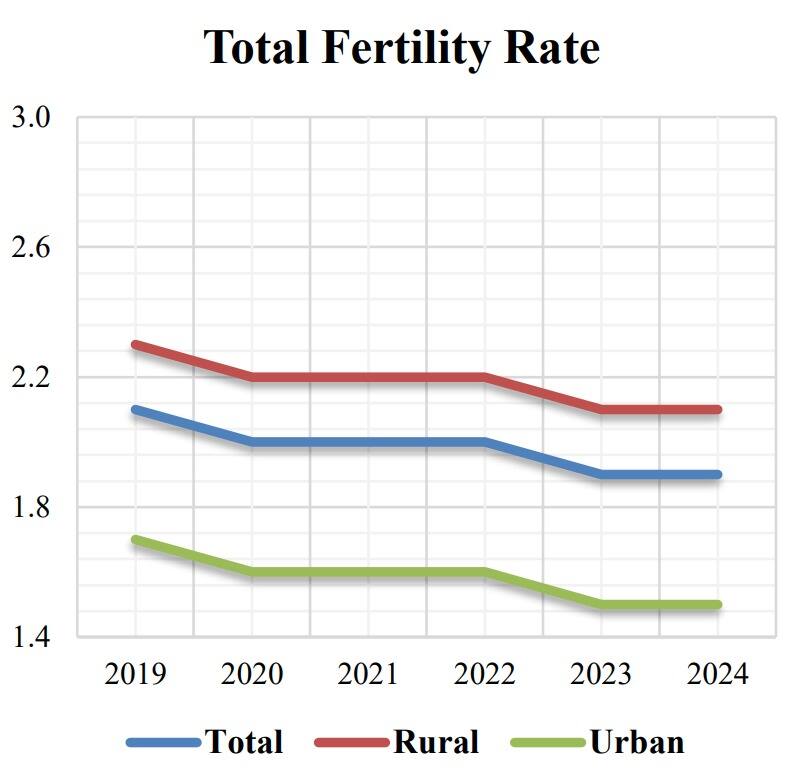
The total fertility rate is the number of children that would be born to each woman at current rates of fertility. It is a synthetic measure, because no woman experiences 2024 rates of fertility throughout her entire life. She bears children over a period of years, but the fertility rate pulls together the experiences of women of all ages in the current year.
Each woman has to have two children to replace the current population—one for herself and one for her husband. But sadly some babies do not live long enough to have children for themselves. On top of that, slightly more boys are born every year than girls, and boys don't bear children. So the total fertility replacement rate for India is estimated to be 2.21 children per woman.
India's total fertility rate fell below 2.2 in 2017 and has stayed below 2.2 ever since.
Nonetheless, the population of India is still growing. The Economist (citing University of Washington research) writes that India's population will reach a maximum of 1.6 billion in 2048 before falling "sharply" to "just over 1 billion" in 2100.
That population projection is based on fertility projections for the 2050s-2080s for the childbearing plans of women who have not yet been born. In most cases, their mothers have not yet been born. Indian ladies in your 20s, listen carefully: we're talking about your grandchildren's fertility decisions.
How can the University of Washington know what your grandchildren’s fertility decisions will be? Of course, they don’t. They model these decisions statistically, based on four variables: levels of women’s education, population density, unmet need for contraception, and child mortality.
And how do they know what the values of these four variables will be in the 2050s-2080s? They don't. They model these variables based on yet other variables. And the model fit at each step is shockingly low.
In short, no one knows what India’s fertility rate will be in the second half of the century and thus what India’s population will be in 2100.
There's nothing wrong with academics making guesses of these things. Modelling is modelling; that's what we do. But academics should be very careful when talking to the press about turning demographic forecasts into alarming predictions.
Of course, if India goes down the Chinese road to one child per mother, India’s population will shrink. That would not necessarily be a bad thing. An economically and socially stronger India would have fewer poor people engaged in agriculture, and one way to accomplish that is for people to have fewer children.
Those fewer children would then receive greater investments in their education and concentrate in India’s growing cities, propelling India to prosperity.
The important thing is that those changes be gradual, and in India they have been gradual. China's fertility rate fell from 6 children per woman to 2 over a period of just two decades, 1970-1990. In India, the transition took 55 years, from 1965 to 2020.
It seems likely that India’s fertility decline will continue to be gradual. It may even be arrested. The models that predict continuing fertility decline are very weak and not remotely reliable. If Indians want babies, they will have them. If Indian governments (at all levels) make that easier and less costly, parents and potential parents will respond.
(Salvatore Babones is an associate professor at the University of Sydney and the author of ‘Democracy with Dharma: The Successful Indian Experiment’. The views expressed are personal and solely those of the author and do not necessarily reflect Firstpost’s views.)

When Manila and Tokyo draw a line, Beijing draws a red line
Bangladesh gets a new envoy to reset its India ties
Escalation trap to an exit strategy: How can the Iran war end?
India must seize its demographic dividend before it fades
Bangladesh’s instability has sharpened India’s ‘Chicken Neck’ challenge