


How Muslim invaders and British rulers killed over 300 million people in India — still no memorial for Hindu holocaust
It’s unsettling to see Hindus being largely silent or indifferent about the horrors being unleashed on them for centuries. One wonders why there’s no memorial for the Hindu holocaust of the last 1,000 years

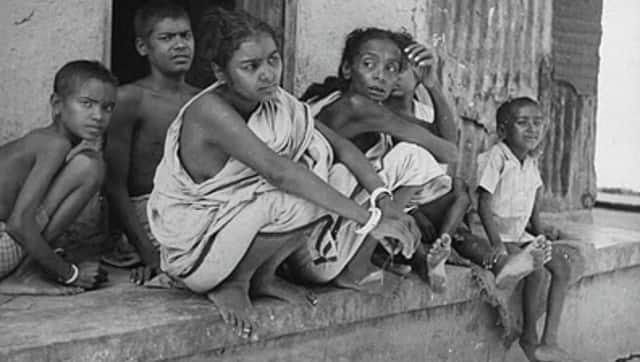
Bengal Famine of 1943. Image courtesy Wikimedia Commons[/caption]Since 1770, India saw at least two dozen massive famines, the last big one being again in Bengal in the early 1940s whose man-made nature can be understood from the fact that a series decisions by Winston Churchill, the then British prime minister, “directly and inevitably led to the deaths of some three million Indians”, as Madhusree Mukerjee writes in Churchill’s Secret War. “The streets of eastern Indian cities were lined with corpses, yet instead of sending emergency food shipments, Churchill used the wheat and ships and his disposal to build stockpiles for feeding post-War Britain and Europe,” she adds.Famines, however, weren’t the only killing machines. The country saw hundreds of rebellions against the British, most of them were crushed with iron fist. In War of Civilisations: India AD 1857, the two-volume series on what many saw as “India’s first war of independence”, author Amaresh Misra states that there was an “untold holocaust” which caused the deaths of almost 10 million people over 10 years beginning in 1857. Such was the polarised milieu and hatred for Indians that Charles Dickens, who warmed our hearts with Oliver Twist-like tales, said on the Great Mutiny: “I wish I were commander-in-chief in India... I should proclaim to them that I considered my holding that appointment by the leave of God, to mean that I should do my utmost to exterminate the race.”The Frog and the Boiling WaterKS Lal, in his monumental work, Growth of Muslim Population in Medieval India (AD 1000-1800), provides a detailed assessment of change in Indian demography between 1000 AD and 1500 AD. His studies suggest that the population of the subcontinent actually saw a decline between 1000 AD, on the eve of Mahmud of Ghazni’s invasions, and 1500 AD, just before Babur laid the foundation of the Mughal Empire in India in 1526 AD. (According to Lal, more than 2 million Hindus died during Mahmud of Ghazni’s invasions of India.) Taking into account all the available details, Lal comes to the conclusion that about 60 to 80 million Hindus died between 1000 and 1500 AD.Now add to them the exploits of Babur, who after one of his victories got “a tower of infidels’ skulls” being “erected on the hill on the northwest side of Chanderi” — and this wasn’t an exception during his four-year rule in India. As for Aurangzeb, his fanaticism is beyond doubt, except when one deliberately wears Audrey Truschke-like ideological/opportunistic blinders. Even during Akbar’s largely non-partisan rule, the Chittor massacre of 30,000 civilians, including women and children, took place soon after the Mughal victory.On a purely statistical comparison, the European atrocities outlast and outsmart the Muslim persecution. Still, the Raj largely comes out unscathed. Even its last act — India’s Partition — was a manmade tragedy: One, the British felicitated India’s Partition to retain some footholds in the subcontinent after India’s Independence; and two, they did pretty little to stop the Partition-related violence after Cyril Redcliffe beat the ‘impossible’ five-week deadline to divide the subcontinent. Such was the chaos that people on border areas didn’t know till 15 August 1947 whether they would be in India or Pakistan. Rumour-mongers had a field day. “Each time one of these rumours became rife, people of the other community would abandon their homes and run, leaving everything behind,” Urvashi Butalia writes in The Other Side of Silence. A better handling of the situation would have saved a million lives.Still if we mourn the death of the British Queen, then something is not right. Maybe the frog in the boiling water theory can explain pathetic sense of amnesia. Unlike the Muslim marauders, who believed in the might of the sword to conquer India, the British death didn’t happen at one go; the killings, even though on a much bigger proportion, were spaced out. And like the proverbial frog in the hot water, Hindus didn’t realise they were being boiled to death! It won’t be unreasonable to say that while the Muslim invaders largely resorted to jhatka-style of executions, the British took to the halal way of killing Indians. The first was dramatic and sudden, but the second was long and more painful.Maybe the part of the amnesia for British crime has been because unlike the Muslim invaders who didn’t discriminate in the killing of kafirs, the British adopted a much ‘smarter’ strategy of divide and rule. To use the Macaulayan term, the British patronised and got the support of people who were “Indian in blood and colour but English in taste, in opinions, in morals and in intellect”. These were mostly the elite, urbane and educated Indians. This class of people also supported the British because it had not experienced this kind of peaceful milieu for centuries, leading to some sort of renaissance as we saw in the 19th century Bengal. But this came at the cost of lives and livelihoods of millions of poor in the rural, semi-urban areas. But then these were largely silent sufferers. Life was a daily drudgery for them, and death a way to escape that.ConclusionIt’s unsettling to see Hindus being largely silent or indifferent about the horrors being unleashed on them for centuries. One wonders why there’s no memorial for the Hindu holocaust of the last 1,000 years. Maybe centuries of mass killings have made them indifferent towards their own plight. Being a witness to untold persecution and conditioned by unending miseries and losses, they seem to have stopped reacting the way others would do — the way, for instance, the Jews reacted after Auschwitz. Maybe Hindus could survive those pogroms because they just stopped being affected by them.Maybe… Maybe not!But what’s beyond doubt is that people of this land have suffered immensely. Even by conservative estimates, as we see in this article, more than 300 million people might have been killed in the past 1,000 years. We, as a nation, have not yet examined the true nature of those killings. In fact, we tend to ignore, if not hide, such inconvenient truths. Till that happens, we as a nation won’t be able to take due lessons from history. And when one fails to learn from the past, one tends to stand with one’s own nemesis. The recent mourning over the British Queen’s death is a case in point.The author is Opinion Editor, Firstpost and News18. He tweets from @Utpal_Kumar1. Views expressed are personal.Read all the Latest News, Trending News, Cricket News, Bollywood News,India News and Entertainment News here. Follow us on Facebook, Twitter and Instagram.
The author is Opinion Editor, Firstpost and News18

When Manila and Tokyo draw a line, Beijing draws a red line
Bangladesh gets a new envoy to reset its India ties
Escalation trap to an exit strategy: How can the Iran war end?
India must seize its demographic dividend before it fades
Bangladesh’s instability has sharpened India’s ‘Chicken Neck’ challenge