


'Hindutva is a way of life, not a religion': Vivek Sood explores SC insights, PM Modi's perspectives in new book
Hindutva has been defined by the Supreme Court, especially in the context of election disputes, says senior advocate Vivek Sood

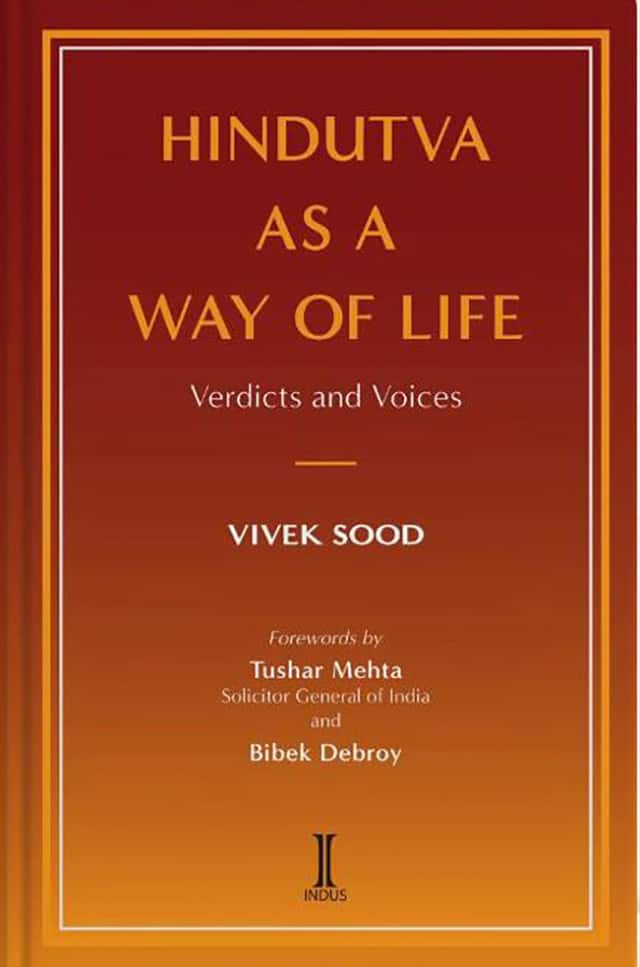
Image courtesy Shishir Tripathi[/caption]You have already explained how the Supreme Court has explained or defined Hinduism. Please tell us how the apex court has defined Hindutva.So, Hindutva has been defined by the Supreme Court, especially in the context of election disputes. In the 90s, you had these speeches Bal Thackeray and other leaders during election campaigns in which Hindutva was used during election campaigning. So it was challenged before the Supreme Court, and the question before the Supreme Court was whether using Hindutva amounts to using religion to seek votes from the voters. It was in this context that the Supreme Court held that Hindutva is a way of life and that using Hindutva in elections does not amount to asking for votes in the name of religion. So this is how the Supreme Court has defined Hindutva.So what prompted you to write a chapter on Ram Janmabhoomi verdict of the apex court?Ram Janmabhoomi verdict, as we all know, runs into over 1,000 pages. It is a very complex judgement and it is beyond the comprehension and intelligence of the common man or the layman to read those thousand pages and understand the technicalities behind the judgment or the legal jargon or the legal principles on which the Ram Janmaboomi judgement has come. So I have simplified the Ram Janmaboomi dispute and how the Supreme Court has decided the case in about 40 to 50 pages so that every citizen of the country and every member of the Hindu religion should be able to understand the Ram Janmabhoomi verdict. So with this thought in mind, I have written this chapter on the Ram Janmabhoomi verdict.Do you agree with the Supreme Court verdict?Yes, absolutely. It's a beautifully written judgment and the Supreme Court judges have gone into such details and they have applied the principles of the law of evidence. They have applied principles of law to the facts of the case. And then they have decided the decision is not based on any ideology, it's not an ideological verdict, it's a legal verdict based on principles of the law of evidence. So it's a very, very well-written judgment. I therefore call this judgment one of the landmarks in case law and landmark judgments. It is amongst the landmark judgments delivered by the Supreme Court of India since Independence.Do you agree that using Hindutva in elections doesn't amount to asking for votes in the name of religion?Yes, I absolutely agree. The meaning of Hindutva is it's a way of life. It is not a religion like other religions. It is an ocean. Hindutva is a mindset. It is a way of life. It cannot be called a religion by itself. And I totally agree with the view of the Supreme Court of India which said in so many cases that Hindutva is a way of life. Hindutva is not a religion. It cannot be called as one religion. And therefore, asking for votes in the name of Hindutva does not amount to asking for votes in the name of a religion. And therefore it is valid in law. It is not invalid. There is no breach of the Representation of the People Act that we have.Sir, your book has raised an interesting issue as to how the prime minister views Hindutva. Please tell us the process you followed while writing this chapter.What I did was, I explored the life and actions of the Prime Minister of India, Narendra Modi. I followed up on the various speeches given by him on his actions as the Prime Minister of India. So when I read about him, when I read about his speeches, when I read about his policies as the Prime Minister of India, I then could gather as to what is the meaning of Hindutva for the Prime Minister of India. I will not reveal my conclusions. The readers must read my book to find out how Prime Minister Modi views Hindutva.The writer is a journalist and researcher based in Delhi. He has worked with The Indian Express, Firstpost, Governance Now, and Indic Collective. He writes on Law, Governance and Politics. Views expressed in the above piece are personal and solely that of the author. They do not necessarily reflect Firstpost’s views.Read all the Latest News, Trending News, Cricket News, Bollywood News,India News and Entertainment News here. Follow us on Facebook, Twitter and Instagram.

When Manila and Tokyo draw a line, Beijing draws a red line
Bangladesh gets a new envoy to reset its India ties
Escalation trap to an exit strategy: How can the Iran war end?
India must seize its demographic dividend before it fades
Bangladesh’s instability has sharpened India’s ‘Chicken Neck’ challenge