


Book review | Reclaiming dharma, democracy and diplomacy in New India
Adhering to a nationalist line and without entering into chauvinism or jingoism, Utpal Kumar's book takes a fresh look at New India and calls for reinterpretation of the country’s past to look ahead

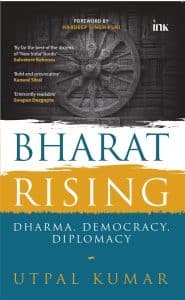
Bharat Rising (Dharma, Democracy, Diplomacy), BluOne Ink, Rs 599, Paperback – 26 January 2024. Author: Utpal Kumar[/caption]He writes, “If Bharat gained political independence in 1947, it became economically free only in 1991 under the first non-Gandhi-led Congress government to run the full term. P.V. Narasimha Rao, in a jugalbandi with Manmohan Singh, initiated the country’s liberalisation process. It was this decision to let the genies of the market come out of the statist bottle that laid the foundation of the global economic power that Bharat is today. Building on this foundation, the country has today displaced the United Kingdom (UK) to become the fifth-largest economy in the world and is all set to take the third slot in the elite list by the end of the decade — after the United States (US) and China.”In underlining the fault lines of the past, there has been a series of books that not necessarily have put forward non-partisan and meaningful debate on liberal versus right-of-the-centre ideas. Even though, non-sparing for highlighting the active nationalistic paradigms cornered by the governments before 2014 (including those of BJP) for combining dharma, democracy and diplomacy in real sense, the book appears refreshingly readable and thought-provoking for keeping reason in order. Its successes lie in the fact that it calls spade a spade without letting the imaginative instinct go haywire; it deals with the somersaults or notable accomplishments of the past with equal sensibility.Notwithstanding the contexts (here it is the democratisation of India’s freedom struggle saga by the current ruling dispensation), certain conclusions out of the book are worthy enough to be quoted including this from page-79: “It’s unfortunate that a number of freedom fighters found themselves largely obliterated from India’s national consciousness just because they were on the other side of the politico-ideological divide. Even Mahatma Gandhi was reduced to khadi and charkha. The list of such leaders is long and exhaustive. But none have been as targeted and vilified as Savarkar, Netaji Bose, and Babasaheb Ambedkar.”Adding to it on page-82, in broader reflexive terms, sums up unputdownable conviction: “The true set of liberalism lies in defending those who belong to the opposite camp. Liberalism can’t — and should not — be selective. There can be, after all, full liberalism or none at all. This is where the Nehruvian order failed the rest. It not just allowed the marginalisation of those who stood on the other side of the ideological divide, but also in some cases ensured they and their supporters were viciously targeted too.”As a young modern democracy but old civilisation, India needed to choose the path of progress after attaining freedom from dark British colonial rule. It rightly opted to prioritise the institution-making, gave mixed economy a prominence besides imbibing scientific temperament among the masses — characterising the thought process of India’s first prime minister Jawaharlal Nehru and freedom fighters including Netaji Subhas Chandra Bose. Not to be forgotten, the idea of Planning Commission first came from Netaji with keeping in mind the contemporary need of command economy in a fledgling democracy with a troubled past of long colonial rule. Also, he was someone who advocated the merit of pure liberalism. However, in connecting the dots, an unmissable fact remains that for decades ‘India’s history-writing project’ was lopsided, thus paving a wave of counters and reinterpretations.A uniquely insightful long-form work like Utpal Kumar’s Bharat Rising: Dharma, Democracy, Diplomacy, is reassuring with its informed tone when we are seeing reading, reckoning and interpretation of the history getting increasingly purposeful. Somewhere deep within, an assault on the ‘illiberal agenda’ of ‘liberal media’ is legitimised. This is as important as to hammer on journalism of any kind without ‘objectivity and fairness’. Similarly, the book has richness filled with commentaries on “Brave New Diplomacy in an Uncertain World”, “India’s Rise and the Western Dilemma”, “The Dragon in the Room” and “Pakistan and the Chimera of a Friendly Neighbourhood”.Presenting a changing overview of the home and the world from the perspectives of a rising India, the book is a remarkable addition to the serious literature to get a glimpse of the country’s past, present and probable future, besides its ever prominent role in the fast-changing world. India gives hope to the world, the book reflects well on that. It reimagines India’s prominence in the new world order, and effectively advocates for development backed with civilisational values. The book should get many readers and an impressive shelf-life for its timeless relevance.The reviewer is a policy professional, columnist and writer with a special focus on South Asia. Views expressed in the above piece are personal and solely that of the author. They do not necessarily reflect Firstpost’s views.Read all the Latest News, Trending News, Cricket News, Bollywood News,India News and Entertainment News here. Follow us on Facebook, Twitter and Instagram

When Manila and Tokyo draw a line, Beijing draws a red line
Bangladesh gets a new envoy to reset its India ties
Escalation trap to an exit strategy: How can the Iran war end?
India must seize its demographic dividend before it fades
Bangladesh’s instability has sharpened India’s ‘Chicken Neck’ challenge