


A hero or a pariah?: How Russia & the West remain divided over Gorbachev's legacy
While Germany has announced that official flags in capital Berlin will be lowered at half-mast in honour of Gorbachev, Putin has decided to skip the last Soviet leader's funeral in Moscow due to 'scheduling issues'

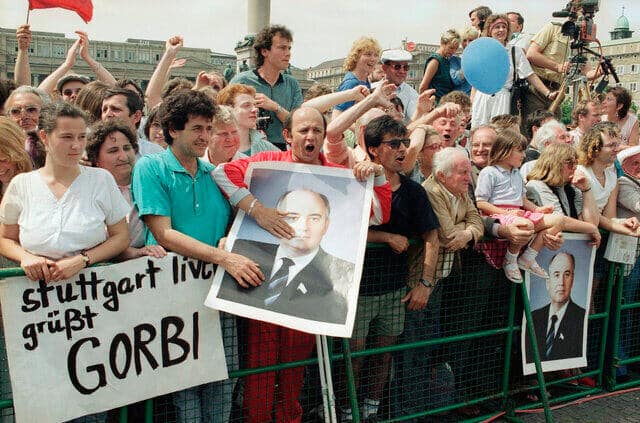
Wellwishers hold photographs of then-Soviet President Mikhail S. Gorbachev who left the 'New Castle' in Stuttgart, Germany, 14 June 1989 after talks with representatives of the city. AP[/caption]Germany was reunified a year later.In 1949- four years after the end of the Second World War- Germany was divided into the US-backed allied-controlled West Germany and Soviet-controlled East Germany.'There must not be bloodshed'Unlike his predecessors, Gorbachev refused to intervene militarily to counter the revolutions.Years later in an interview with the BBC in 2019, Gorbachev explained the reason behind this decision.He said, "There must not be bloodshed. We could not allow that, over an issue of such magnitude for Germany, for us, for Europe, the whole world. So we declared, we won't interfere."While Gorbachev's policies shaped Europe as we know it, in Russia he became the symbol of the ruin of an erstwhile superpower.This was evident in Putin's first reaction to Gorbachev's demise. He initially "expressed his condolences" but later called Gorbachev "a statesman who had a huge impact on the course of world history.”However, Russian leaders did not mince their words.Comparing the collapse of the Soviet Union to Nazi Germany's defeat in WW2, Russian MP Vitaly Milonov said that Gorbachev left a legacy “worse than Hitler for our country."The division between Russia and the West over Gorbachev's legacy has been visible both during the leader's lifetime and after his death.While Germany has announced that official flags in capital Berlin will be lowered at half-mast in honour of Gorbachev, Putin has decided to skip the last Soviet leader's funeral in Moscow due to "scheduling issues."Putin's move is hardly surprising. In the past, he dubbed the dissolution of the Soviet Union the “greatest geopolitical catastrophe of the century.”Will history be kind to Gorbachev?Away from the political circles, some Russians especially those who faced a crackdown from the authorities for their opposition to the Ukraine war, will perhaps see Gorbachev in a better light.Dmitry Muratov- the Russian journalist & chief editor of Novaya Gazeta newspaper, who won the 2020 Nobel Peace Prize hailed Gorbachev as a leader who "valued peace over personal power."Gorbachev used his prize money from the Nobel Peace Prize to set up Novaya Gazeta in 1993.In March, the newspaper suspended publication in Russia following the start of the Ukraine war."Gorbachev despised war. He was convinced that the time to resolve issues of the world order by force had passed," Muratov said.Read all the Latest News, Trending News, Cricket News, Bollywood News,India News and Entertainment News here. Follow us on Facebook, Twitter and Instagram.
Annu Kaushik is a Senior Sub Editor at Firstpost. She writes about international affairs and history. You can find her on Twitter @AnnuKaushik253

When Manila and Tokyo draw a line, Beijing draws a red line
Bangladesh gets a new envoy to reset its India ties
Escalation trap to an exit strategy: How can the Iran war end?
India must seize its demographic dividend before it fades
Bangladesh’s instability has sharpened India’s ‘Chicken Neck’ challenge