


Word of the Week: Artemis, Nasa’s space mission that takes humans back to the Moon after 50 years
For the first time in nearly 54 years, humans are on their way to the lunar surface, courtesy of Nasa’s Artemis II mission. This is part of the US space agency’s larger goal of establishing a permanent presence on the Moon

As the war in West Asia enters its second month, people’s attention shifted little this week from Iran to space, namely the Moon, as Nasa launched the Artemis II mission in which four astronauts embarked on a high-stakes flight around the lunar surface for the next 10 days.
The Artemis II launch on April 1 at 6.35 pm, EDT marks the return of Nasa to the lunar surface (mind you, the astronauts won’t land on the Moon but conduct a flyby). The last time the American space agency sent a crew to the Earth’s natural satellite was in December 1972, when American astronauts Eugene Cernan and Harrison Schmitt spent three days on the lunar surface.
The four astronauts on the Artemis II mission carry America’s starry-eyed ambitions for space. After all, Artemis II is meant to be the first in a years-long series of crewed deep-space missions that, if successful, will realise the construction of a multibillion-dollar moon base at the lunar south pole sometime in the 2030s.
 More from Explainers
If you are interested in the what, why, and how of the Artemis mission, here’s a deep dive into it as part of our ‘Word of the Week’ special.
The origins of Artemis
Before we delve into the nitty-gritty of the programme, why did Nasa choose the name Artemis? It’s a nod to the American space agency’s previous Moon missions, titled Apollo, which first took humans to the lunar surface between 1968 and 1972.
Artemis is the twin sister of Apollo and the goddess of the Moon in Greek mythology. As Nasa noted, together, Artemis and Apollo form a symbolic and literal bridge between the past and future of human spaceflight. The thinking behind the name is simple and deliberate. Apollo proved that humans could land on the Moon. Artemis is about going back, but with a longer plan in mind.

In Greek mythology, Artemis is often portrayed as independent, fiercely protective, and closely connected to nature — qualities that resonate with Nasa’s vision for a sustainable lunar programme and mission designed to explore uncharted territory. She is often depicted carrying a bow, or sometimes a torch.
There’s also further symbolism attached to the name, Artemis. It aligns with the programme’s goal to land the first woman on the Moon.
To the Moon and beyond: The Artemis programme
Wednesday’s launch of the Artemis II is part of Nasa’s larger Artemis programme. Through this programme, Nasa aims to send astronauts to the lunar south pole and eventually establish a permanent presence on the Moon.
The first leg of this programme, Artemis I, took place in 2022 when Nasa launched an uncrewed test of the Space Launch System and Orion capsule on a lunar flyby. The next stage, Artemis II, is the first crewed lunar flyby in which astronauts will travel the farthest they ever have — some 252,000 miles (406,000 km) into space. The current record for the farthest spaceflight at roughly 248,000 miles is held by the three-man crew of the Apollo 13 lunar mission in 1970, which was beset by technical problems after an oxygen tank exploded and was unable to land on the Moon as planned.

If successful and everything goes as planned, Artemis II will pave the way for Artemis III, scheduled for 2027. In this, Nasa aims to send a crew to low-Earth orbit to dock with a future lunar lander, and Artemis IV aims to land a four-person crew on the Moon’s south pole.
The Artemis programme is also a stepping stone towards future human missions to Mars.
The Artemis programme also has a geopolitical factor to it. The US views the missions as a way to maintain leadership in space exploration amid growing competition, particularly from China.
Artemis II takes off!
On Wednesday, amid much hype and hoopla — around 400,000 people gathered at the Florida Space Centre — to witness the take-off of the Artemis II mission. At 6.35 pm EDT, Nasa’s SLS rocket lifted off without incident with the four members — commander Reid Wiseman, pilot Victor Glover, mission specialist Christina Koch, and mission specialist (and rookie Canadian astronaut) Jeremy Hansen — of the Artemis II spacecraft aboard.
Minutes before lift-off, Canadian astronaut Hansen, strapped inside the gumdrop-shaped Orion capsule, told mission control in Houston: “This is Jeremy, we are going for all humanity.”
To which, Launch director Charlie Blackwell-Thompson said: “Reid, Victor, Christina, and Jeremy, on this historic mission, you take with you the heart of this Artemis team, the daring spirit of the American people and our partners across the globe, and the hopes and dreams of a new generation.”
“Good luck, godspeed, Artemis II. Let’s go.”
After a successful launch, the Artemis II crew will now spend 10 days carrying out a long list of mission objectives that includes the first human lunar flyby in more than half a century.
Experts note that Artemis II is essentially a systems validation mission. Nasa will use the flight to test the Orion spacecraft’s life support systems, navigation, communication links and overall performance in deep space with a crew on board – conditions that cannot be fully replicated on Earth.
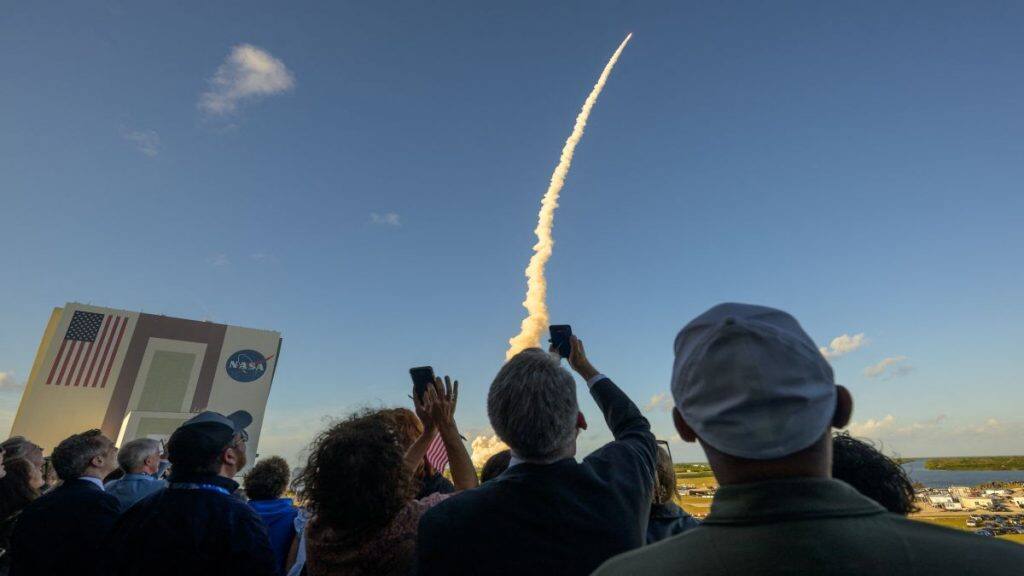
And after 10 days, the Artemis II will return to Earth, following a so-called “free-return” trajectory. It will eventually make a splashdown in the Pacific Ocean off the California coast.
But it seems that the Artemis II mission has already witnessed a glitch; the capsule's toilet is already acting up. Koch informed Mission Control that it shut down seconds after she activated it. Mission Control advised her to use a handheld bag-and-funnel system for now — CCU, short for Collapsible Contingency Urinal — while engineers pondered how to deal with the so-called lunar loo.
However, the enthusiasm around the Artemis II mission hasn’t waned. We shall keep a further lookout for the Artemis II crew and monitor their progress as they look to complete their 10-day space voyage.

Military drones & police check-ups: How Sri Lanka is fighting against worst dengue outbreak in a decade
How Facebook job ad lured 2 Karnataka men into Myanmar cyber scam camp
Why is India seeing 95% cloud cover despite a Super El Niño?
What is CJP’s fourth demand to the government as protests in Delhi intensify?
The new geography of war: Why the Houthis can no longer be ignored