
Advertisement


Sections
Will Pakistan have a rotational prime minister? Who’s in the race for the top post?
The Nawaz Sharif-led PML-N and Bilawal Bhutto Zardari’s PPP are in talks to form a government in Pakistan. However, they are unable to decide on the post of prime minister. Amid this delay, now the two parties are deliberating if the top job should be held on a rotational basis

It’s been almost a week since Pakistan held its elections and threw up the biggest of surprises when Imran Khan’s Pakistan Tehreek-e-Insaf (PTI)-backed candidates bagged the most number of seats, trouncing Nawaz Sharif’s Pakistan Muslim League-Nawaz (PML-N) and Bilawal Bhutto Zardari’s Pakistan People’s Party.However, as none of the parties have secured a simple majority in the 266-seat National Assembly — there is no clear winner — Pakistanis, along with many others around the world, are wondering which party will form the next government or who will be the next prime minister.As the wheeling-dealing between parties gathers pace, we break down what’s going on after the hotly-contested elections, which saw violence as well as allegations of rigging.What’s brewing between PML-N and PPP?After the final ballot was cast, and counting began, it emerged that Nawaz Sharif’s party, which reportedly had the backing of the powerful military, received 75 votes while Bhutto-led PPP secured 54 votes. This is way behind the tally of the PTI-backed ‘Independents’, who won 101 seats.Shortly after the results were declared, both parties realised that the only way to thwart Imran Khan and his party’s return to power was to join hands and since then have been in talks to hammer out some sort of power-sharing formula.However, it is easier said than done as both parties are unable to reach a consensus on the issue of prime minister. Interestingly, even within Nawaz Sharif’s PML-N, there are varying opinions with some suggesting that Shehbaz, and not Nawaz, be made the premier. In fact, party stalwart Khawaja Asif had told Samaa TV earlier that Shehbaz was the PML-N’s prime ministerial candidate. However, Maryam Nawaz later clarified saying this was the veteran’s personal opinion and not that of the party.The PPP, on the other hand, is yet to take a final decision on the alliance, with the Dawn reporting that the Central Executive Committee of the PPP will meet today (13 February) to deliberate on the post-poll scenario and proposals regarding the coalition government.It seems that the PPP isn’t fully amenable to an alliance with the PML-N. There is a faction of members within the Bhutto-led party who believe that the results were questionable and even advocated for staying in opposition at the federal level.However, there are others who argue that the PPP should join hands with the PML-N on the condition that 35-year-old Bilawal Bhutto Zardari, the son of assassinated former premier Benazir Bhutto, be made prime minister. Their reason being that he is a fresh face in a country where more than 60 per cent of the population are under 30.[caption id="attachment_13720552" align="alignnone" width="640"]![]() Supporters of Pakistan's former Prime Minister Nawaz Sharif's party chant slogans outside party headquarters in Lahore, Pakistan. AP[/caption]Prime minister on rotational basis?There’s also talks of a possibility of having a rotational premiership. Pakistan’s GeoTV has reported that the PML-N and the PPP are deliberating the possibility of appointing prime ministers from their parties for a three- and two-year term under a power-sharing formula. What this means is that one party will govern for three years and the other will take charge for the remaining two years.The idea of such a power-sharing method came about on 11 February when leaders of both parties sat down for talks to form a coalition government in the Centre. This formula, interestingly, was used by the PML-N and the National Party (NP) in Balochistan in 2013 when two chief ministers from the two parties held office for half of the five-year term.What about the PTI and the ‘independents? And amid talks of a possible PML-N and PPP alliance, there’s also a third possible route. That of the PTI-backed ‘independents’ joining hands with the PPP and other smaller parties.In fact, this idea has gathered some steam after senior PPP leader Sherry Rehman said that the party’s doors are open to all political forces.However, it seems very unlikely that the PTI will form an alliance with the PPP.[caption id="attachment_13720512" align="alignnone" width="640"]
Supporters of Pakistan's former Prime Minister Nawaz Sharif's party chant slogans outside party headquarters in Lahore, Pakistan. AP[/caption]Prime minister on rotational basis?There’s also talks of a possibility of having a rotational premiership. Pakistan’s GeoTV has reported that the PML-N and the PPP are deliberating the possibility of appointing prime ministers from their parties for a three- and two-year term under a power-sharing formula. What this means is that one party will govern for three years and the other will take charge for the remaining two years.The idea of such a power-sharing method came about on 11 February when leaders of both parties sat down for talks to form a coalition government in the Centre. This formula, interestingly, was used by the PML-N and the National Party (NP) in Balochistan in 2013 when two chief ministers from the two parties held office for half of the five-year term.What about the PTI and the ‘independents? And amid talks of a possible PML-N and PPP alliance, there’s also a third possible route. That of the PTI-backed ‘independents’ joining hands with the PPP and other smaller parties.In fact, this idea has gathered some steam after senior PPP leader Sherry Rehman said that the party’s doors are open to all political forces.However, it seems very unlikely that the PTI will form an alliance with the PPP.[caption id="attachment_13720512" align="alignnone" width="640"]![]() A supporter of former Prime Minister Imran Khan's party, the Pakistan Tehreek-e-Insaf (PTI), adjusts his mask as he and others block the Peshawar-Islamabad motorway as part of their protest demanding free and fair results of the election, in Peshawar, Pakistan. Reuters[/caption]Syed Zulfikar Bukhari, a senior PTI member and an advisor to Imran Khan, said the party is content to take up the position of “kingmaker” due to its number of seats and will do “whatever we want to”.“We will not be aligning with any major party to set up a hodgepodge government in the centre. We have learned from our previous tenure that having a compromised government with allies means being blackmailed daily,” Al Jazeera quoted him as saying.He further added that he does not believe a government formed via an alliance of other parties would last long. “We intend to merge with a party for the sake of putting all our candidates under one banner, and we will be the strongest opposition this country has ever seen,” Bukhari said.
A supporter of former Prime Minister Imran Khan's party, the Pakistan Tehreek-e-Insaf (PTI), adjusts his mask as he and others block the Peshawar-Islamabad motorway as part of their protest demanding free and fair results of the election, in Peshawar, Pakistan. Reuters[/caption]Syed Zulfikar Bukhari, a senior PTI member and an advisor to Imran Khan, said the party is content to take up the position of “kingmaker” due to its number of seats and will do “whatever we want to”.“We will not be aligning with any major party to set up a hodgepodge government in the centre. We have learned from our previous tenure that having a compromised government with allies means being blackmailed daily,” Al Jazeera quoted him as saying.He further added that he does not believe a government formed via an alliance of other parties would last long. “We intend to merge with a party for the sake of putting all our candidates under one banner, and we will be the strongest opposition this country has ever seen,” Bukhari said.
Please also read:Nawaz Sharif, Bilawal Bhutto Zardari & more: The winners and losers of Pakistan pollsHow the military is still man of the match despite Imran Khan’s victory
What comes next?As per Pakistan’s laws, now that the election results are out, Pakistan’s president has to convene the inaugural session of the new National Assembly within 21 days of the election — 29 February. Following this, a new Speaker is elected and he/she will call for the election of the leader of the House, the prime minister.Once the PM is elected, the person takes an oath and the announces his Cabinet. The caretaker PM, who oversees the elections, then hands over power to the new government.Experts believe that any delay in forming the government will only add to the country’s economic concerns. As Bloomberg reported, a nine-month bailout program with the International Monetary Fund, Pakistan’s 23rd since independence in 1947, expires in March, suggesting any new leader will have to negotiate a new deal.With inputs from agencies
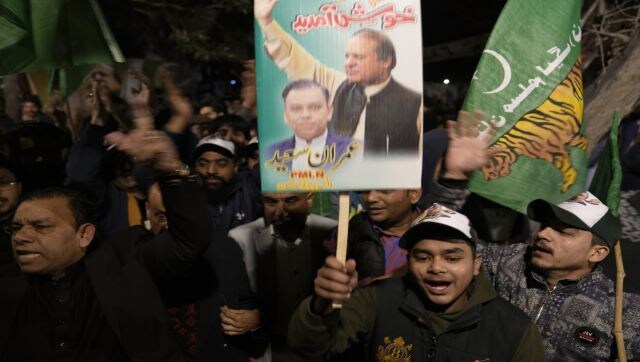 Supporters of Pakistan's former Prime Minister Nawaz Sharif's party chant slogans outside party headquarters in Lahore, Pakistan. AP[/caption]Prime minister on rotational basis?There’s also talks of a possibility of having a rotational premiership. Pakistan’s GeoTV has reported that the PML-N and the PPP are deliberating the possibility of appointing prime ministers from their parties for a three- and two-year term under a power-sharing formula. What this means is that one party will govern for three years and the other will take charge for the remaining two years.The idea of such a power-sharing method came about on 11 February when leaders of both parties sat down for talks to form a coalition government in the Centre. This formula, interestingly, was used by the PML-N and the National Party (NP) in Balochistan in 2013 when two chief ministers from the two parties held office for half of the five-year term.What about the PTI and the ‘independents? And amid talks of a possible PML-N and PPP alliance, there’s also a third possible route. That of the PTI-backed ‘independents’ joining hands with the PPP and other smaller parties.In fact, this idea has gathered some steam after senior PPP leader Sherry Rehman said that the party’s doors are open to all political forces.However, it seems very unlikely that the PTI will form an alliance with the PPP.[caption id="attachment_13720512" align="alignnone" width="640"]
 A supporter of former Prime Minister Imran Khan's party, the Pakistan Tehreek-e-Insaf (PTI), adjusts his mask as he and others block the Peshawar-Islamabad motorway as part of their protest demanding free and fair results of the election, in Peshawar, Pakistan. Reuters[/caption]Syed Zulfikar Bukhari, a senior PTI member and an advisor to Imran Khan, said the party is content to take up the position of “kingmaker” due to its number of seats and will do “whatever we want to”.“We will not be aligning with any major party to set up a hodgepodge government in the centre. We have learned from our previous tenure that having a compromised government with allies means being blackmailed daily,” Al Jazeera quoted him as saying.He further added that he does not believe a government formed via an alliance of other parties would last long. “We intend to merge with a party for the sake of putting all our candidates under one banner, and we will be the strongest opposition this country has ever seen,” Bukhari said.
Please also read:Nawaz Sharif, Bilawal Bhutto Zardari & more: The winners and losers of Pakistan pollsHow the military is still man of the match despite Imran Khan’s victory
What comes next?As per Pakistan’s laws, now that the election results are out, Pakistan’s president has to convene the inaugural session of the new National Assembly within 21 days of the election — 29 February. Following this, a new Speaker is elected and he/she will call for the election of the leader of the House, the prime minister.Once the PM is elected, the person takes an oath and the announces his Cabinet. The caretaker PM, who oversees the elections, then hands over power to the new government.Experts believe that any delay in forming the government will only add to the country’s economic concerns. As Bloomberg reported, a nine-month bailout program with the International Monetary Fund, Pakistan’s 23rd since independence in 1947, expires in March, suggesting any new leader will have to negotiate a new deal.With inputs from agencies
First Published:Feb 13, 2024, 13:00:01 IST
Advertisement
Advertisement

Military drones & police check-ups: How Sri Lanka is fighting against worst dengue outbreak in a decade
Sri Lanka is fighting its most severe dengue outbreak in nearly a decade, with infections rising sharply across the nation. Military drones have been deployed to tackle the outbreak, which has claimed 56 lives. Health officials said the outbreak is being driven primarily by the DENV-2 variant of the virus
3 min read
How Facebook job ad lured 2 Karnataka men into Myanmar cyber scam camp
The Karnataka Cyber Command has rescued two youths from a scam compound in Myanmar operated by Chinese fraudsters. The duo from Karnataka were lured on the pretext of data-entry jobs. They were asked to work for 16 hours a day and were expected to sleep for six hours daily
4 min read
Why is India seeing 95% cloud cover despite a Super El Niño?
India is witnessing nearly 95 per cent cloud cover despite a Super El Niño, a climate event usually linked to weaker monsoons. Regional weather systems, cyclonic circulations, the monsoon trough and moisture from two seas are temporarily overpowering one of the world's strongest climate phenomena
5 min read
What is CJP’s fourth demand to the government as protests in Delhi intensify?
The protest by the Cockroach Janta Party at Delhi’s Jantar Mantar refuses to die down. The group have made a fourth demand to the Centre, asking that no FIRs are filed against the agitators and that no legal action be taken. The government has expressed willingness to speak to the protesters, but refused to accede on the resignation of Education Minister Dharmandra Pradhan
5 min read
The new geography of war: Why the Houthis can no longer be ignored
The rise of the Houthis marks the emergence of a new geography of war — one in which influence flows not only from capitals and conventional armies, but also from rugged mountains overlooking vital sea lanes
6 min read
Advertisement
Advertisement