


Why Thomas Massie's loss in Kentucky’s Republican primary is a win for Trump
Donald Trump-backed candidate Ed Gallrein defeated Kentucky Congressman Thomas Massie in one of the most expensive House primaries in US history. Massie’s loss highlighted Trump’s continued dominance over Republican politics and highlighted the risks faced by GOP lawmakers who openly challenge the US president

United States President Donald Trump secured a major victory at one of the Republican primaries of the 2026 election cycle after Kentucky Congressman Thomas Massie was defeated by Trump-endorsed challenger Ed Gallrein in a historically expensive contest.
Massie’s defeat was not simply another congressional primary loss. The race had become a litmus test of Trump’s continued dominance over Republican voters.
For years, Massie had built a reputation as one of the most unconventional Republicans in Congress — a libertarian-minded conservative who repeatedly broke with party leadership and, increasingly, with Trump himself.
His willingness to oppose spending bills, criticise foreign military interventions and press for the release of the Jeffrey Epstein files made him a unique figure inside the Republican party.
 More from Explainers
But in today’s GOP, where loyalty to Trump remains a defining political force, Massie’s independent streak ultimately became his biggest vulnerability.
The Kentucky result is now being interpreted as another warning to Republicans nationwide that crossing Trump can still carry severe political consequences, even in safe conservative districts and even for long-serving incumbents.
How Kentucky turned into a national political battleground
Massie had represented Kentucky’s 4th Congressional District since 2012 and had long appeared secure in the deeply Republican seat. Before Trump’s involvement, few viewed the district as vulnerable territory for the congressman.
That changed when Trump personally entered the race and endorsed Gallrein, a former Navy SEAL who built his campaign almost entirely around support for the president and loyalty to the Maga movement.
The contest soon escalated into the most expensive House primary race in US history, drawing enormous national attention and millions of dollars in outside spending.
Gallrein framed Massie as a Republican who had abandoned Trump and repeatedly obstructed the party’s agenda in Washington. Trump amplified that message through relentless public criticism, repeatedly attacking Massie on social media and portraying him as disloyal to the Republican base.
As the campaign reached a boiling point, the White House and Trump allies treated the Kentucky primary as a referendum on party unity and Trump’s authority within the GOP.
Gallrein eventually emerged victorious, delivering Trump another major win against a Republican who had openly challenged him.
After the result became clear, Trump declared, “He [Massie] was a bad guy. He deserves to lose.” White House communications director Steven Cheung also celebrated the outcome online, posting, “Do not ever doubt President Trump and his political power.”
Gallrein, meanwhile, used his victory speech to thank Trump for his support and political backing. The US president had visited Kentucky earlier in the campaign season to boost Gallrein’s candidacy and remained deeply involved until Election Day.
The former Navy SEAL also campaigned alongside Defence Secretary Pete Hegseth during the final stretch of the race.
Gallrein is now heavily favoured to defeat Democrat Melissa Strange in the general election in the Republican-dominated district.
Why Trump targeted Massie so aggressively
Among Republicans in Congress, Massie had become one of the few lawmakers consistently willing to oppose Trump publicly and substantively.
Unlike many Republicans who eventually aligned themselves fully with the Maga movement, Massie often prioritised his libertarian and constitutional conservative beliefs over party discipline.
One of the biggest flashpoints between Trump and Massie involved government spending. Massie voted against Trump’s major tax legislation last year because he believed the package would worsen America’s fiscal situation and expand the national debt.
The Kentucky congressman frequently argued that Republican lawmakers claiming to support fiscal conservatism were abandoning those principles.
Massie also opposed several aspects of Trump’s foreign policy approach. He criticised military involvement in Iran and Venezuela and regularly voted against foreign aid measures, including assistance packages for Israel.
Those positions made him increasingly isolated within the Republican Party.
Working alongside Democratic Congressman Ro Khanna, Massie continued pressing the Justice Department to release files connected to Jeffrey Epstein. The issue generated sustained attention and became politically uncomfortable for the White House.
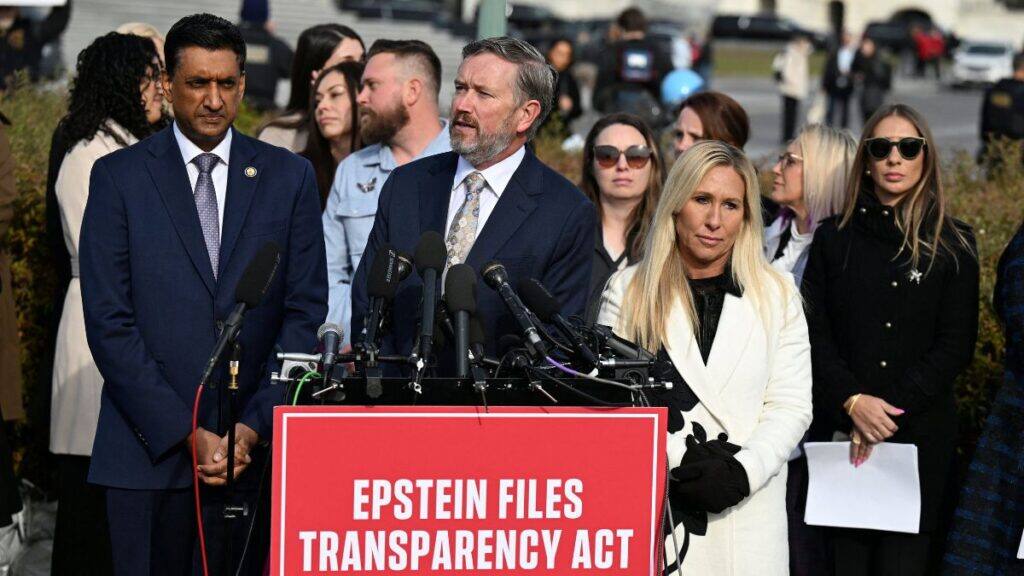
Trump responded angrily, at one point calling Massie a “lowlife” as the congressman continued pushing the issue publicly.
Massie’s repeated willingness to defy Trump on major political and legislative battles transformed him into one of the president’s most visible Republican critics on Capitol Hill.
How Massie’s entered politics & rose in Congress
Massie was never a traditional Republican lawmaker.
An engineer by education, he became known in Washington not only for his political positions but also for his highly unconventional personal lifestyle and independent political identity.
Before entering Congress, Massie developed several patents and technological inventions. One of his better-known creations was a debt calculator that tracked America’s rising national debt in real time.
A miniature version of that calculator often appeared pinned to his suit jacket during congressional appearances.
Massie and his late wife Rhonda built a largely self-sufficient lifestyle in Kentucky, living in a solar-powered off-grid home they designed themselves.
The congressman raised cattle, drove an early Tesla vehicle and became popular among libertarian-minded conservatives who admired his emphasis on self-reliance and limited government.
Inspired politically by fellow Kentuckian Rand Paul, Massie eventually entered politics himself.
After winning election to Congress during the Tea Party era in 2012, he quickly gained attention for his refusal to follow Republican leadership automatically. Although he shared many conservative positions with members of the House Freedom Caucus, he chose not to formally join the group.
Over time, Massie established himself as one of the most unpredictable Republican lawmakers in Congress — willing to vote against both Democratic and Republican priorities when he believed legislation violated constitutional or fiscal principles.
That independence helped build his national profile but also repeatedly created friction with party leaders and eventually with Trump.
How Massie had been on Trump's hit list for years
The political conflict between Trump and Massie did not begin during the 2026 primary. Their tensions stretched back to Trump’s first presidential term.
One of the earliest and most dramatic confrontations occurred in 2020 during debate over a $2.2 trillion coronavirus relief package. Massie objected to approving the measure through voice vote and demanded a formal recorded vote instead.
His decision forced hundreds of lawmakers to return physically to the Capitol during the pandemic. Trump erupted publicly, calling Massie a “third rate Grandstander.”
Although many Republicans eventually reconciled themselves fully to Trump’s political movement, Massie continued charting his own course. The relationship between the two men deteriorated further in the years that followed.
Trump’s criticism even extended into Massie’s personal life. After Massie’s wife Rhonda died in 2024, the congressman announced in 2025 that he had remarried Carolyn Grace Moffa, a former staffer for Rand Paul.
Trump later mocked Massie online over the remarriage, writing that "his wife will soon find out that she’s stuck with a LOSER!”
Despite those attacks, Massie remained politically resilient for years because of his popularity among many Kentucky conservatives and his image as a politician who refused to bend to party pressure.
However, once Trump formally endorsed Gallrein, the race fundamentally changed.
How the Kentucky GOP primary became the most expensive in US history
The Kentucky primary attracted extraordinary levels of outside money and became one of the most closely watched congressional races in the country.
Massie’s opposition to foreign aid for Israel became a major issue in the contest.
Although Massie repeatedly argued that he opposed foreign aid broadly and denied accusations of antisemitism, pro-Israel organisations heavily targeted him during the campaign.
Groups supportive of Israel, including the Republican Jewish Coalition Victory Fund and organizations linked to AIPAC, spent millions of dollars backing efforts against Massie.
According to campaign tracking data, approximately half of the outside spending supporting Gallrein came from pro-Israel interests.
Massie frequently addressed the issue during campaign appearances, arguing that his views were consistent with his broader opposition to overseas spending and foreign military involvement.
The issue even surfaced during his concession speech after the election. “I would have come out sooner, but I had to call my opponent and concede and it took a while to find Ed Gallrein in Tel Aviv,” Massie told supporters.
The race became increasingly bitter during its final weeks. Massie attempted to reassure Republican voters that supporting him did not amount to opposing Trump.
He brought in Republican allies, including Lauren Boebert, to campaign on his behalf and demonstrate that he still had support from parts of the conservative movement.
After Boebert publicly endorsed Massie, Trump used social media to call for a Republican challenger against her, despite filing deadlines already having passed in Colorado. “Anybody that dumb deserves a good Primary fight!” Trump wrote.
How a pattern is emerging
Just days before Massie’s loss, Louisiana Senator Bill Cassidy failed to advance after struggling to repair his relationship with Trump following his vote to convict the president during Trump’s second impeachment trial.
Trump also successfully backed challengers against several Indiana Republicans who opposed his preferred redistricting plan.
Meanwhile, the president continued influencing races across multiple states.
In Kentucky’s Senate primary, Trump-endorsed Congressman Andy Barr won the Republican nomination to replace retiring GOP leader Mitch McConnell.
Barr defeated former Kentucky Attorney General Daniel Cameron in what many Republicans viewed as a symbolic generational transition within the party.
Both Barr and Cameron had previously maintained ties with McConnell, but throughout the campaign they carefully distanced themselves from the longtime Senate leader while simultaneously embracing Trump and the MAGA movement.
McConnell, who became the longest-serving Senate leader in American history, had increasingly found himself out of step with many Republican voters aligned with Trump’s “America First” movement.
In Georgia, Trump backed Lieutenant Governor Burt Jones in the Republican gubernatorial primary, while billionaire businessman Rick Jackson spent tens of millions of dollars attempting to counter Trump’s political weight.
In Alabama, Trump endorsed Congressman Barry Moore in the Senate race to replace Tommy Tuberville, who is running for governor.
And in Texas, Trump endorsed Attorney General Ken Paxton in his challenge against incumbent Senator John Cornyn.
Taken together, the developments have spotlighted Trump’s continued ability to influence Republican primaries nationwide and determine which politicians remain viable within the party.
What next for Massie
Even after suffering defeat, Massie remained unapologetic about his political approach.
Speaking before an energetic crowd after the results were announced, the congressman defended his record and argued that America still needed politicians willing to place constitutional principles above party loyalty.
“We stirred up something. There is a yearning in this country for someone who will vote for principles over party,” Massie told supporters during a speech that lasted more than 20 minutes.
The crowd repeatedly chanted slogans including “America First!” and “no more wars.”
Massie also issued a warning about lawmakers blindly following presidential authority. “If the legislative branch always votes whichever way the wind is blowing, then we have mob rule,” he said.
“But if lawmakers follow the Constitution, we have a republic.”
At another moment in the speech, he declared, “If the legislative branch always votes with the president, we do have a king.”
Supporters responded with chants of “2028!” and “President!” leading to speculation about Massie’s future political ambitions.
“You’ve made a compelling argument,” Massie replied. “We’ll talk about it later.”
With inputs from agencies

Military drones & police check-ups: How Sri Lanka is fighting against worst dengue outbreak in a decade
How Facebook job ad lured 2 Karnataka men into Myanmar cyber scam camp
Why is India seeing 95% cloud cover despite a Super El Niño?
What is CJP’s fourth demand to the government as protests in Delhi intensify?
The new geography of war: Why the Houthis can no longer be ignored