


Why ‘monster’ robot wolves are being deployed across farms and schools in Japan
Japan is witnessing a surge in demand for the 'Monster Wolf' robot as deadly bear attacks and wildlife sightings hit record levels. The animatronic wolf, equipped with flashing LED eyes and loud deterrent sounds, is now being used by farmers, schools and local authorities to keep bears away

Japan is witnessing a sharp rise in demand for a robotic wolf-like device designed to scare away bears and other wild animals, as the country grapples with a record surge in deadly bear encounters and wildlife sightings.
The animatronic machine, known as “Monster Wolf”, is manufactured by Hokkaido-based Ohta Seiki and is increasingly being deployed across rural and semi-urban parts of Japan to keep bears and other wild animals away from farms, schools, roads, golf courses and residential zones.
The surge in orders has become so intense that the company says it is struggling to keep up with production.
What is behind the robot wolf surge in Japan?
Japan experienced its deadliest year on record for bear-related incidents during fiscal year 2025, which ended in March 2026. Official figures showed that 13 people lost their lives in attacks by bears, surpassing the previous record of six deaths reported in 2023.
 More from Explainers
The overall number of casualties — including both deaths and injuries — climbed to 238, exceeding the previous high of 219 recorded two years earlier.
The crisis has continued into 2026. Japanese authorities last week confirmed the first fatal bear attack of the year, while two additional deaths were also being investigated as suspected bear-related incidents.
At the same time, sightings of bears have risen sharply across the country. Government data showed that 50,776 sightings were recorded nationwide during fiscal 2025. The figure represented more than double the previous record of 24,348 logged only two years earlier.
Encounters between humans and bears are no longer limited to remote forests or mountain regions. In recent months, the animals have been spotted in a range of public spaces and populated areas.
Reports from across Japan described bears appearing on airport runways, roaming through golf courses, approaching schools, wandering into residential neighbourhoods and causing alarm inside supermarkets and hot spring resorts.
In response to the growing threat, authorities significantly increased capture and culling operations. The number of bears trapped and killed rose to nearly 14,700 in 2025, almost three times higher than the previous year and another record high.
Several northern prefectures also reported a dramatic increase in sightings after bears emerged from hibernation this spring.
According to local media reports, some regions saw more than four times as many sightings in April compared with the same month a year earlier.
What is the “Monster Wolf”?
The “Monster Wolf” machine was originally developed in 2016 by Yuji Ohta as a method to reduce damage caused by wild deer, boars and bears to agricultural land and crops. At the time, many people reportedly viewed the invention as little more than a novelty.
A decade later, however, the robot is increasingly being regarded as a practical safety measure.
Ohta Seiki has already received approximately 50 orders during the first months of 2026 — a number that usually matches the company’s total annual sales.
“We make them by hand. We cannot make them fast enough now. We are asking our customers to wait two to three months,” Ohta told AFP.
The buyers are no longer limited to farmers. Orders are now coming from golf course operators, construction firms, local authorities and people working outdoors in rural areas where encounters with bears have become more frequent.
“Awareness of bear safety and measures against wildlife damage (on farm products) improved. There was also a growing recognition that our product is effective in dealing with bears,” Ohta said.
How does Japan's robot wolf work?
The “Monster Wolf” has been designed to trigger fear and confusion among wild animals through a combination of movement, sound and visual effects.
The device features artificial fur attached to a metal or pipe-based frame and is topped with a large wolf-like head with an open mouth and sharp-looking teeth. Its appearance is intended to resemble a threatening predator.
When its infrared motion sensors detect movement nearby, the robot activates automatically.
The machine rotates its head from side to side while flashing bright red LED eyes. Blue LEDs installed on the tail add to the visual effect, particularly during nighttime operation.
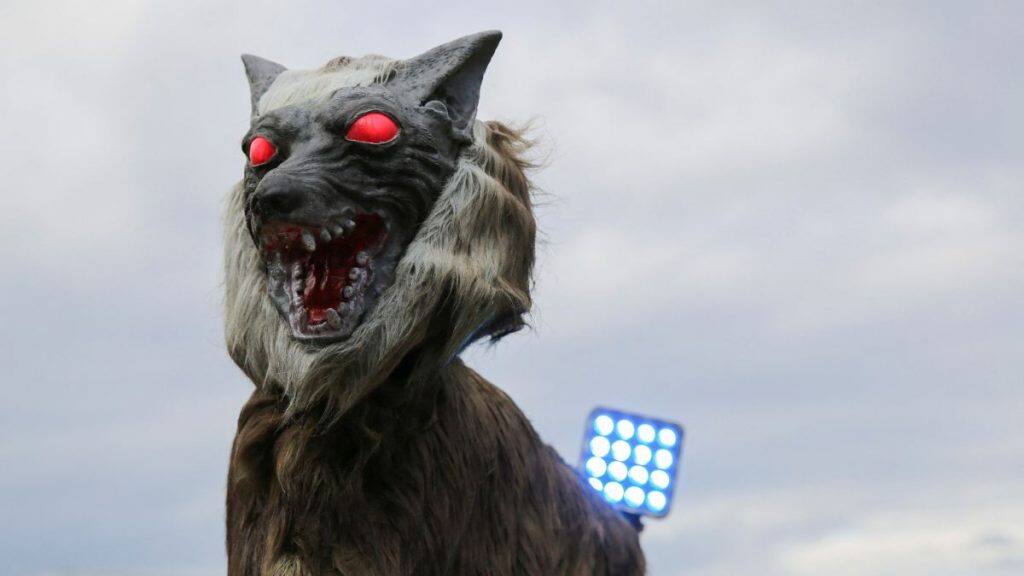
Its sound system is among its most distinctive features. The device can emit more than 50 different sounds, including wolf howls, electronic noises, gunshot-like sounds and recorded human voices.
The audio output can reportedly reach about 110 decibels and may be heard from distances of up to one kilometre away.
Developers say the variety of noises is important because it reduces the chances of animals becoming accustomed to repeated sound patterns over time.
The units are usually equipped with batteries, solar panels, speakers and sensor systems, enabling them to function in isolated outdoor environments without continuous human supervision.
Prices for the system begin at around 600,000 yen, or roughly $4,000, depending on installation and maintenance requirements.
Beyond its technological role, the “Monster Wolf” also carries symbolic significance in Japan.
The country’s native wolf species became extinct in the early 20th century after years of hunting and eradication campaigns. Wildlife researchers have long debated the ecological impact created by the disappearance of a natural apex predator.
The robotic device effectively imitates the appearance and sounds of a predator that no longer exists in Japan’s forests, serving as a mechanical substitute intended to deter animals that once feared wolves naturally.
Why are bear encounters increasing in Japan?
Scientists and researchers studying wildlife behaviour say the current situation is being driven by several overlapping environmental and demographic factors.
One major issue is depopulation in rural Japan. As villages shrink and the average age of residents rises, large areas of farmland and vegetation surrounding communities are no longer being maintained.
These zones — historically serving as transitional areas between forests and human settlements — are increasingly overgrown.
The disappearance of these natural buffers has allowed bears to move closer to residential neighbourhoods and populated areas.
Experts also point to climate-related disruptions affecting food supplies for wildlife. Bears rely heavily on nuts such as acorns and beechnuts before and after hibernation. Poor harvests linked to changing weather conditions are believed to be forcing bears to travel further in search of food.
Researchers have additionally noted behavioural shifts among Japan’s bear population. According to biologists, many bears now appear less wary of human activity than in previous decades.
This change is reflected in the growing number of sightings in locations once considered highly unusual for wildlife activity, including airports, commercial areas and urban facilities.
From agricultural tool to public safety device
Will future versions of the "Monster Wolf" use AI?
The company is now developing several upgraded versions of the “Monster Wolf” system in response to growing interest.
One upcoming model is expected to include wheels, allowing the device to move along designated routes or patrol fences and pathways autonomously.
Ohta Seiki is also researching the use of artificial intelligence-equipped cameras that could identify specific animals before triggering tailored deterrent sounds.
Such systems could potentially distinguish bears from smaller animals or domestic pets, improving efficiency and reducing unnecessary activation.
The company has additionally explored the development of compact portable versions aimed at hikers, anglers and schoolchildren.
A smaller “Monster Wolf Mini” prototype was reportedly introduced in late 2024 before being launched for personal outdoor use.
“We wanted to apply our manufacturing to do our part to deal with bears,” Ohta said.
With inputs from agencies

Military drones & police check-ups: How Sri Lanka is fighting against worst dengue outbreak in a decade
How Facebook job ad lured 2 Karnataka men into Myanmar cyber scam camp
Why is India seeing 95% cloud cover despite a Super El Niño?
What is CJP’s fourth demand to the government as protests in Delhi intensify?
The new geography of war: Why the Houthis can no longer be ignored