


Why is Trump’s top army general retiring?
The retirement of General Christopher Donahue, the last US soldier to leave Afghanistan, has spotlighted Defence Secretary Pete Hegseth’s sweeping overhaul of military leadership. Donahue will retire on July 2, 2026, after 18 months leading US Army Europe and Africa

The retirement of General Christopher Donahue, one of the United States military’s most experienced combat commanders and the senior American army officer overseeing Europe and Africa is the latest chapter in a sweeping transformation of the Pentagon under President Donald Trump’s second administration.
Donahue’s departure, scheduled for July 2, comes after only 18 months in one of the military’s most influential commands.
While the Army’s official announcement offered no explanation for his exit, multiple reports indicate that his retirement followed a request from US Defence Secretary Pete Hegseth, whose tenure has been marked by an unprecedented restructuring of the military’s senior leadership, The Atlantic first reported.
US Army spokeswoman Cynthia Smith confirmed that Donahue “will relinquish command on July 2, 2026,” while noting that Major General Christopher Norrie, currently his deputy, would assume responsibility for the command on an interim basis.
 More from Explainers
“The Army thanks Gen. Donahue for his leadership of US Army Europe and Africa,” Smith said. The statement did not explain why the general was stepping down after such a short period in office.
The brevity of the announcement contrasted sharply with the significance of the role Donahue occupies. He currently commands US Army Europe and Africa, one of the Army’s most strategically important overseas formations.
Simultaneously, he serves as commander of Nato’s Allied Land Command, placing him at the centre of coordination between the United States and its European allies at a time of continuing tensions with Russia and ongoing support for Ukraine.
The latest departure in a wider Pentagon overhaul
Since US President Donald Trump returned to the White House, senior military leadership has undergone extensive changes. The administration has repeatedly argued that presidents are entitled to select military leaders who reflect their priorities and strategic vision.
Under Hegseth, however, the pace and scale of leadership turnover have attracted unusual attention.
Among the most notable departures was General Charles “CQ” Brown, who served as chairman of the Joint Chiefs of Staff before being removed from the post in February 2025. Brown’s dismissal also came without a public explanation.
Other senior officers who have either been removed, retired, or seen their careers curtailed include General Randy George, the Army’s chief of staff; Admiral Lisa Franchetti, the Navy’s top uniformed officer; General Timothy Haugh, who led both the National Security Agency and US Cyber Command; the vice chief of staff of the Air Force; a Navy admiral assigned to NATO; and several senior military lawyers.
The chief of staff of the Air Force also announced his retirement despite being only halfway through a four-year term, while the commander of US Southern Command left his position after roughly a year.
Donahue is therefore one among more than two dozen senior military leaders who have departed under Hegseth’s watch.
The defence secretary has consistently defended these moves, arguing that they reflect the administration’s effort to reshape military leadership rather than an attempt to politicise the armed forces.
Democratic lawmakers, however, have expressed concern that the removals risk undermining the military’s tradition of political neutrality.
Hegseth’s vision: fewer generals, more troops
The retirement of Donahue is closely linked to a restructuring programme that Hegseth has promoted since taking office. The Pentagon chief has repeatedly pointed out the need to reduce the number of senior officers while directing resources toward frontline troops.
Reports indicate that Hegseth has blocked extensions, promotions and advancement opportunities for several senior officers whose careers otherwise appeared likely to continue.
Last year he ordered a reduction of at least 20 per cent in active-duty four-star generals and admirals across the armed forces. He also directed a 10 per cent cut in the overall number of general and flag officers.
Within this context, Donahue’s retirement is viewed by many observers as part of a deliberate effort to reduce the size and influence of the military’s senior leadership structure.
Multiple reports suggest that efforts were made behind the scenes by Army officials and supporters on Capitol Hill to identify another senior position for Donahue, including potential opportunities within Army leadership in Washington.
Those efforts reportedly failed. As a result, the general’s options for continued service narrowed considerably.
Donahue in Afghanistan
Although no official reason has been offered for his departure, Donahue’s role in the final stages of America’s war in Afghanistan has remained in the spotlight politically.
Donahue became known around the world on August 30, 2021, when he became the last American soldier to board the final evacuation aircraft leaving Kabul.
The image of him walking toward a C-17 transport aircraft through the darkness, captured through night-vision equipment, quickly became one of the defining photographs of the war’s conclusion.
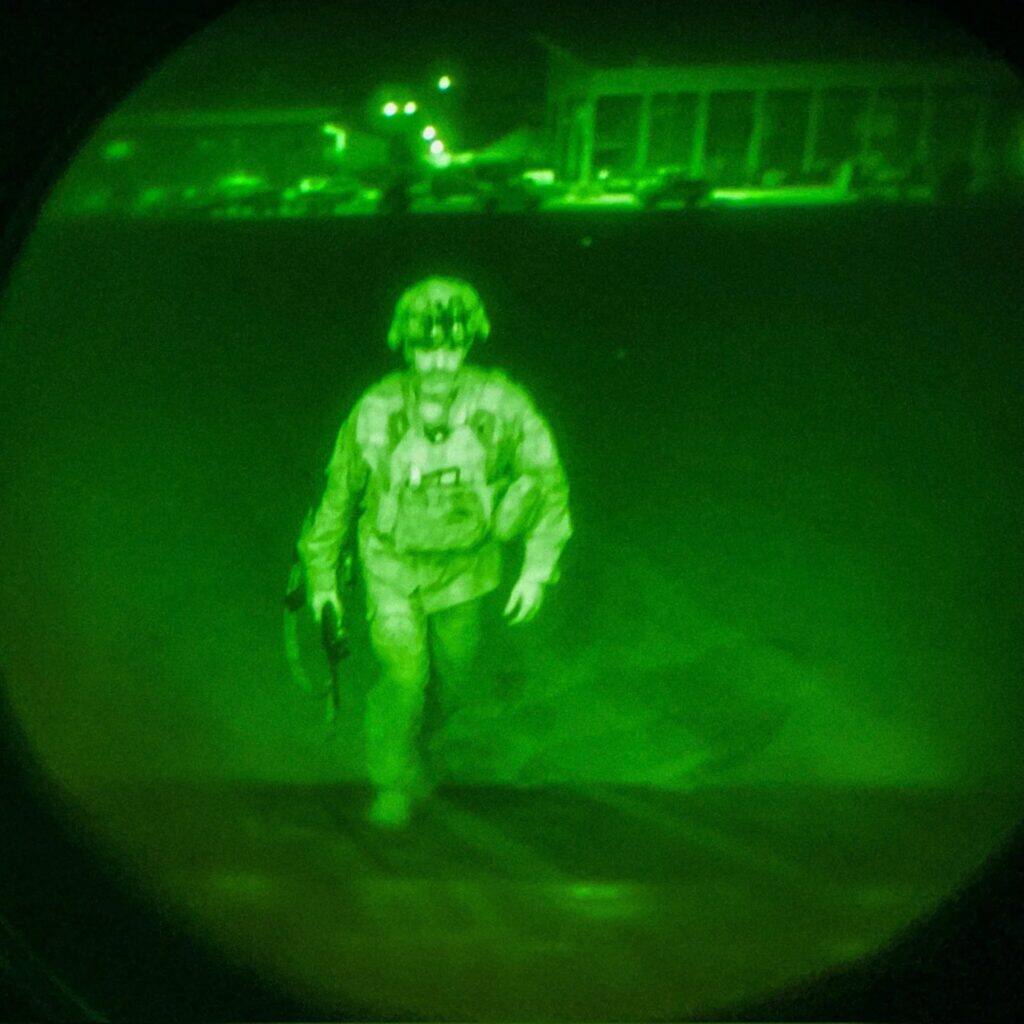
At the time, Donahue commanded the 82nd Airborne Division. He had been deployed to oversee security operations at Hamid Karzai International Airport during the chaotic final phase of the evacuation effort.
The mission unfolded under extraordinary pressure as American forces worked to evacuate US citizens, allied personnel and vulnerable Afghans while Taliban fighters entered Kabul and government institutions collapsed.
During the operation, approximately 124,000 Afghan citizens were evacuated from the country. The withdrawal remains controversial because of the speed of events and the collapse of the Afghan government. However, Donahue’s conduct during the evacuation earned praise from figures across the political spectrum.
Reports also note that Marines, rather than forces under Donahue’s direct command, were responsible for security at Abbey Gate, where an ISIS-K suicide bomber carried out an attack that killed 13 American service members and roughly 170 Afghan civilians.
Nevertheless, because Donahue became the public face of the final evacuation, his name remains closely associated with one of the most politically charged episodes of recent American foreign policy.
Why the Afghanistan issue remains relevant
Trump has spent years criticising former US president Joe Biden over the manner in which the withdrawal was conducted. The issue has remained a recurring political theme for the president and many of his allies.
Hegseth has also taken a strong interest in the matter. Last year, the defence secretary directed a fresh investigation into the withdrawal despite previous reviews conducted by the Pentagon, US Central Command, Congress and the State Department.
According to reports, Donahue’s connection to the withdrawal resurfaced during discussions about future military appointments. When a vacancy emerged at US European Command, Donahue was reportedly regarded by many within traditional Army circles as a leading candidate.
However, reports indicate that his role in Afghanistan became part of the conversation surrounding the selection process. Ultimately, Air Force Lieutenant General Alexus Grynkewich was nominated instead.
Critics of the 2021 withdrawal have also targeted Donahue directly. Some political figures aligned with the administration argued that he received recognition for an operation they viewed as flawed.
Whether those criticisms directly influenced decisions regarding his future remains unclear, but the Afghanistan connection continues to shadow discussions about his retirement.
From special operations commander to four-star general
A graduate of the United States Military Academy at West Point, Donahue was commissioned as an Army officer in 1992. Over the years, he became one of the military’s most experienced battlefield leaders.
His career included service in Iraq, Afghanistan, Syria and other conflict zones. He commanded elite Delta Force units during some of the most demanding periods of America’s post-9/11 wars and later rose through increasingly senior leadership positions.
Following his special operations assignments, he commanded the 82nd Airborne Division from July 2020 until March 2022. He subsequently led the XVIII Airborne Corps before being selected by Biden to head US Army Europe and Africa in December 2024.
Within military circles, Donahue was widely regarded as one of the Army’s most accomplished operational commanders. His extensive combat experience distinguished him from many of his contemporaries.
Some observers even viewed him as a potential future chairman of the Joint Chiefs of Staff.
How US' priorities in Ukraine and Nato may have been a factor
As commander of US Army Europe and Africa, Donahue played an important role in coordinating military support for Ukraine following Russia’s invasion. The command has served as a major hub for logistics, planning, intelligence sharing and military assistance related to the conflict.
Officials familiar with Donahue’s work reportedly viewed him as one of the Army’s leading authorities on modern drone warfare because of his involvement in studying and responding to developments on the Ukrainian battlefield.
At the same time, the Trump administration has increasingly pressed European governments to assume greater responsibility for regional defence. That approach has raised questions about the future size and structure of the American military presence on the continent.
Donahue’s departure coincides with discussions regarding a potential downgrade of US Army Europe and Africa from a four-star command to a three-star command.
Speaking to Nato officials in Brussels, Hegseth made clear that the review is intended to assess whether European allies are doing enough to support their own defence.
“This will be a real review. It will be designed to ensure that Nato is moving fast and irreversibly toward Europe leading, stepping up to take primary responsibility for the defense of Europe,” he said.
“It’s a review that some countries will fail and others will pass with flying colors.” The review is expected to examine force posture, military commitments and alliance responsibilities across the continent.
What next
The removal of a commander with Donahue’s credentials has generated concern among current and former military officers.
His retirement follows the firing of Army chief of staff General Randy George and comes amid continuing turnover at the highest levels of the armed forces.
Several former military leaders have reportedly argued that the cumulative effect of these personnel changes has created uncertainty throughout the officer corps. Reports citing former senior officers suggest that many within the military believe the atmosphere surrounding leadership appointments has become increasingly tense.
The concerns are particularly notable because Donahue enjoyed a reputation that extended across different branches and communities within the armed forces. His standing among both conventional Army units and elite special operations formations made him one of the military’s most broadly respected officers.
With inputs from agencies

Military drones & police check-ups: How Sri Lanka is fighting against worst dengue outbreak in a decade
How Facebook job ad lured 2 Karnataka men into Myanmar cyber scam camp
Why is India seeing 95% cloud cover despite a Super El Niño?
What is CJP’s fourth demand to the government as protests in Delhi intensify?
The new geography of war: Why the Houthis can no longer be ignored