


Why are Greenlanders protesting against the new US consulate in Nuuk?
The opening of a larger US consulate in Greenland’s capital Nuuk has resulted in protests and renewed concerns over President Donald Trump’s Arctic ambitions. Demonstrators accused Washington of trying to expand its influence over the strategically important island amid rising Nato tensions

The inauguration of a larger United States consulate in Greenland’s capital Nuuk have resulted in protests on the Arctic island.
The diplomatic opening, which under ordinary circumstances would have been viewed as a routine upgrade of facilities, came against the backdrop of repeated statements by US President Donald Trump about the strategic importance of Greenland and his administration’s desire to "own" it.
Those comments have alarmed leaders in Greenland and Denmark and generated visible resistance among ordinary Greenlanders.
On Thursday, hundreds of demonstrators marched through Nuuk carrying Greenlandic flags and anti-American banners while chanting slogans opposing US involvement in the territory.
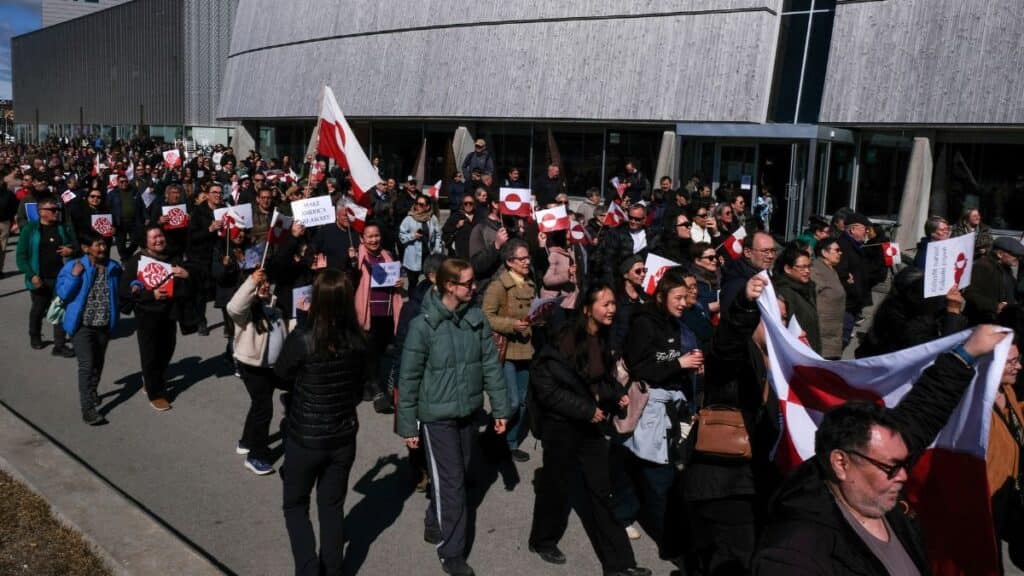
Protesters gathered near the new consulate building and outside Greenland’s parliament, accusing Washington of attempting to expand its footprint under the cover of diplomacy and economic cooperation.
 More from Explainers
The protests came only days after Louisiana Governor Jeff Landry, acting as Trump’s special envoy to Greenland, travelled to Nuuk with an American delegation.
His visit, coupled with remarks about increasing US security operations and “putting its footprint back on Greenland”, also resulted in criticism from Greenlanders who were already uneasy about Washington’s intentions.
Why did Greenlanders protest against the new US consulate?
The United States had already maintained a consulate in Greenland’s capital from a relatively modest traditional-style structure.
However, the relocation to a much larger and more visible office tower in central Nuuk was interpreted by many Greenlanders as a sign of Washington’s increasing strategic ambitions on the island.
As the inauguration ceremony took place inside the new building, hundreds gathered in the streets outside. Protesters held placards carrying messages including “USA, stop it”, “USA Asu”, “We don’t want your money”, and “Greenlanders know a MAGA Trojan horse when we see one.”
Demonstrators also shouted “Go home”, “No means no”, and “Greenland belongs to the Greenlanders.”
Several senior Greenlandic politicians deliberately distanced themselves from the opening. Greenland Prime Minister Jens-Frederik Nielsen and multiple ministers declined invitations to attend the ceremony.
“We haven't made a decision in principle, but I won't participate,” Nielsen told local daily Sermitsiaq.
The protests were organised partly by local activist and IT account manager Aqqalukkuluk Fontain, who said the demonstration aimed to communicate Greenlanders’ opposition to outside pressure over the island’s future.
“It’s very important, now more than ever, to show the American people what we already said, that no means no, and that the future and self-determination of Greenland belongs to the Greenlandic people,” Fontain said, quoted by The Guardian.
He added, “The protest itself is not to provoke Donald Trump or Jeff Landry but to show the world that Greenland has its own democracy.” Fontain also warned that Greenland’s geopolitical importance meant the issue extended beyond local politics.
“It is very dangerous what the United States is trying to do, because if Greenland falls, the world will fall and it might lead to world war three,” he said.
The protest movement was also fuelled by frustration over the conduct of Landry’s visit to Nuuk earlier in the week.
During his trip, Landry reportedly attempted informal outreach by offering chocolate chip cookies and distributing red Maga caps to residents, though local officials and many Greenlanders reacted negatively.
As guests inside the consulate reportedly ate musk ox hot dogs during the opening event, demonstrators outside continued shouting slogans against the American presence.
How did Jeff Landry’s visit escalate tensions?
Landry arrived in Nuuk accompanied by an American delegation that reportedly included a doctor tasked with assessing Greenland’s healthcare needs.
The inclusion of a medical representative created irritation among some Greenlanders, who interpreted the move as patronising and politically tone-deaf.
The Louisiana governor briefly attended a business conference in Nuuk alongside US Ambassador to Denmark Kenneth Howery before leaving Greenland on Wednesday night.
During the visit, Landry repeatedly emphasised the need for deeper American involvement in Greenland. “It’s time for the US to put its footprint back on Greenland,” he told Agence France-Presse.
He also argued that Greenland required stronger American engagement. “Greenland needs the US. I think that you’re seeing the president talk about increasing national security operations and repopulating certain bases in Greenland,” Landry said.
Those remarks refreshed fears among Greenlanders who remain wary of Trump’s earlier comments about taking control of the island.
Landry nevertheless attempted to portray the United States as a supportive partner that could help Greenland achieve greater economic independence. “I think there are some incredible opportunities that can actually lift Greenlanders from dependency to independence,” he told Sermitsiaq.
“I think that the president of the United States would like to see the country become economically independent. And I think it’s possible here.”
Upon arriving in Greenland, Landry reportedly said Trump had instructed him to “go over there and make as many friends as we can get.” But many Greenlanders felt the visit failed to improve America’s image on the island.
Christian Keldsen, chief executive of Greenland Business Association, criticised Landry’s approach and suggested the envoy underestimated local resentment toward Washington.
“Three months ago Greenland was under threat of invasion and takeover and he [Landry] was one of the people supporting that statement,” Keldsen told The Guardian.
“Then three months later you show up here wanting to make friends, handing out chocolate to children and trying to hand out Maga caps.”
Former US ambassador to Denmark Rufus Gifford also publicly criticised Landry during the Future Greenland conference.
In a video posted online, Gifford said, “He wants Greenlanders to be grateful to Donald Trump. You are way in over your head, man. Way in over your head. Go home.”
Why does the US believe Greenland is important?
Trump has repeatedly described Greenland as essential to US national security, particularly in relation to Russia and China. The island sits along the shortest route between North America and Europe, making it important for missile defence systems, surveillance operations, and Arctic military logistics.
As climate change accelerates the melting of Arctic ice, Greenland’s location has become even more valuable. New maritime routes are gradually becoming accessible, increasing commercial and military interest in the region.
The island is also attracting global attention because of its reserves of rare-earth minerals, which are critical for advanced technology, renewable energy systems, and defence manufacturing.
The United States currently operates Pituffik Space Base in Greenland, its only remaining military installation on the island. However, during the Cold War, Washington maintained approximately 17 facilities there.
American military officials are now evaluating options for expanding defence infrastructure in Greenland beyond Pituffik.
A spokesperson for US Northern Command reportedly said Washington was considering “significant investment” in Pituffik while also examining the possibility of establishing additional defence areas elsewhere on the island.
Among the locations under consideration is Narsarsuaq in southern Greenland, though officials stressed that no final decisions have been made.
US Northern Command also indicated interest in deep-water ports, extended airfields, and enhanced maritime surveillance capabilities across the North Atlantic and the Greenland-Iceland-UK Gap.
According to American officials, any future defence expansion would take place under the framework of the 1951 defence agreement involving Denmark.
Trump’s administration has simultaneously argued that Greenland’s strategic importance requires closer US involvement.
Earlier this year, the White House acknowledged that the administration was considering options for increasing control and influence over Greenland, including discussions that reportedly involved potential military measures before the approach shifted toward diplomacy.
Those comments triggered alarm across Europe, particularly among Nato allies concerned about Washington’s willingness to pressure a fellow alliance member.
How have Greenland & Denmark responded to Trump?
Greenlandic and Danish leaders have consistently rejected the idea that Greenland could be sold, annexed, or brought under American control.
Greenland, while largely self-governing, remains part of the Kingdom of Denmark. The territory has broad autonomy over domestic affairs, though Copenhagen retains authority over foreign policy and defence matters.
Following a meeting with Landry earlier this week, Nielsen reiterated Greenland’s position in unequivocal terms. “The Greenlandic people are not for sale. Greenlandic self-determination is not something that can be negotiated,” he said.
At the same time, Greenlandic officials have attempted to maintain constructive relations with Washington.
Nielsen described his meeting with the American delegation as respectful and positive, saying Greenland still sought “good cooperation” with the United States.
Greenland Foreign Minister Múte B Egede also stated that a working group involving Greenland, Denmark, and the United States continues efforts to reduce tensions and find mutually acceptable solutions.
“We haven’t been the ones creating obstacles to cooperation between the United States and Greenland,” Egede said.
“So if we are to continue down this positive and constructive path, we must await the working group’s report.” Egede added that discussions within the working group appeared “more promising” than before.
Greenland’s government also stated earlier this week that progress had been made in negotiations over the island’s future while again insisting that Greenland “belongs to its people and will never be for sale.”
Despite firmly rejecting any transfer of sovereignty, Greenlandic officials have acknowledged the need to manage relations carefully with Washington.
Nielsen recently said Greenland was “obliged to find a solution” with the United States, reflecting the difficult balance between defending self-determination and maintaining ties with a major security partner.
What next for Greenland?
Trump’s push for greater influence in Greenland has unsettled European allies, especially Denmark, which is itself a Nato member.
The issue has become even more sensitive amid growing disagreements inside the alliance over military cooperation and Washington’s broader foreign policy.
US Secretary of State Marco Rubio is expected to discuss tensions within Nato during meetings with alliance foreign ministers in Sweden on Friday.
Before travelling to the Nato gathering, Rubio sharply criticised certain member states for refusing to allow the United States to use military bases on their territory during the Iran conflict.
“You have countries like Spain denying us the use of these bases - well then why are you in Nato?” Rubio said.
Trump has also openly questioned whether the United States should remain fully committed to Nato’s collective defence obligations, while accusing European allies of failing to contribute sufficiently to joint security efforts.
Nato officials have responded by noting that the alliance itself was not formally asked to participate in the Iran conflict, although several members still permitted US forces to use their airspace and facilities.
Against this backdrop, Trump’s focus on Greenland has reinforced European fears about Washington’s increasingly confrontational approach toward allies.
The Arctic dimension of it has also drawn Canada more deeply into regional cooperation. Canadian authorities have reportedly been working with Greenlandic and Danish officials on Arctic security arrangements, including discussions about establishing a local reserve force modelled after Canada’s Rangers.
The Canadian Rangers maintain a permanent presence across remote Arctic regions and are viewed as an important element of northern security infrastructure.
Prime Minister Mark Carney has been strengthening ties with Nordic countries as part of a broader strategy to deepen cooperation among middle powers at a time when confidence in the United States has become more uncertain.
With inputs from agencies

Military drones & police check-ups: How Sri Lanka is fighting against worst dengue outbreak in a decade
How Facebook job ad lured 2 Karnataka men into Myanmar cyber scam camp
Why is India seeing 95% cloud cover despite a Super El Niño?
What is CJP’s fourth demand to the government as protests in Delhi intensify?
The new geography of war: Why the Houthis can no longer be ignored