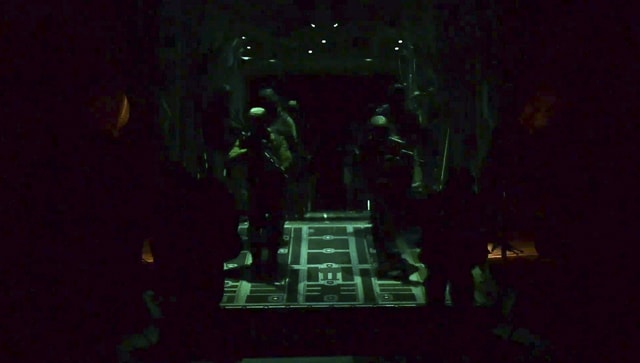
The C-130J Super Hercules transport aircraft of the Indian Air Force made a night landing at the high-altitude Kargil airstrip near the Line of Control (LoC) with Pakistan. This demonstrates the IAF’s capability to conduct specialised missions at any time in the strategically important sector
The Indian Air Force (IAF) recently conducted a successful night landing at the high-altitude Kargil airstrip near the Line of Control (LoC) with Pakistan. The C-130J Super Hercules transport aircraft was used to carry out the feat with the elite Garud commandos on board.“In a first, an IAF C-130 J aircraft recently carried out a night landing at the Kargil airstrip. Employing terrain masking enroute, the exercise also dovetailed a training mission of the Garuds,” the IAF said in a post on X on Sunday (7 January).Why is the IAF aircraft’s night landing in Kargil a big achievement? Let’s understand.
Strategic siteThe night landing of the C-130J Super Hercules aircraft, which US aircraft maker Lockheed Martin produces, exhibited IAF’s operational capabilities in the strategically important sector, sources told the news agency
PTI."This is the first time a fixed-wing aircraft has landed at the Kargil airstrip at night. The C-130J, which employed terrain masking en route, landed with the help of onboard avionics and night-vision devices," an IAF officer was quoted as saying by
Times of India (TOI).The Kargil Advanced Landing Ground (ALG) is situated at an altitude of 9,700 feet, nestled between Dras on the west and Batalik on the east, noted
NDTV.The restricted airstrip with a unidirectional approach is surrounded by rough terrain. The Kargil ALG is crucial as it is the only airstrip in that area making it critical for any emergency, according to
The Hindu.The airstrip had sustained damage from artillery bombing by Pakistani troops during the
1999 Kargil war.What’s terrain masking?Terrain Masking is a technique deployed by pilots to evade detection by enemy radar by using natural or man-made terrain. During C-130J's recent night landing, the IAF used the surrounding hills to hide their movements, reported
NDTV.Why it is a big feat for IAFAn official told
The Hindu that while transport aircraft had been landing at the Kargil airstrip during the day, this was the first time that a night landing was undertaken. The airfield does not have night landing facilities.The tactical lift aircraft was carrying Garud commandos, a special operations unit of the
IAF.“The uniqueness of the Kargil ALG is that it is at about 10,500 feet and the approach is unidirectional. It is surrounded by hills, which gives limited space for manoeuvring. Hence, pulling off a night landing is very difficult,” a source told
ThePrint.The C-130J’s night landing demonstrates IAF’s ability to conduct specialised missions at any time.[caption id="attachment_13589012" align="alignnone" width="640"]
![iaf night landing kargil]()
The night landing demonstrates IAF’s ability to conduct specialised missions at night or day. PTI[/caption]“The aircraft had IAF commandos, the Garuds, on board and it shows the capability to carry out any kind of operation at night or day,” the source added.The successful landing was facilitated by sensors on board the C-130J, as per ThePrint report.Boosting infrastructureThe defence ministry has been upgrading ALGs near the border, especially along the Line of Actual Control (LAC) with China, for the last 10 years, The Hindu reported.The IAF is boosting infrastructure at the Daulat Beg Oldi Advanced Landing Ground (ALG) in Ladakh and Nyoma airstrip. The ALG at Nyoma, which is located at an altitude of about 13,700 feet and is close to the South Bank of Pangong Tso, is being converted into a full-fledged air base for fighter operations.A source told ThePrint that the “full exploitation of the ALGs is crucial for operational needs and this was felt during the ongoing stand-off with China” at LAC.India's relations with two of its neighbours, Pakistan and China, have been tense. Keeping its rivals in mind, New Delhi has been upgrading infrastructure at forward air bases and ALGs, including Thoise, Fukche, Nyoma and Daulat Beg Oldie in the north and Pasighat, Mechuka, Walong, Tuting, Along and Ziro in Arunachal Pradesh, noted TOI.With inputs from agencies