
Advertisement


Sections
Why did Russia sell Alaska to US in 1867? Has Putin declared the decree illegal?
Some on social media are saying Vladimir Putin wants Alaska back from the United States and has signed a decree regarding the same. Let's take a look at the history of Russia's interest in Alaska, why Moscow sold it to Washington and whether there's any truth to the claim

Is Vladimir Putin planning to take back Alaska from the United States?That’s what some on social media claimed after sharing a document allegedly signed by the Russian president.But is it true? And why did Russia sell Alaska to the United States in the first place? And why did America buy Alaska?Let’s take a closer look:Why did Russia sell Alaska to the US?First, let’s briefly examine Russia’s interest in the region.As per the US state department website, this kicked off in 1725 when Peter the Great sent Vitus Bering on an expedition to Alaska’s coast.![]() The swollen Mendenhall River courses along a neighborhood in Juneau, Alaska in August 2023. AP[/caption]While Russia tried to get around this by establishing trade with the Spaniards and even set up shop at Fort Ross in 1812, the firm handling the explorations – the Russian American Company – went bankrupt.The decline of the sea otter populace had also taken a toll on the profitability of the colony.Making things worse was that Alaska was a hard place to defend.Russia also happened to be fighting the Crimean War – which was a huge drain on money.As per the state department, Moscow first made the offer to sell Alaska – then known as Russian America – in 1859.However, the purchase was delayed by the US Civil War.The US finally bought Alaska from Russia in on 30 March, 1867.Seward and Russian minister Edouard de Stoeckl agreed that the US would purchase Alaska for $7.2 million.The agreement was officially known as the Treaty of Cession, as per The Times of India.The US paid Russia in gold for Alaska – which works out to around 2 cents per acre.The US Senate gave its blessing on 9 April, following which then president Andrew Johnson signed the bill on 28 May.The territory came into US possession on 18 October, 1867.Why did the US buy Alaska?Because the US was looking to get expand.According to The Smithsonian, the US in the 1840s took Oregon, Texas and California as its own territory.“Our population is destined to roll resistless waves to the ice barriers of the north, and to encounter oriental civilization on the shores of the Pacific,” Secretary of State William Seward wrote in 1848.“In Alaska, the Americans foresaw a potential for gold, fur and fisheries, as well as more trade with China and Japan. The Americans worried that England might try to establish a presence in the territory, and the acquisition of Alaska – it was believed – would help the US become a Pacific power. And overall the government was in an expansionist mode backed by the then-popular idea of “manifest destiny,” The Smithsonian piece states.But not everyone agreed.
The swollen Mendenhall River courses along a neighborhood in Juneau, Alaska in August 2023. AP[/caption]While Russia tried to get around this by establishing trade with the Spaniards and even set up shop at Fort Ross in 1812, the firm handling the explorations – the Russian American Company – went bankrupt.The decline of the sea otter populace had also taken a toll on the profitability of the colony.Making things worse was that Alaska was a hard place to defend.Russia also happened to be fighting the Crimean War – which was a huge drain on money.As per the state department, Moscow first made the offer to sell Alaska – then known as Russian America – in 1859.However, the purchase was delayed by the US Civil War.The US finally bought Alaska from Russia in on 30 March, 1867.Seward and Russian minister Edouard de Stoeckl agreed that the US would purchase Alaska for $7.2 million.The agreement was officially known as the Treaty of Cession, as per The Times of India.The US paid Russia in gold for Alaska – which works out to around 2 cents per acre.The US Senate gave its blessing on 9 April, following which then president Andrew Johnson signed the bill on 28 May.The territory came into US possession on 18 October, 1867.Why did the US buy Alaska?Because the US was looking to get expand.According to The Smithsonian, the US in the 1840s took Oregon, Texas and California as its own territory.“Our population is destined to roll resistless waves to the ice barriers of the north, and to encounter oriental civilization on the shores of the Pacific,” Secretary of State William Seward wrote in 1848.“In Alaska, the Americans foresaw a potential for gold, fur and fisheries, as well as more trade with China and Japan. The Americans worried that England might try to establish a presence in the territory, and the acquisition of Alaska – it was believed – would help the US become a Pacific power. And overall the government was in an expansionist mode backed by the then-popular idea of “manifest destiny,” The Smithsonian piece states.But not everyone agreed.![]() The signing of the Alaska treaty. Image courtesy: History.state.gov.[/caption]But the discovery of gold in the Yukon in 1896 changed everything.By World War II, Alaska had been recognised as a location of strategic importance.It finally became a state on 3 January, 1959.The US has done quite well from the bargain.As per The Smithsonian, not only did it gain access to 370 million acres of mostly pristine wilderness, but it has also received hundreds of billions of dollars in whale oil, fur, copper, gold, timber, fish, platinum, zinc, lead and petroleum from Alaska.The state likely contains billions of barrels of oil reserves.Has Putin declared the agreement illegal?No.According to Snopes, what actually happened was that Putin on 18 January signed a decree relating to the property of the Russian Federation abroad.
The signing of the Alaska treaty. Image courtesy: History.state.gov.[/caption]But the discovery of gold in the Yukon in 1896 changed everything.By World War II, Alaska had been recognised as a location of strategic importance.It finally became a state on 3 January, 1959.The US has done quite well from the bargain.As per The Smithsonian, not only did it gain access to 370 million acres of mostly pristine wilderness, but it has also received hundreds of billions of dollars in whale oil, fur, copper, gold, timber, fish, platinum, zinc, lead and petroleum from Alaska.The state likely contains billions of barrels of oil reserves.Has Putin declared the agreement illegal?No.According to Snopes, what actually happened was that Putin on 18 January signed a decree relating to the property of the Russian Federation abroad.
Russia found the region both rich in natural resources and without many inhabitants.Meanwhile, the US continued its expansion westward – which caused a rivalry between Americans and Russian explorers and traders.But St. Petersburg did not have the manpower or funds to back major settlements or ensconce its military in Alaska.The Russian populace in Alaska never crossed 400, as per the state departmentThe Smithsonian puts that figure at around 800 people.Regardless, the population itself remained limited to just hundreds of people.According to the magazine, communication with Alaska remained a huge problem for Russia. Another big problem was growing food in Alaska’s harsh climate.[caption id="attachment_12975322" align="alignnone" width="640"]
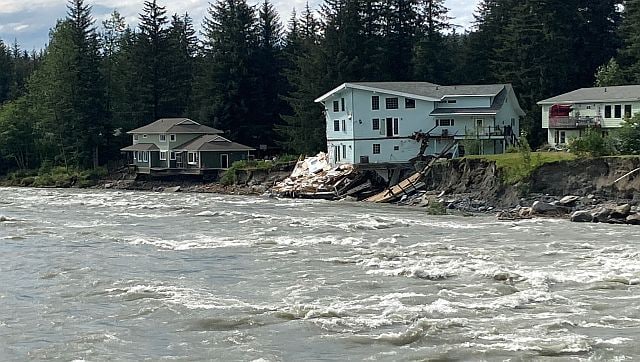 The swollen Mendenhall River courses along a neighborhood in Juneau, Alaska in August 2023. AP[/caption]While Russia tried to get around this by establishing trade with the Spaniards and even set up shop at Fort Ross in 1812, the firm handling the explorations – the Russian American Company – went bankrupt.The decline of the sea otter populace had also taken a toll on the profitability of the colony.Making things worse was that Alaska was a hard place to defend.Russia also happened to be fighting the Crimean War – which was a huge drain on money.As per the state department, Moscow first made the offer to sell Alaska – then known as Russian America – in 1859.However, the purchase was delayed by the US Civil War.The US finally bought Alaska from Russia in on 30 March, 1867.Seward and Russian minister Edouard de Stoeckl agreed that the US would purchase Alaska for $7.2 million.The agreement was officially known as the Treaty of Cession, as per The Times of India.The US paid Russia in gold for Alaska – which works out to around 2 cents per acre.The US Senate gave its blessing on 9 April, following which then president Andrew Johnson signed the bill on 28 May.The territory came into US possession on 18 October, 1867.Why did the US buy Alaska?Because the US was looking to get expand.According to The Smithsonian, the US in the 1840s took Oregon, Texas and California as its own territory.“Our population is destined to roll resistless waves to the ice barriers of the north, and to encounter oriental civilization on the shores of the Pacific,” Secretary of State William Seward wrote in 1848.“In Alaska, the Americans foresaw a potential for gold, fur and fisheries, as well as more trade with China and Japan. The Americans worried that England might try to establish a presence in the territory, and the acquisition of Alaska – it was believed – would help the US become a Pacific power. And overall the government was in an expansionist mode backed by the then-popular idea of “manifest destiny,” The Smithsonian piece states.But not everyone agreed.
Critics dubbed the idea of purchasing Alaska ‘Seward’s Folly.’As per the state department, the government gave Alaska little to no attention over the next 30 years.The US would only establish a civil authority in 1884 – that too for regulating mining laws.For a time, it did look like Alaska was ‘Seward’s Folly’.[caption id="attachment_13648152" align="alignnone" width="640"]
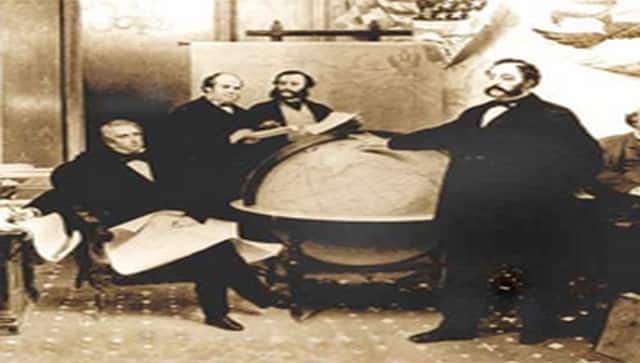 The signing of the Alaska treaty. Image courtesy: History.state.gov.[/caption]But the discovery of gold in the Yukon in 1896 changed everything.By World War II, Alaska had been recognised as a location of strategic importance.It finally became a state on 3 January, 1959.The US has done quite well from the bargain.As per The Smithsonian, not only did it gain access to 370 million acres of mostly pristine wilderness, but it has also received hundreds of billions of dollars in whale oil, fur, copper, gold, timber, fish, platinum, zinc, lead and petroleum from Alaska.The state likely contains billions of barrels of oil reserves.Has Putin declared the agreement illegal?No.According to Snopes, what actually happened was that Putin on 18 January signed a decree relating to the property of the Russian Federation abroad.
The document made no mention of Alaska or that the sale was ‘illegal.’Russian news agency Tass on 19 January reported that Russia will allocate funds for an effort to find, register and ensure legal protection of Russia’s property abroad, including property of the Soviet Union and the Russian Empire.It reported that the decree signed by Putin would allocate funds for this purpose to the Department of Foreign Property of the Administrative Directorate of the President of the Russian Federation.The funds will be allocated to cover expenses related to "the process of searching the real estate property owned by the Russian Federation, the former Russian Empire, the former USSR," as well as for "due registration of [property] rights" and "legal protection of this property."So much for that rumour.However, Snopes quoted the Institute for the Study of War, a nonprofit research group and think-tank as saying, "The Kremlin may use the 'protection' of its claimed property in countries outside of its internationally recognised borders to forward soft power mechanisms in post-Soviet and neighbouring states ultimately aimed at internal destabilisation.So while Putin may not want Alaska back from America, he may have some nefarious ideas in mind.With inputs from agencies
First Published:Jan 23, 2024, 18:52:04 IST
Advertisement
Advertisement

Military drones & police check-ups: How Sri Lanka is fighting against worst dengue outbreak in a decade
Sri Lanka is fighting its most severe dengue outbreak in nearly a decade, with infections rising sharply across the nation. Military drones have been deployed to tackle the outbreak, which has claimed 56 lives. Health officials said the outbreak is being driven primarily by the DENV-2 variant of the virus
3 min read
How Facebook job ad lured 2 Karnataka men into Myanmar cyber scam camp
The Karnataka Cyber Command has rescued two youths from a scam compound in Myanmar operated by Chinese fraudsters. The duo from Karnataka were lured on the pretext of data-entry jobs. They were asked to work for 16 hours a day and were expected to sleep for six hours daily
4 min read
Why is India seeing 95% cloud cover despite a Super El Niño?
India is witnessing nearly 95 per cent cloud cover despite a Super El Niño, a climate event usually linked to weaker monsoons. Regional weather systems, cyclonic circulations, the monsoon trough and moisture from two seas are temporarily overpowering one of the world's strongest climate phenomena
5 min read
What is CJP’s fourth demand to the government as protests in Delhi intensify?
The protest by the Cockroach Janta Party at Delhi’s Jantar Mantar refuses to die down. The group have made a fourth demand to the Centre, asking that no FIRs are filed against the agitators and that no legal action be taken. The government has expressed willingness to speak to the protesters, but refused to accede on the resignation of Education Minister Dharmandra Pradhan
5 min read
The new geography of war: Why the Houthis can no longer be ignored
The rise of the Houthis marks the emergence of a new geography of war — one in which influence flows not only from capitals and conventional armies, but also from rugged mountains overlooking vital sea lanes
6 min read
Advertisement
Advertisement