


Who is Menaka Guruswamy, India’s first openly queer Rajya Sabha MP?
Menaka Guruswamy, a senior Supreme Court advocate, took the oath on Monday (April 6), becoming the country’s first openly queer MP in the Rajya Sabha. The 51-year-old has been fielded by the Trinamool Congress (TMC). For many, Guruswamy’s election is a watershed moment in recognising personal liberty in matters of sexuality

Menaka Guruswamy, senior Supreme Court advocate, has become India's first openly queer Member of Parliament (MP). Guruswamy took oath as a Rajya Sabha MP on Monday (April 6), making a significant moment for LGBTQ+ visibility in India's political life.
The term “queer" is an inclusive word that can refer to gay, lesbian, bisexual, transgender, and other non-heterosexual or non-cisgender identities. Guruswamy proudly identifies as queer.
The 51-year-old was nominated by the Trinamool Congress (TMC), a step widely hailed as progressive. A senior TMC functionary told Deutsche Welle (DW), "With her election, five of the TMC's 13 Rajya Sabha MPs are women." Guruswamy has said she will stand for "equality, fraternity and non-discrimination."
We take a look.
 More from Explainers
Who is Menaka Guruswamy?
Born in Hyderabad in 1974, Guruswamy has established a distinguished legal career and has impeccable academic records.
In 1997, she earned her Bachelor of Laws degree from the National Law School of India. Before heading to Oxford University in 1998 to pursue further law studies, Guruswamy briefly worked with Ashok Desai, then the Attorney General of India.
In 2000, she got a Bachelor of Civil Law degree from Oxford. In 2001, she secured a Master of Laws degree from Harvard Law School. For a thesis on “Constitutionalism in India, Pakistan and Nepal," Guruswamy was awarded a DPhil from Oxford in 2015.
At Oxford, Guruswamy was a Rhodes Scholar and a Gammon Fellow at Harvard. Guruswamy has also been a visiting faculty member at Yale Law School, New York University School of Law, and the University of Toronto Faculty of Law.
After completing her LL.M. at Harvard, she was briefly associated with Davis Polk & Wardwell, a New York law firm.
From 2017 to 2019, at Columbia Law School, New York, Guruswamy was the B.R. Ambedkar Research Scholar and Lecturer. In 2009, she started practising in India and in 2019, Guruswamy was designated as a senior advocate in the Supreme Court.
Her father, Mohan Guruswamy, is a former Adviser to the Ministry of Finance. Meera Guruswamy is Guruswamy's mother and an advertising professional.
In 2019, Guruswamy and her partner, Arundhati Katju, were named in Time Magazine’s list of 100 most influential people. She was also featured among the 100 most influential Global Thinkers for 2019 by Foreign Policy Magazine.
What Guruswamy's election could mean
For many, Guruswamy’s election is a watershed moment in the acknowledgement of personal liberty in matters of sexuality. Vishwa Schoolwallah, an LGBTQ+ rights activist, called Guruswamy’s election "symbolic."
Schoolwallah told DW, "For decades, LGBTQ people in India have often been spoken about in debates on rights and dignity, but rarely represented in the spaces where those decisions are made."
According to Schoolwallah, Guruswamy’s elections may also lead to "meaningful changes, progress, stronger protections against discrimination, and greater dignity for LGBTQ families."
Another activist, Preeti Sharma, asserted, "An openly queer MP in parliament has the potential to broaden public debate, normalise conversations around LGBTQ rights and gradually reshape political attitudes."
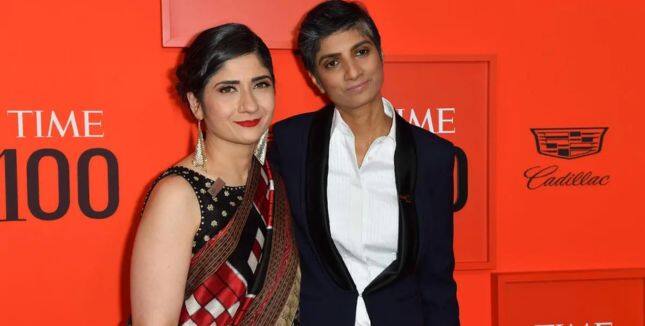
Sharif Rangnekar, a gay rights activist, also welcomed the move, describing it as a "moment that brings greater visibility."
However, he cautioned against presuming that she can automatically speak for an entire community marked by diverse identities, regions, and lived experiences.
"She was ultimately chosen by the TMC to represent the party's political interests. The bigger question is whether she becomes a flag bearer for the community," Rangnekar told the publication.
Activists will closely watch how her role in Parliament evolves and whether it truly translates into substantive and meaningful representation, said Rangnekar.
In past, India has had openly queer politicians. Shabnam Mausi made history in 1998 by becoming the first openly transgender person elected to public office, securing a seat in the Madhya Pradesh State Legislative Assembly from Sohagpur.
Others followed at the state and local levels, making it a vital breakthrough; however, it was still confined to regional bodies.
At any level, no openly queer person has ever sat in any Indian parliament until Guruswamy broke that barrier. However, she is still not a newcomer to political battles.
What are Guruswamy's prominent cases?
Guruswamy's one of the most defining moments of her career remains her role in the Section 377 case. In 2018, she argued for the rights of LGBTQ+ people, contributing to a judgment that reshaped India’s legal and social landscape by scrapping a colonial-era provision.
While making an impassioned plea for Section 377 to be declared unconstitutional in July 2018, Guruswamy argued that by criminalising homosexuality, the colonial-era law violated the fundamental rights of citizens.
"How strongly must you love knowing you are unconvicted felons under Section 377 IPC?” Guruswamy posed a powerful question. The top court was reportedly choc-a-bloc with lawyers, who came to hear her. Guruswamy's strong argument left the entire court in silence, and a few had moist eyes.
Among other renowned cases argued by Guruswamy was the Right to Education Act case.
She argued the constitutionality of the provision in the Act requiring private unaided schools to ensure 25 per cent of their seats for children from weaker and disadvantaged sections, and that they were provided free education.
Guruswamy made a strong point in the Nandini Sundar vs State of Chhattisgarh case in the Supreme Court by arguing against the Salwa Judum, a private militia supported by the government to take on Maoist insurgents, the Hindu Frontline reported.
The Supreme Court appointed Guruswamy as amicus curiae in a case concerning the alleged extrajudicial killing of 1,528 people by the armed forces in Manipur in 2012. She advised the court to set up a special team to investigate the incidents.
With inputs from agencies

Military drones & police check-ups: How Sri Lanka is fighting against worst dengue outbreak in a decade
How Facebook job ad lured 2 Karnataka men into Myanmar cyber scam camp
Why is India seeing 95% cloud cover despite a Super El Niño?
What is CJP’s fourth demand to the government as protests in Delhi intensify?
The new geography of war: Why the Houthis can no longer be ignored