


What’s the giant hole in the Sun bigger than 60 Earths? How will it affect the planet?
A gigantic gap has appeared near the Sun’s equator and it is emitting powerful streams of radiation towards the Earth. Scientists say this is out of the ordinary. Here’s why

The Sun and its many mysteries continue. Some continue to alarm the world. You must’ve heard before that the star at the centre of our universe is dying. Now astronomers are alarmed by a massive coronal hole that has formed recently on the solar surface.The gigantic gap, which is wider than 60 Earths, is temporary. It has appeared near the Sun’s equator and is spewing powerful streams of unusually fast radiation, known as solar winds, towards our planet, reports Live Science. The size and orientation of the hole are out of the ordinary at this stage of the solar cycle, say scientists.We take a look at what this hole in the Sun is and how it could affect the Earth.What are coronal holes?The gap in the Sun is a coronal hole. These develop at any time on the Sun but are more common during the years around the solar minimum, the beginning of a solar cycle. They occur when the magnetic fields that hold the sun in place suddenly open up, causing the contents of the sun’s upper surface to stream away in the form of solar wind, according to the National Oceanic and Atmospheric Administration (NOAA).They appear as dark areas in the solar corona because they are cooler and less dense than the surrounding plasma. This is the reason why sunspots appear to be black. However, unlike sunspots, coronal holes are visible only when viewed in ultraviolet light.[caption id="attachment_13474272" align="alignnone" width="640"]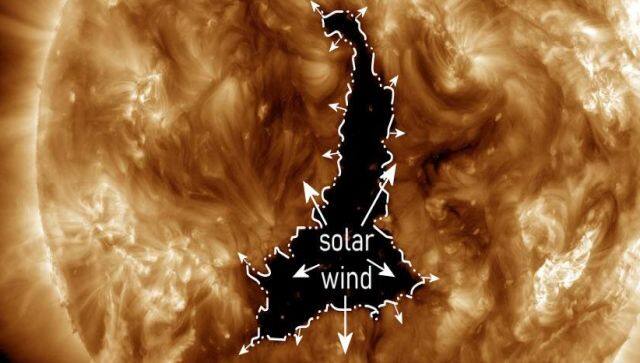 The coronal hole is more than 60 times wider than Earth. Image courtesy: NASA/SDO/AIA[/caption]Coronal holes are most prevalent and stable at the solar north and south poles, but they can grow and expand to lower solar latitudes. It is also possible for coronal holes to develop in isolation from the polar holes or for an extension of a polar hole to split off and become an isolated structure, according to NOAA. Persistent coronal holes are long-lasting sources of high-speed solar wind streams.The radiation streams from coronal holes are much faster than normal solar wind and often trigger disturbances in the Earth’s magnetic shield, known as geomagnetic storms.Also read: Explained: What happens when the sun goes to ‘sleep’?How the new hole in the Sun will affect Earth?The current hole is massive. It measures around 800,000 kilometres along its longest axis. Jupiter’s diameter is around 140,000 kilometres; Earth’s is 12,742.The giant new coronal hole is emitting a powerful solar wind that’s blasting through the solar system. It is rotating away from the Earth now. But until a few days ago, it was pointed right towards the planet.The hole was facing Earth around 2 December and the solar wind hit the planet on 4 and 5 December.[caption id="attachment_13474282" align="alignnone" width="640"]
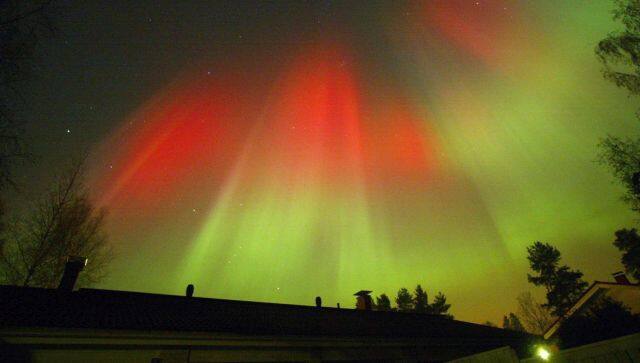 The aurora borealis is seen over the town of Hyvinkaa in southern
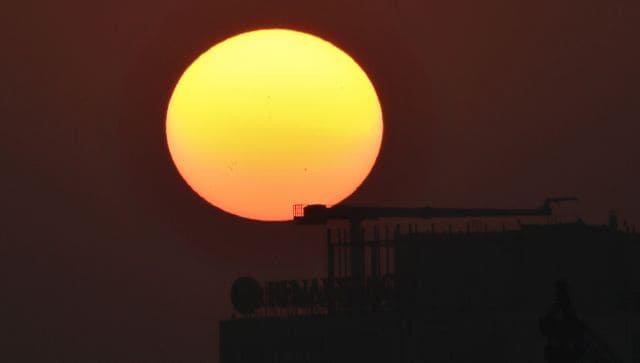
The Sun's explosive peak, solar maximum, could begin in early 2024. Reuters[/caption]What can we expect ahead of solar maximum?The sun is reportedly getting more active.On 28 November, a solar flare emerged from the Sun and ejected a plasma eruption, called coronal mass ejection (CME), towards the direction of Earth. It triggered a geomagnetic storm which lit up lower latitudes with auroras.On 25 November, an explosive “cannon of fire” eruption near the star’s equator released a CME, which caused rare orange auroras. And on 18 November, a gigantic “sunspot archipelago” made up of at least five different sunspot groups emerged on the Sun’s near side and has since spat out dozens of solar storms into space, Live Science reports.The Sun is nearing solar maximum and scientists have predicted that its peak could begin in early 2024.With inputs from agencies

Military drones & police check-ups: How Sri Lanka is fighting against worst dengue outbreak in a decade
How Facebook job ad lured 2 Karnataka men into Myanmar cyber scam camp
Why is India seeing 95% cloud cover despite a Super El Niño?
What is CJP’s fourth demand to the government as protests in Delhi intensify?
The new geography of war: Why the Houthis can no longer be ignored