


What is going on in Northern Ireland? Homes, vehicles set on fire after knife attack
Anti-immigrant protests erupted across Northern Ireland after a Sudanese asylum seeker was charged over a brutal Belfast stabbing. Homes were torched, vehicles burned, and immigrant communities targeted as political leaders condemned the violence and warned against social media-fuelled unrest and racial hatred

A knife attack in Belfast has triggered a wave of anti-immigrant protests and riots across Northern Ireland, leading to attacks on homes, arson incidents, clashes with police and growing fears among migrant communities.
The violence erupted after authorities charged a Sudanese asylum seeker with attempted murder over a stabbing that left a man seriously injured.
As footage of the attack circulated online, anti-immigration activists seized upon the incident, prompting demonstrations that rapidly escalated into disorder in several locations.
Houses believed to be occupied by immigrants were targeted, vehicles were set ablaze, public transport was disrupted and political leaders from across Northern Ireland condemned targeted racist attacks.
 More from Explainers
What happened in the Belfast stabbing?
The sequence of events began late on Monday evening in north Belfast when a man in his 40s was attacked with a knife in an incident that police later described as particularly severe.
Video recordings of the assault quickly spread across social media platforms and messaging groups, drawing widespread attention across Northern Ireland and beyond.
Investigators said the victim suffered extensive injuries. Northern Ireland Assistant Chief Constable Ryan Henderson stated that the man sustained serious damage to his eyes as well as slash wounds to his face and back. Officers also recovered a kitchen knife from the location.
Footage from the incident showed members of the public intervening before emergency services arrived. Senior police officials later credited those bystanders with preventing an even worse outcome.
The victim was rushed to hospital, where he was treated for what authorities described as significant injuries.
Police subsequently arrested and charged a 30-year-old Sudanese national. The charges include attempted murder, possession of an article with a blade or point in a public place and threats to kill.
The accused is scheduled to appear before Belfast Magistrates' Court on Wednesday.
Authorities have pointed out that the case is not being investigated as an act of terrorism. The Police Service of Northern Ireland also said investigators were not searching for any additional suspects.
More details released by police indicated that the suspect entered Northern Ireland from the neighbouring Republic of Ireland in 2023. He later applied for asylum and was granted a five-year permit allowing him to remain in the country.
British Prime Minister Keir Starmer reacted to the attack, describing it as "sickening". He later expanded his comments as unrest spread through Northern Ireland, saying he had "no tolerance for abhorrent scenes of violence like this on our streets."
How did protests spread across Belfast and Northern Ireland?
The release of graphic footage of the stabbing quickly transformed the incident into a massive political flashpoint. By Tuesday, calls for demonstrations had begun circulating online.
As evening approached, groups gathered in multiple locations across Belfast, with further protests reported elsewhere in Northern Ireland.
Police responded by deploying officers and armoured vehicles as crowds assembled.
What followed was a night of disorder that extended across several districts.
Vehicles were set on fire in multiple locations. In east Belfast, rioters targeted a public bus, which became engulfed in flames. The incident forced the suspension of services on part of the city's transport network.
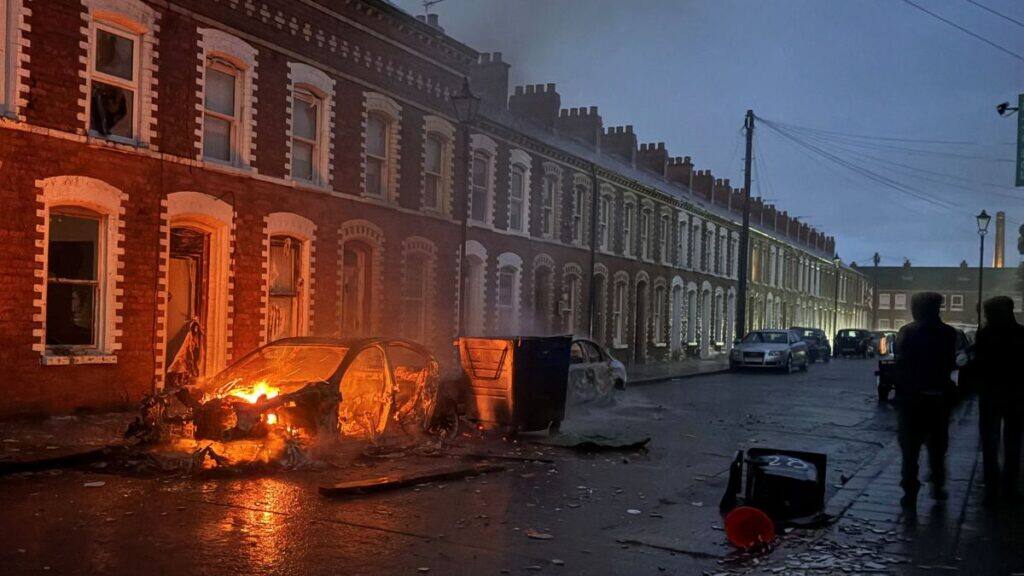
Bins were set alight and pushed towards vehicles and infrastructure. Explosions were heard in some areas as fireworks and flares were used amid the unrest.
Roads were also affected. Protesters blocked traffic at various points, including routes leading towards the M2 motorway.
Disorder was not confined to Belfast. Demonstrations and disturbances were reported in Antrim, Bangor, Ballymena, Lisburn and Newtownabbey. In one area, two vehicles were burned.
As violence escalated, emergency services were dispatched to multiple incidents involving fires and attacks on property. Firefighters rescued residents from homes that had been set ablaze.
BBC footage showed police helping a family escape from a burning property while flames spread through parts of the building.
Several homes suffered extensive damage. The unrest represented one of the most serious outbreaks of anti-immigrant violence witnessed in Northern Ireland in recent years.
How were immigrants and ethnic minorities targeted?
Reports say that many of the affected properties were occupied by immigrants or members of ethnic minority communities. Community representatives and local politicians said Black residents appeared to be among those most directly affected.
One of the clearest examples came from east Belfast, where a crowd reportedly smashed windows and forced entry into homes.
According to BBC, approximately 100 men attacked properties along one street. Pastor Jack McKee later described what he had witnessed. "They're getting put out just because they're Black," he told the BBC.
Earlier in the day, members of Belfast's Sudanese community had already voiced concerns about growing hostility following the stabbing. As tensions mounted, many immigrant-owned businesses took precautionary measures.
By late afternoon, foreign-owned shops in areas such as Sandy Row had pulled down security shutters. Staff left work early and returned home amid concerns that further disturbances could occur after dark.
Political leaders repeatedly stressed that people who had no connection to the stabbing were being targeted.
Deputy First Minister Emma Little-Pengelly said that "taking frustration at the evil actions of a person out on those who had no part in it is utterly wrong."
Northern Ireland Justice Minister Naomi Long also argued that innocent people were being singled out because of their ethnicity. "If you’re driving people from their homes based on nothing but the color of their skin, you can’t dress that up any other way, it’s racism, and those bad faith actors need to take a step back," she told the BBC.
One of the most dramatic incidents occurred in a residential area near the Shankill Road, reported The Guardian. According to observations from the scene, a group of masked men approached a house occupied by residents from an ethnic minority background.
The property already had a boarded-up window and a security camera installed outside.
Witnesses reported seeing a woman watching from an upstairs window as members of the crowd forced their way into the building. Bricks were thrown through ground-floor windows while smoke from fireworks filled the surrounding streets.
Some participants reportedly claimed they were "liberating" the property as they entered it.
Nearby, a vehicle was set on fire. As events unfolded, a man wearing a skull-patterned face covering instructed people not to record the scene on their mobile phones.
Helicopters circled overhead while police monitored developments. Officers initially remained at a distance, apparently assessing that immediate intervention would present safety risks. By the time additional police units arrived in several vans, many of those involved had already dispersed.
Elsewhere in east Belfast, crowds gathered around the remains of the burned Glider bus and damaged homes.
Witnesses described a mixed atmosphere in parts of the city. Families with children stood alongside masked individuals and groups of young people. Some posed for photographs while others consumed alcohol near the damaged vehicles.
Graffiti carrying anti-Islam messages appeared near some of the locations affected by the unrest. Throughout the evening, emergency sirens and helicopters became a constant presence over parts of the city.
How did anti-immigration activists use social media?
As video footage spread across social media, a number of prominent figures used the incident to call for demonstrations. Among them was Stephen Yaxley-Lennon, more widely known as Tommy Robinson.
Robinson shared footage connected to the attack and encouraged people to attend protests.
In one post referenced in the reports, he called for demonstrations following what he described as "yet another invader attack on our people".
US-based tech billionaire Elon Musk also amplified several messages relating to the incident. Responding to Robinson's call for protests, Musk wrote, "Only by protesting REPEATEDLY and LOUDLY will there be any change!!"
Musk also shared a post from the far-right Restore Britain party announcing protest locations. Another message he amplified contained the statement, "Do not make peace with evil. Destroy it."
Political leaders expressed concern that online actors were exploiting local fears. Justice Minister Naomi Long warned that individuals with little connection to Northern Ireland were helping inflame tensions.
She told Reuters that "bad faith actors" had sought to exploit the anger generated by the stabbing. Long said, "Do not allow your genuine concerns to be manipulated by bad faith actors."
She added, "We know in Northern Ireland the damage that can do when you demonize a whole group of people because of the behaviour of a few, and we do not want to go back there."
How have political leaders reacted?
Northern Ireland First Minister Michelle O'Neill was among the most vocal critics of the attacks. "There can be no excuse and no justification for these attacks tonight," she said.
"Groups of masked men burning families out of their homes is nothing less than disgusting cowardice."
In separate comments, O'Neill described the unrest as "thuggery."
Other senior politicians echoed her concerns. Emma Little-Pengelly emphasised that blame should not be directed at entire communities because of the actions of one individual.
Education Minister Paul Givan appealed for restraint during a gathering in Lisburn. "There is a genuine shock about what happened last night," he said.
"I think it has sent shockwaves across the community."
Givan added, "It is important that people do conduct themselves in a peaceful manner to make sure that the key issues here around immigration can be heard and we are not distracted by any form of violence."
"That will only distract. People should express their views in a peaceful manner."
Claire Hanna, leader of the opposition Social Democratic and Labour Party, used even stronger language when describing the attacks. She characterised the violence as a "race based pogrom".
"The online ecosystem that talked this up will move on now and the people of Belfast will be left picking up the pieces," she told Reuters.
How does the unrest fit into wider tensions across Britain?
Recent months have seen repeated demonstrations concerning Britain's asylum system, with populist political figures arguing that immigration policies have allowed dangerous individuals to enter the country.
The Belfast stabbing occurred shortly after another controversial criminal case generated intense public discussion. That case involved the killing of university student Henry Nowak in Southampton.
Nowak, who was white, was stabbed to death by Vickrum Digwa, a Sikh man who falsely claimed to police that he had been the victim of a racist assault.
When officers arrived, they initially treated Nowak as a suspect before recognising the severity of his injuries and attempting to save his life.
Digwa was later convicted of murder and sentenced to life imprisonment with a minimum term of 21 years.
Demonstrations linked to the killing also descended into disorder, with some participants attacking police officers using chairs and rocks. Several individuals subsequently faced charges related to violent disorder.
Northern Ireland has experienced similar episodes before. In 2025, anti-immigrant riots broke out following allegations of sexual assault. Prosecutors later withdrew charges against two boys connected to that case.
With inputs from agencies

Military drones & police check-ups: How Sri Lanka is fighting against worst dengue outbreak in a decade
How Facebook job ad lured 2 Karnataka men into Myanmar cyber scam camp
Why is India seeing 95% cloud cover despite a Super El Niño?
What is CJP’s fourth demand to the government as protests in Delhi intensify?
The new geography of war: Why the Houthis can no longer be ignored