
Advertisement


Sections
What is Free Movement Regime that Centre has scrapped at Myanmar border?
Home Minister Amit Shah has announced the end of the Free Movement Regime (FMR), which allowed tribes along the Indo-Myanmar Border to travel up to 16 km inside the other country without a visa. Implemented in 2018, the pact was a part of India's Act East policy

“The Ministry of Home Affairs (MHA) has decided that the Free Movement Regime (FMR) between India and Myanmar be scrapped to ensure the internal security of the country and to maintain the demographic structure of India’s North Eastern States bordering Myanmar.”With this statement on social media platform X, Home Minister Amit Shah announced the suspension of the India-Myanmar Free Movement Regime (FMR). This means people living in border areas, who could cross over to India, will now require visas.In making the announcement, the Union minister also said that the decision was also taken in an attempt to maintain the demographic structure of India’s northeastern states bordering Myanmar.Notably, the decision to end FMR comes just days after the home ministry announced that a fence would be constructed along the entire 1,643-km-long Myanmar border to facilitate better surveillance.But what is the Free Movement Regime? Why has the Centre ended it now? Let’s take a closer look.What is FMR?The FMR is a mutually agreed pact between India and Myanmar that allows tribes dwelling along the border on either side to travel up to 16 kilometres inside the other country without a visa. The members of hill tribes have to produce a border pass, which is valid for a year, and can stay in the other country for about two weeks per visit, according to PTI.The FMR was introduced in 2018 when relations between the Narendra Modi-led government and Myanmar were on the rise. The agreement aimed to facilitate people-to-people ties between the countries as residents in the region enjoy strong ethnic and familial relations on both sides of the border.[caption id="attachment_13704622" align="alignnone" width="640"]![]() A gerneral view of Farkawn village near the India-Myanmar border, in the northeastern state of Mizoram, India. File image/Reuters[/caption]The FMR was also brought to provide impetus to local trade and business.Why has it been removed?India and Myanmar share a mostly unfenced border. In Manipur, just 10 km of its border with Myanmar is fenced. The IMB goes through forested terrain which is difficult to monitor.Mizoram has a 510-km-long porous border with Myanmar. Nagaland shares a 215 km boundary with the Southeast Asian nation and Arunachal Pradesh has a 520 km-long boundary with Myanmar.Since the ethnic conflict erupted in Manipur last May, the Free Movement Regime has come to the spotlight. The Meiteis have blamed the illegal migration of tribal Kuki-Chin peoples from Myanmar for stirring up tensions in the state. On the other hand, the Kukis in Manipur have accused the Meiteis and Chief Minister N Biren Singh of using this as an excuse for “ethnic cleansing”, as per Indian Express.The alleged illegal migration via the FMR has emerged as a key issue between local leaders in Manipur. CM Singh said in September last year that he had urged the Ministry of Home Affairs (MHA) to end the FMR, blaming the free movement of people from across Myanmar into India for the ethnic violence in the state, reported The Hindu."We are going to end the FMR along the Indo-Myanmar border soon. We are going to put fencing along the entire border. The fencing will be completed in next four-and-a-half years. Anyone coming through will have to...get a visa,” a senior government functionary had then PTI.[caption id="attachment_13572662" align="alignnone" width="640"]
A gerneral view of Farkawn village near the India-Myanmar border, in the northeastern state of Mizoram, India. File image/Reuters[/caption]The FMR was also brought to provide impetus to local trade and business.Why has it been removed?India and Myanmar share a mostly unfenced border. In Manipur, just 10 km of its border with Myanmar is fenced. The IMB goes through forested terrain which is difficult to monitor.Mizoram has a 510-km-long porous border with Myanmar. Nagaland shares a 215 km boundary with the Southeast Asian nation and Arunachal Pradesh has a 520 km-long boundary with Myanmar.Since the ethnic conflict erupted in Manipur last May, the Free Movement Regime has come to the spotlight. The Meiteis have blamed the illegal migration of tribal Kuki-Chin peoples from Myanmar for stirring up tensions in the state. On the other hand, the Kukis in Manipur have accused the Meiteis and Chief Minister N Biren Singh of using this as an excuse for “ethnic cleansing”, as per Indian Express.The alleged illegal migration via the FMR has emerged as a key issue between local leaders in Manipur. CM Singh said in September last year that he had urged the Ministry of Home Affairs (MHA) to end the FMR, blaming the free movement of people from across Myanmar into India for the ethnic violence in the state, reported The Hindu."We are going to end the FMR along the Indo-Myanmar border soon. We are going to put fencing along the entire border. The fencing will be completed in next four-and-a-half years. Anyone coming through will have to...get a visa,” a senior government functionary had then PTI.[caption id="attachment_13572662" align="alignnone" width="640"]![myanmar]() People who fled from Myanmar walk near a church after attending a mass at Farkawn village near the India-Myanmar border, in Mizoram, 21 November 2021. Reuters File Photo[/caption]Speaking to ThePrint, a government source said the FMR was suspended several times in the past, including in 2020 during COVID-19.Since the military coup in Myanmar on 1 February 2021, a large number of tribals fleeing violence in their country have crossed over to India, especially into Manipur and Mizoram. As per The Hindu, over 40,000 refugees belonging to the Kuki-Chin-Zo ethnic group took shelter in Mizoram, while about 4,000 migrants are said to have entered Manipur.There are allegations that these refugees took shelter on Indian soil and then got involved in illegal activities such as drug smuggling, reported ThePrint.A senior government official told The Hindu that around 300 km of the Indo-Myanmar border will be fenced and a tender will be issued soon.Is ending FMR the solution?According to a paper published by Anuradha Oinam of the Centre for Land Warfare Studies (CLAWS), many insurgent groups such as United National Liberation Front (UNLF), People’s Liberation Army (PLA), the United Liberation Front of Assam (ULFA), National Socialist Council of Nagaland (NSCN), and small groups of Kukis and Zomis have constructed camps in Myanmar's Sagaing Division, Kachin State and Chin State, reported Indian Express.“They took shelter there, obtained arms, trained cadres, and, most importantly, engaged in illegal activities such as smuggling drugs and selling weapons to raise funds. This is possible because of the porous borders and frequent misuse of FMR. Therefore, managing and administering the border areas effectively is pertinent for reducing drug trafficking and illegal cross-border movement on unfenced borders,” the paper said.However, Oinam in his paper argued that neither cancelling the FMR nor completely fencing the border was the solution as it could affect livelihoods, education and essential travel for health care. The paper said “it is imperative for New Delhi to tackle the issue by pursuing ‘killing the snake without breaking the stick’ approach,” reported Indian Express.Sources in the security establishment told the Indian daily last year that stopping illegal immigration or drug trafficking across an unfenced border in perilous terrain is a tough task. A senior officer said that all borders, including fenced ones, are “are struggling to deal with drug trafficking”.With inputs from agencies
People who fled from Myanmar walk near a church after attending a mass at Farkawn village near the India-Myanmar border, in Mizoram, 21 November 2021. Reuters File Photo[/caption]Speaking to ThePrint, a government source said the FMR was suspended several times in the past, including in 2020 during COVID-19.Since the military coup in Myanmar on 1 February 2021, a large number of tribals fleeing violence in their country have crossed over to India, especially into Manipur and Mizoram. As per The Hindu, over 40,000 refugees belonging to the Kuki-Chin-Zo ethnic group took shelter in Mizoram, while about 4,000 migrants are said to have entered Manipur.There are allegations that these refugees took shelter on Indian soil and then got involved in illegal activities such as drug smuggling, reported ThePrint.A senior government official told The Hindu that around 300 km of the Indo-Myanmar border will be fenced and a tender will be issued soon.Is ending FMR the solution?According to a paper published by Anuradha Oinam of the Centre for Land Warfare Studies (CLAWS), many insurgent groups such as United National Liberation Front (UNLF), People’s Liberation Army (PLA), the United Liberation Front of Assam (ULFA), National Socialist Council of Nagaland (NSCN), and small groups of Kukis and Zomis have constructed camps in Myanmar's Sagaing Division, Kachin State and Chin State, reported Indian Express.“They took shelter there, obtained arms, trained cadres, and, most importantly, engaged in illegal activities such as smuggling drugs and selling weapons to raise funds. This is possible because of the porous borders and frequent misuse of FMR. Therefore, managing and administering the border areas effectively is pertinent for reducing drug trafficking and illegal cross-border movement on unfenced borders,” the paper said.However, Oinam in his paper argued that neither cancelling the FMR nor completely fencing the border was the solution as it could affect livelihoods, education and essential travel for health care. The paper said “it is imperative for New Delhi to tackle the issue by pursuing ‘killing the snake without breaking the stick’ approach,” reported Indian Express.Sources in the security establishment told the Indian daily last year that stopping illegal immigration or drug trafficking across an unfenced border in perilous terrain is a tough task. A senior officer said that all borders, including fenced ones, are “are struggling to deal with drug trafficking”.With inputs from agencies
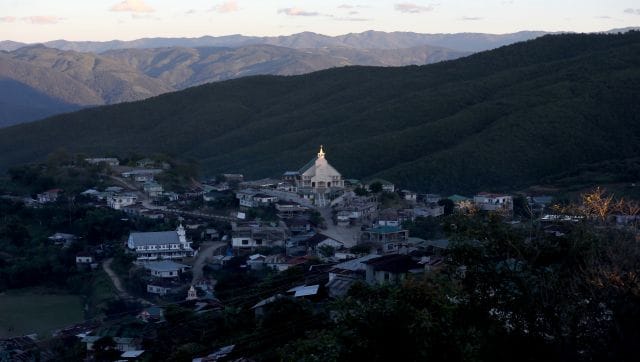 A gerneral view of Farkawn village near the India-Myanmar border, in the northeastern state of Mizoram, India. File image/Reuters[/caption]The FMR was also brought to provide impetus to local trade and business.Why has it been removed?India and Myanmar share a mostly unfenced border. In Manipur, just 10 km of its border with Myanmar is fenced. The IMB goes through forested terrain which is difficult to monitor.Mizoram has a 510-km-long porous border with Myanmar. Nagaland shares a 215 km boundary with the Southeast Asian nation and Arunachal Pradesh has a 520 km-long boundary with Myanmar.Since the ethnic conflict erupted in Manipur last May, the Free Movement Regime has come to the spotlight. The Meiteis have blamed the illegal migration of tribal Kuki-Chin peoples from Myanmar for stirring up tensions in the state. On the other hand, the Kukis in Manipur have accused the Meiteis and Chief Minister N Biren Singh of using this as an excuse for “ethnic cleansing”, as per Indian Express.The alleged illegal migration via the FMR has emerged as a key issue between local leaders in Manipur. CM Singh said in September last year that he had urged the Ministry of Home Affairs (MHA) to end the FMR, blaming the free movement of people from across Myanmar into India for the ethnic violence in the state, reported The Hindu."We are going to end the FMR along the Indo-Myanmar border soon. We are going to put fencing along the entire border. The fencing will be completed in next four-and-a-half years. Anyone coming through will have to...get a visa,” a senior government functionary had then PTI.[caption id="attachment_13572662" align="alignnone" width="640"]
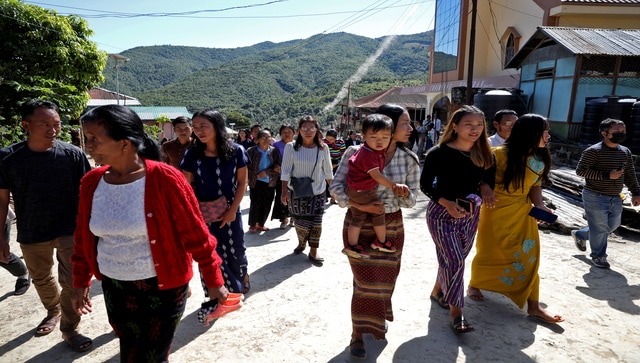 People who fled from Myanmar walk near a church after attending a mass at Farkawn village near the India-Myanmar border, in Mizoram, 21 November 2021. Reuters File Photo[/caption]Speaking to ThePrint, a government source said the FMR was suspended several times in the past, including in 2020 during COVID-19.Since the military coup in Myanmar on 1 February 2021, a large number of tribals fleeing violence in their country have crossed over to India, especially into Manipur and Mizoram. As per The Hindu, over 40,000 refugees belonging to the Kuki-Chin-Zo ethnic group took shelter in Mizoram, while about 4,000 migrants are said to have entered Manipur.There are allegations that these refugees took shelter on Indian soil and then got involved in illegal activities such as drug smuggling, reported ThePrint.A senior government official told The Hindu that around 300 km of the Indo-Myanmar border will be fenced and a tender will be issued soon.Is ending FMR the solution?According to a paper published by Anuradha Oinam of the Centre for Land Warfare Studies (CLAWS), many insurgent groups such as United National Liberation Front (UNLF), People’s Liberation Army (PLA), the United Liberation Front of Assam (ULFA), National Socialist Council of Nagaland (NSCN), and small groups of Kukis and Zomis have constructed camps in Myanmar's Sagaing Division, Kachin State and Chin State, reported Indian Express.“They took shelter there, obtained arms, trained cadres, and, most importantly, engaged in illegal activities such as smuggling drugs and selling weapons to raise funds. This is possible because of the porous borders and frequent misuse of FMR. Therefore, managing and administering the border areas effectively is pertinent for reducing drug trafficking and illegal cross-border movement on unfenced borders,” the paper said.However, Oinam in his paper argued that neither cancelling the FMR nor completely fencing the border was the solution as it could affect livelihoods, education and essential travel for health care. The paper said “it is imperative for New Delhi to tackle the issue by pursuing ‘killing the snake without breaking the stick’ approach,” reported Indian Express.Sources in the security establishment told the Indian daily last year that stopping illegal immigration or drug trafficking across an unfenced border in perilous terrain is a tough task. A senior officer said that all borders, including fenced ones, are “are struggling to deal with drug trafficking”.With inputs from agencies
First Published:Feb 08, 2024, 14:00:11 IST
Advertisement
Advertisement

Military drones & police check-ups: How Sri Lanka is fighting against worst dengue outbreak in a decade
Sri Lanka is fighting its most severe dengue outbreak in nearly a decade, with infections rising sharply across the nation. Military drones have been deployed to tackle the outbreak, which has claimed 56 lives. Health officials said the outbreak is being driven primarily by the DENV-2 variant of the virus
3 min read
How Facebook job ad lured 2 Karnataka men into Myanmar cyber scam camp
The Karnataka Cyber Command has rescued two youths from a scam compound in Myanmar operated by Chinese fraudsters. The duo from Karnataka were lured on the pretext of data-entry jobs. They were asked to work for 16 hours a day and were expected to sleep for six hours daily
4 min read
Why is India seeing 95% cloud cover despite a Super El Niño?
India is witnessing nearly 95 per cent cloud cover despite a Super El Niño, a climate event usually linked to weaker monsoons. Regional weather systems, cyclonic circulations, the monsoon trough and moisture from two seas are temporarily overpowering one of the world's strongest climate phenomena
5 min read
What is CJP’s fourth demand to the government as protests in Delhi intensify?
The protest by the Cockroach Janta Party at Delhi’s Jantar Mantar refuses to die down. The group have made a fourth demand to the Centre, asking that no FIRs are filed against the agitators and that no legal action be taken. The government has expressed willingness to speak to the protesters, but refused to accede on the resignation of Education Minister Dharmandra Pradhan
5 min read
The new geography of war: Why the Houthis can no longer be ignored
The rise of the Houthis marks the emergence of a new geography of war — one in which influence flows not only from capitals and conventional armies, but also from rugged mountains overlooking vital sea lanes
6 min read
Advertisement
Advertisement