
Advertisement


Sections
High Fly: What IndiGo’s deal of 500 planes from Airbus means for India’s aviation sector
IndiGo has inked a deal of 500 A320 planes from France’s Airbus – the largest order in the history of commercial aviation. This comes just five months after Air India signed a massive deal with the French aerospace company as well as Boeing

India’s low-cost carrier IndiGo is soaring high and it has every reason to be. On Monday, the airline’s parent company, Interglobe Aviation, inked a deal with Airbus for 500 A320 planes – the largest order in the history of commercial aviation.The announcement of the deal came on Monday, the opening day of the Paris Air Show – the world’s largest event focusing on aviation and space industry. Neither side disclosed how much the order was worth, but it would likely amount to tens of billions of dollars.The no-frills airline said in a statement, “IndiGo is further defining its long-term future, well into the next decade, by placing a firm order for 500 Airbus A320 Family aircraft. This will provide IndiGo a further steady stream of deliveries between 2030 and 2035.”IndiGo CEO Peter Elbers also hailed the deal, calling it “an enormous milestone”. “No one has ever ordered an order of this magnitude. And it speaks to the potential of Indian aviation and the ambitions which IndiGo is having,” he said at a press conference.What does this deal entail? What does it mean for IndiGo? Is this deal significant to India’s aviation sector? We break it all down and give you the answers.The IndiGo-Airbus dealIndiGo has placed an order to buy 500 narrow-body planes from Airbus, the French aerospace giant. The order comprises of 500 of the Airbus A320 Family aircraft – a mix of A320NEO, A321NEO and A321XLR aircraft – which is to be delivered between 2030 and 2035.This deal, signed on Monday, is the largest-ever aircraft order placed by any airline with Airbus. The historic agreement was signed by Rahul Bhatia, promoter and managing director of IndiGo, Dr Venkataramani Sumantran, chairman and non-executive independent director of IndiGo, Pieter Elbers, CEO of IndiGo, Guillaume Faury, Airbus CEO, and Christian Scherer, Airbus chief commercial officer and head of international, at the Paris Air Show 2023.[caption id="attachment_12761442" align="alignnone" width="640"]![]() (From left to right) Pieter Elbers, CEO of IndiGo, Venkataramani Sumantran, chairman of IndiGo, Rahul Bhatia, managing director of IndiGo, Guillaume Faury, CEO of Airbus and Christian Scherer, chief commercial officer of Airbus attend a news conference, after a purchase agreement between IndiGo and Airbus for 500 A320 Family aircraft, at the 54th International Paris Airshow at Le Bourget Airport near Paris, France. Reuters[/caption]But why choose the Airbus’ A320 aircraft? Worldwide, the A320 aircraft is the undisputed leader in the single-aisle aircraft category. It boasts of the widest single-aisle cabin, incorporating the latest technologies. The aircraft is also fuel-efficient and reliable. In fact, the A320neo family is the aircraft of choice for airlines across the world – having more than 8,700 orders from over 130 customers.While financial details of the deal weren’t disclosed, some believe that it is estimated to be worth some $50 billion at the most recently published Airbus list prices. However, as The Economic Times reported, the actual cost of the order is expected to be significantly lower, as substantial discounts are typically applied to such big acquisitions.Also read: Why Delhi-Mumbai airfares are among the costliest globallySignificance of the dealThere are two reasons why this deal is so important and significant. Firstly, it is the biggest biggest-ever aircraft order in the history of commercial aviation. It surpasses the order that was made five months ago by Air India when it inked a deal for 470 aircraft with Airbus and Boeing.Secondly, it ensures that IndiGo has an uninterrupted supply of new aircraft for the next decade, fortifying its fleet expansion plans. This deal comes at a time when the airline is yet to receive nearly 480 jets from its existing order of 830 Airbus A320-family planes.The company, since its inception in 2006, has been purchasing A320-family planes, ordering a total of 1,330 aircraft from the French aerospace giant. Its first order with Airbus was in 2005 for 100 A320 planes. Then in 2011 for 180 A320 Family, including the NEO. In 2014, IndiGo placed another order for Airbus jets and the last order came in 2019 for 300 A320neo planes. These orders took the total to 830 A320 family aircraft.[caption id="attachment_12761472" align="alignnone" width="640"]
(From left to right) Pieter Elbers, CEO of IndiGo, Venkataramani Sumantran, chairman of IndiGo, Rahul Bhatia, managing director of IndiGo, Guillaume Faury, CEO of Airbus and Christian Scherer, chief commercial officer of Airbus attend a news conference, after a purchase agreement between IndiGo and Airbus for 500 A320 Family aircraft, at the 54th International Paris Airshow at Le Bourget Airport near Paris, France. Reuters[/caption]But why choose the Airbus’ A320 aircraft? Worldwide, the A320 aircraft is the undisputed leader in the single-aisle aircraft category. It boasts of the widest single-aisle cabin, incorporating the latest technologies. The aircraft is also fuel-efficient and reliable. In fact, the A320neo family is the aircraft of choice for airlines across the world – having more than 8,700 orders from over 130 customers.While financial details of the deal weren’t disclosed, some believe that it is estimated to be worth some $50 billion at the most recently published Airbus list prices. However, as The Economic Times reported, the actual cost of the order is expected to be significantly lower, as substantial discounts are typically applied to such big acquisitions.Also read: Why Delhi-Mumbai airfares are among the costliest globallySignificance of the dealThere are two reasons why this deal is so important and significant. Firstly, it is the biggest biggest-ever aircraft order in the history of commercial aviation. It surpasses the order that was made five months ago by Air India when it inked a deal for 470 aircraft with Airbus and Boeing.Secondly, it ensures that IndiGo has an uninterrupted supply of new aircraft for the next decade, fortifying its fleet expansion plans. This deal comes at a time when the airline is yet to receive nearly 480 jets from its existing order of 830 Airbus A320-family planes.The company, since its inception in 2006, has been purchasing A320-family planes, ordering a total of 1,330 aircraft from the French aerospace giant. Its first order with Airbus was in 2005 for 100 A320 planes. Then in 2011 for 180 A320 Family, including the NEO. In 2014, IndiGo placed another order for Airbus jets and the last order came in 2019 for 300 A320neo planes. These orders took the total to 830 A320 family aircraft.[caption id="attachment_12761472" align="alignnone" width="640"]![]() Graphic: Pranay Bhardwaj[/caption]Today, the airline has a combination of aircraft, which includes the A320 (180 seats), the A320neo (186 seats), the A321neo with two configurations (222 seats and 232 seats), and the ATR 72-600 turboprop aircraft.The deal is a reflection of IndiGo’s economic health and also shows its planning for the future. It gives them a robust fleet of planes to continue their dominance of the Indian skies and fend off competition from Tata-owned Air India.As Elbers said in the press conference that the deal gives IndiGo time to elaborately plan our domestic, and international network and also our pilot requirements going forward.India’s aviation sector flies highThe deal will enable IndiGo to maintain its status as the leader of the domestic Indian market. Moreover, it is also a reflection of the growth potential of the Indian aviation market.Country’s aviation regulator, Directorate General Civil Aviation, revealed that the domestic air passenger traffic registered an annual growth of 36.10 per cent during January – May 2023 period compared to the corresponding period of the previous year.India’s domestic airlines carried close to 6.36 crore passengers as against 4.67 crore passengers during the corresponding period of the previous year. Additionally, for April 2023, international passenger traffic for Indian carriers stood at 21.8 lakh, higher than the pre-COVID (April 2019) levels of 18.3 lakh by 20 per cent.According to some reports, as of 2023, India already has the third-largest domestic aviation sector globally, overtaking Japan. The International Air Transport Association (IATA) has predicted that India will overtake the UK to become the third-largest aviation market by 2026. This still leaves it behind the US and China. “China will displace the US as the world’s largest aviation market (defined by traffic to, from and within the country) around 2029. India will displace the UK for the third place in 2026, while Indonesia enters the top ten at the expense of Italy.”However, India’s aviation sector has faced turbulence in the recent past. Go First has filed for bankruptcy after being compelled to ground half of its 50-strong Airbus A320neo aircraft fleet. SpiceJet is also in deep financial trouble; its net worth at the end of March 2022 was a negative Rs 4,340 crore and the losses before tax in the four years to March 2022 were more than Rs 3,870 crore.With inputs from agenciesRead all the Latest News, Trending News, Cricket News, Bollywood News,India News and Entertainment News here. Follow us on Facebook, Twitter and Instagram.
Graphic: Pranay Bhardwaj[/caption]Today, the airline has a combination of aircraft, which includes the A320 (180 seats), the A320neo (186 seats), the A321neo with two configurations (222 seats and 232 seats), and the ATR 72-600 turboprop aircraft.The deal is a reflection of IndiGo’s economic health and also shows its planning for the future. It gives them a robust fleet of planes to continue their dominance of the Indian skies and fend off competition from Tata-owned Air India.As Elbers said in the press conference that the deal gives IndiGo time to elaborately plan our domestic, and international network and also our pilot requirements going forward.India’s aviation sector flies highThe deal will enable IndiGo to maintain its status as the leader of the domestic Indian market. Moreover, it is also a reflection of the growth potential of the Indian aviation market.Country’s aviation regulator, Directorate General Civil Aviation, revealed that the domestic air passenger traffic registered an annual growth of 36.10 per cent during January – May 2023 period compared to the corresponding period of the previous year.India’s domestic airlines carried close to 6.36 crore passengers as against 4.67 crore passengers during the corresponding period of the previous year. Additionally, for April 2023, international passenger traffic for Indian carriers stood at 21.8 lakh, higher than the pre-COVID (April 2019) levels of 18.3 lakh by 20 per cent.According to some reports, as of 2023, India already has the third-largest domestic aviation sector globally, overtaking Japan. The International Air Transport Association (IATA) has predicted that India will overtake the UK to become the third-largest aviation market by 2026. This still leaves it behind the US and China. “China will displace the US as the world’s largest aviation market (defined by traffic to, from and within the country) around 2029. India will displace the UK for the third place in 2026, while Indonesia enters the top ten at the expense of Italy.”However, India’s aviation sector has faced turbulence in the recent past. Go First has filed for bankruptcy after being compelled to ground half of its 50-strong Airbus A320neo aircraft fleet. SpiceJet is also in deep financial trouble; its net worth at the end of March 2022 was a negative Rs 4,340 crore and the losses before tax in the four years to March 2022 were more than Rs 3,870 crore.With inputs from agenciesRead all the Latest News, Trending News, Cricket News, Bollywood News,India News and Entertainment News here. Follow us on Facebook, Twitter and Instagram.
 (From left to right) Pieter Elbers, CEO of IndiGo, Venkataramani Sumantran, chairman of IndiGo, Rahul Bhatia, managing director of IndiGo, Guillaume Faury, CEO of Airbus and Christian Scherer, chief commercial officer of Airbus attend a news conference, after a purchase agreement between IndiGo and Airbus for 500 A320 Family aircraft, at the 54th International Paris Airshow at Le Bourget Airport near Paris, France. Reuters[/caption]But why choose the Airbus’ A320 aircraft? Worldwide, the A320 aircraft is the undisputed leader in the single-aisle aircraft category. It boasts of the widest single-aisle cabin, incorporating the latest technologies. The aircraft is also fuel-efficient and reliable. In fact, the A320neo family is the aircraft of choice for airlines across the world – having more than 8,700 orders from over 130 customers.While financial details of the deal weren’t disclosed, some believe that it is estimated to be worth some $50 billion at the most recently published Airbus list prices. However, as The Economic Times reported, the actual cost of the order is expected to be significantly lower, as substantial discounts are typically applied to such big acquisitions.Also read: Why Delhi-Mumbai airfares are among the costliest globallySignificance of the dealThere are two reasons why this deal is so important and significant. Firstly, it is the biggest biggest-ever aircraft order in the history of commercial aviation. It surpasses the order that was made five months ago by Air India when it inked a deal for 470 aircraft with Airbus and Boeing.Secondly, it ensures that IndiGo has an uninterrupted supply of new aircraft for the next decade, fortifying its fleet expansion plans. This deal comes at a time when the airline is yet to receive nearly 480 jets from its existing order of 830 Airbus A320-family planes.The company, since its inception in 2006, has been purchasing A320-family planes, ordering a total of 1,330 aircraft from the French aerospace giant. Its first order with Airbus was in 2005 for 100 A320 planes. Then in 2011 for 180 A320 Family, including the NEO. In 2014, IndiGo placed another order for Airbus jets and the last order came in 2019 for 300 A320neo planes. These orders took the total to 830 A320 family aircraft.[caption id="attachment_12761472" align="alignnone" width="640"]
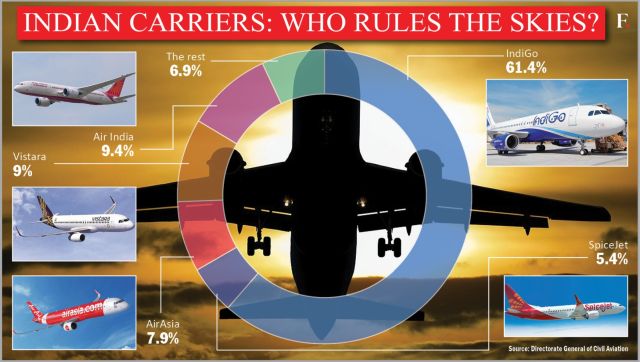 Graphic: Pranay Bhardwaj[/caption]Today, the airline has a combination of aircraft, which includes the A320 (180 seats), the A320neo (186 seats), the A321neo with two configurations (222 seats and 232 seats), and the ATR 72-600 turboprop aircraft.The deal is a reflection of IndiGo’s economic health and also shows its planning for the future. It gives them a robust fleet of planes to continue their dominance of the Indian skies and fend off competition from Tata-owned Air India.As Elbers said in the press conference that the deal gives IndiGo time to elaborately plan our domestic, and international network and also our pilot requirements going forward.India’s aviation sector flies highThe deal will enable IndiGo to maintain its status as the leader of the domestic Indian market. Moreover, it is also a reflection of the growth potential of the Indian aviation market.Country’s aviation regulator, Directorate General Civil Aviation, revealed that the domestic air passenger traffic registered an annual growth of 36.10 per cent during January – May 2023 period compared to the corresponding period of the previous year.
First Published:Jun 20, 2023, 10:13:42 IST
Advertisement
Advertisement

Military drones & police check-ups: How Sri Lanka is fighting against worst dengue outbreak in a decade
Sri Lanka is fighting its most severe dengue outbreak in nearly a decade, with infections rising sharply across the nation. Military drones have been deployed to tackle the outbreak, which has claimed 56 lives. Health officials said the outbreak is being driven primarily by the DENV-2 variant of the virus
3 min read
How Facebook job ad lured 2 Karnataka men into Myanmar cyber scam camp
The Karnataka Cyber Command has rescued two youths from a scam compound in Myanmar operated by Chinese fraudsters. The duo from Karnataka were lured on the pretext of data-entry jobs. They were asked to work for 16 hours a day and were expected to sleep for six hours daily
4 min read
Why is India seeing 95% cloud cover despite a Super El Niño?
India is witnessing nearly 95 per cent cloud cover despite a Super El Niño, a climate event usually linked to weaker monsoons. Regional weather systems, cyclonic circulations, the monsoon trough and moisture from two seas are temporarily overpowering one of the world's strongest climate phenomena
5 min read
What is CJP’s fourth demand to the government as protests in Delhi intensify?
The protest by the Cockroach Janta Party at Delhi’s Jantar Mantar refuses to die down. The group have made a fourth demand to the Centre, asking that no FIRs are filed against the agitators and that no legal action be taken. The government has expressed willingness to speak to the protesters, but refused to accede on the resignation of Education Minister Dharmandra Pradhan
5 min read
The new geography of war: Why the Houthis can no longer be ignored
The rise of the Houthis marks the emergence of a new geography of war — one in which influence flows not only from capitals and conventional armies, but also from rugged mountains overlooking vital sea lanes
6 min read
Advertisement
Advertisement