
Advertisement


Sections
Voting with nails, mascots, doppelgangers: Fun facts about Indonesia polls
Over 200 million people are eligible to vote in the Muslim-majority nation of Indonesia with the posts of president and vice president and a number of parliamentary and local legislatures up for grabs. Let's take a look at some interesting facts about the Indonesia polls

One of the world's biggest democracies is set to hold one of its most complicated elections today.Over 200 million people are eligible to vote in the Muslim-majority nation of Indonesia and millions of officials are going to be conducting the voting.At stake are the posts of president and vice president -- as well as a number of parliamentary and local legislatures.Let's take a look at some interesting facts about the Indonesia polls:Voting with nailsAs per Straits Times, Indonesian voters use a nail to punch their ballot slips rather than use the pen.'Coblos', the word for voting in Indonesian, means "to punch."Votes are counted in public with each paper being held up to allow observers to get a good look.Voters' fingers are inked to show that they cast their ballot.According to Vice, this unique tradition began under the regime of Indonesian president Suharto.![]() Supporters of presidential candidate Anies Baswedan cheer during his campaign rally in Lampung Timur, Indonesia, AP[/caption]“The combination of simultaneous elections with an open proportional system which is carried out manually also makes the Indonesian election one of the most complicated and complex elections in the world.”"The logistics distribution and the voting will happen in the rainy season," general election commission chairman Hasyim Asyari told reporters last year. "We hope the worst won't happen."Officials have been distributing ballot boxes under armed guard to every corner of the 5,000-kilometre-long archipelago that is home to hundreds of ethnic groups and languages.Elephants or horses?In Sumatra's Aceh province, a provincial election official told AFP organisers were still deciding whether to use elephants to carry ballot boxes again after commandeering several tuskers for the task in the 2019 election.Horses will be used in a southeast corner of Java island, where officials have prepared at least three trusty stallions to bring ballots to a remote village of just 160 people in case of bad weather."The road is very difficult to reach so we have to use the horses," said Ahmad Hanafi, spokesperson for a local election commission in East Java.In Lampung province on Sumatra island, cows will be used in at least four villages to drag votes through mud tracks to and from polling stations, local election commission head Marlini, who like many Indonesians goes by one name, told AFP.
Supporters of presidential candidate Anies Baswedan cheer during his campaign rally in Lampung Timur, Indonesia, AP[/caption]“The combination of simultaneous elections with an open proportional system which is carried out manually also makes the Indonesian election one of the most complicated and complex elections in the world.”"The logistics distribution and the voting will happen in the rainy season," general election commission chairman Hasyim Asyari told reporters last year. "We hope the worst won't happen."Officials have been distributing ballot boxes under armed guard to every corner of the 5,000-kilometre-long archipelago that is home to hundreds of ethnic groups and languages.Elephants or horses?In Sumatra's Aceh province, a provincial election official told AFP organisers were still deciding whether to use elephants to carry ballot boxes again after commandeering several tuskers for the task in the 2019 election.Horses will be used in a southeast corner of Java island, where officials have prepared at least three trusty stallions to bring ballots to a remote village of just 160 people in case of bad weather."The road is very difficult to reach so we have to use the horses," said Ahmad Hanafi, spokesperson for a local election commission in East Java.In Lampung province on Sumatra island, cows will be used in at least four villages to drag votes through mud tracks to and from polling stations, local election commission head Marlini, who like many Indonesians goes by one name, told AFP.![]() Electoral workers arrange ballot boxes in a boat during the distribution of election paraphernalia to remote villages, in Pemulutan, South Sumatra. AP[/caption]The fears are not unfounded.In neighbouring Banten province last month, a storage facility was inundated by heavy rain, causing hundreds of ballots to be destroyed.All this takes its toll.In 2019, over 890 election workers died after the polls, as per Al Jazeera.Communal votingVoters in remote areas of the mineral-rich region will use a communal voting system called Noken, in which a village head represents his community at the ballot box.It is a challenge to the concept of direct voting, and local officials have said the system is fraud-prone, in a country where vote buying is already rife."People can't really say anything, they might have a different choice but... the village uses the 'one command' system," said Papua cultural expert Marshall Suebu.Doppelgangers galoreAs per Straits Times, a number of doppelgangers have gone viral this election.For example, Arie Budiarto, a community leader from West Java's Banten, gained much attention for looking rather like Ganjar Pranowo -- one of the three main candidates.Wasil Afin, a fried rice seller from Central Jawa, also got attention for his resemblance to presidential candidate Anies Baswedan.MascotsIndonesia also has two election mascots named Sura and Sulu.Sura, a male songbird, gets his name from “suara rakyat” -- meaning the “voice of the people.”Sulu, meanwhile, gets he rname from “suara pemilu” -- meaning the “voice of the election”.Fast countAccording to Al Jazeera, the counting begins as soon as voting ends.Many polling stations employ use a sampling method to determine a 'quick count' -- which has proven fairly accurate.While the preliminary results will likely be out tomorrow, the final result could take weeks.With inputs from agencies
Electoral workers arrange ballot boxes in a boat during the distribution of election paraphernalia to remote villages, in Pemulutan, South Sumatra. AP[/caption]The fears are not unfounded.In neighbouring Banten province last month, a storage facility was inundated by heavy rain, causing hundreds of ballots to be destroyed.All this takes its toll.In 2019, over 890 election workers died after the polls, as per Al Jazeera.Communal votingVoters in remote areas of the mineral-rich region will use a communal voting system called Noken, in which a village head represents his community at the ballot box.It is a challenge to the concept of direct voting, and local officials have said the system is fraud-prone, in a country where vote buying is already rife."People can't really say anything, they might have a different choice but... the village uses the 'one command' system," said Papua cultural expert Marshall Suebu.Doppelgangers galoreAs per Straits Times, a number of doppelgangers have gone viral this election.For example, Arie Budiarto, a community leader from West Java's Banten, gained much attention for looking rather like Ganjar Pranowo -- one of the three main candidates.Wasil Afin, a fried rice seller from Central Jawa, also got attention for his resemblance to presidential candidate Anies Baswedan.MascotsIndonesia also has two election mascots named Sura and Sulu.Sura, a male songbird, gets his name from “suara rakyat” -- meaning the “voice of the people.”Sulu, meanwhile, gets he rname from “suara pemilu” -- meaning the “voice of the election”.Fast countAccording to Al Jazeera, the counting begins as soon as voting ends.Many polling stations employ use a sampling method to determine a 'quick count' -- which has proven fairly accurate.While the preliminary results will likely be out tomorrow, the final result could take weeks.With inputs from agencies
Suharto, who reigned for over three decades, won every poll.According to the website, this was because if someone voted against Suharto, his pollsters would simply take a nail and make a second hold -- thus spoilling any ballots against him.Ironically, as per Al Jazeera, these days it is argued that this method makes manipulating votes more difficult.A logistical nightmareVoting is set to last just six hours with officials preparing for possible rainy season downpours, cyber-attacks and fraud.The election will be held across three time-zones, beginning in easternmost province Papua where rebels are waging a deadly insurgency against the military.
Behind India and the United States, Indonesia is the world's third-largest democracy.It is only the fifth presidential election since the country emerged from autocratic rule less than three decades ago.According to Al Jazeera, over seven million election officials and independent workers will oversee the polling.“The anatomy of the sheer numbers of voters involved makes the Indonesian election the largest one-day election in the world,” Titi Anggraini, an advisory board member of the Association for Elections and Democracy and a constitutional law lecturer at Universitas Indonesia, told the website.[caption id="attachment_13720052" align="alignnone" width="640"]
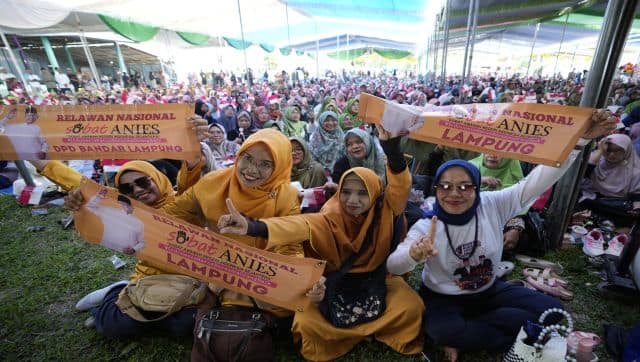 Supporters of presidential candidate Anies Baswedan cheer during his campaign rally in Lampung Timur, Indonesia, AP[/caption]“The combination of simultaneous elections with an open proportional system which is carried out manually also makes the Indonesian election one of the most complicated and complex elections in the world.”"The logistics distribution and the voting will happen in the rainy season," general election commission chairman Hasyim Asyari told reporters last year. "We hope the worst won't happen."Officials have been distributing ballot boxes under armed guard to every corner of the 5,000-kilometre-long archipelago that is home to hundreds of ethnic groups and languages.Elephants or horses?In Sumatra's Aceh province, a provincial election official told AFP organisers were still deciding whether to use elephants to carry ballot boxes again after commandeering several tuskers for the task in the 2019 election.Horses will be used in a southeast corner of Java island, where officials have prepared at least three trusty stallions to bring ballots to a remote village of just 160 people in case of bad weather."The road is very difficult to reach so we have to use the horses," said Ahmad Hanafi, spokesperson for a local election commission in East Java.In Lampung province on Sumatra island, cows will be used in at least four villages to drag votes through mud tracks to and from polling stations, local election commission head Marlini, who like many Indonesians goes by one name, told AFP.
"The logistics will be distributed by a cart pulled by a cow. This is the only possible mode of transportation we can use," she said.Speedboats will take ballots from Jakarta to islands off the Javan coast, while the military said warships have been enlisted to help deliver ballots.The risk of flooding is high, with more than 2,000 polling booths vulnerable in capital Jakarta alone, according to authorities.The megalopolis' election authorities have mooted relocating polls to higher ground, using mobile pumps or even rubber boats. They will also wrap ballots in plastic for protection.[caption id="attachment_13723452" align="alignnone" width="640"]
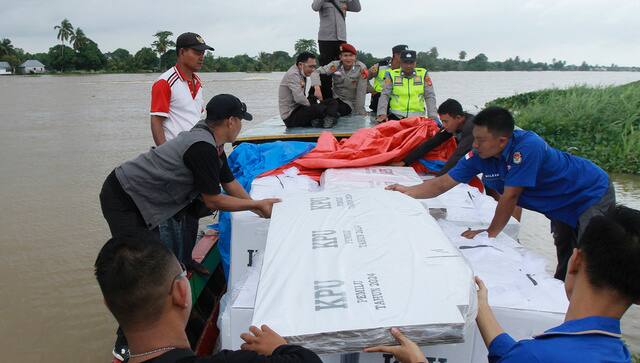 Electoral workers arrange ballot boxes in a boat during the distribution of election paraphernalia to remote villages, in Pemulutan, South Sumatra. AP[/caption]The fears are not unfounded.In neighbouring Banten province last month, a storage facility was inundated by heavy rain, causing hundreds of ballots to be destroyed.All this takes its toll.In 2019, over 890 election workers died after the polls, as per Al Jazeera.Communal votingVoters in remote areas of the mineral-rich region will use a communal voting system called Noken, in which a village head represents his community at the ballot box.It is a challenge to the concept of direct voting, and local officials have said the system is fraud-prone, in a country where vote buying is already rife."People can't really say anything, they might have a different choice but... the village uses the 'one command' system," said Papua cultural expert Marshall Suebu.Doppelgangers galoreAs per Straits Times, a number of doppelgangers have gone viral this election.For example, Arie Budiarto, a community leader from West Java's Banten, gained much attention for looking rather like Ganjar Pranowo -- one of the three main candidates.Wasil Afin, a fried rice seller from Central Jawa, also got attention for his resemblance to presidential candidate Anies Baswedan.MascotsIndonesia also has two election mascots named Sura and Sulu.Sura, a male songbird, gets his name from “suara rakyat” -- meaning the “voice of the people.”Sulu, meanwhile, gets he rname from “suara pemilu” -- meaning the “voice of the election”.Fast countAccording to Al Jazeera, the counting begins as soon as voting ends.Many polling stations employ use a sampling method to determine a 'quick count' -- which has proven fairly accurate.While the preliminary results will likely be out tomorrow, the final result could take weeks.With inputs from agencies
First Published:Feb 14, 2024, 07:34:48 IST
Advertisement
Advertisement

Military drones & police check-ups: How Sri Lanka is fighting against worst dengue outbreak in a decade
Sri Lanka is fighting its most severe dengue outbreak in nearly a decade, with infections rising sharply across the nation. Military drones have been deployed to tackle the outbreak, which has claimed 56 lives. Health officials said the outbreak is being driven primarily by the DENV-2 variant of the virus
3 min read
How Facebook job ad lured 2 Karnataka men into Myanmar cyber scam camp
The Karnataka Cyber Command has rescued two youths from a scam compound in Myanmar operated by Chinese fraudsters. The duo from Karnataka were lured on the pretext of data-entry jobs. They were asked to work for 16 hours a day and were expected to sleep for six hours daily
4 min read
Why is India seeing 95% cloud cover despite a Super El Niño?
India is witnessing nearly 95 per cent cloud cover despite a Super El Niño, a climate event usually linked to weaker monsoons. Regional weather systems, cyclonic circulations, the monsoon trough and moisture from two seas are temporarily overpowering one of the world's strongest climate phenomena
5 min read
What is CJP’s fourth demand to the government as protests in Delhi intensify?
The protest by the Cockroach Janta Party at Delhi’s Jantar Mantar refuses to die down. The group have made a fourth demand to the Centre, asking that no FIRs are filed against the agitators and that no legal action be taken. The government has expressed willingness to speak to the protesters, but refused to accede on the resignation of Education Minister Dharmandra Pradhan
5 min read
The new geography of war: Why the Houthis can no longer be ignored
The rise of the Houthis marks the emergence of a new geography of war — one in which influence flows not only from capitals and conventional armies, but also from rugged mountains overlooking vital sea lanes
6 min read
Advertisement
Advertisement