


Reading into Vladimir Putin’s flattery for India, PM Modi
Vladimir Putin said the Delhi G20 Summit was a ‘personal success’ for PM Narendra Modi. From backing India's bid for a UNSC seat to hailing the country’s leadership, the Russian president has recently upped efforts to court New Delhi. Is it because of India's growing proximity to the US?

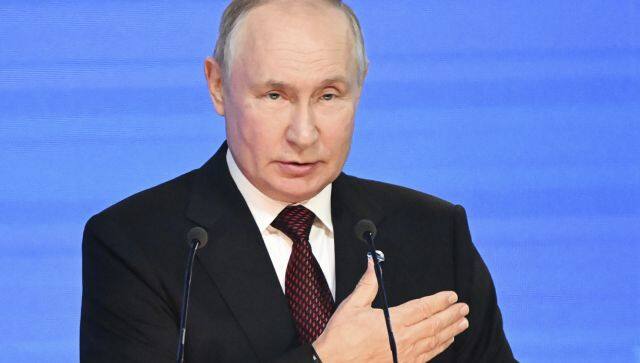 Russian president Vladimir Putin addressing the annual meeting of the Valdai Discussion Club in the Black Sea resort of Sochi on 5 October. AP[/caption]India has been vying for a permanent seat in the UNSC for decades. However, China, Russia’s diplomatic ally, has continued to oppose the move.The Russian president also hit out at the West for “flirting” with India and praised the Modi government for acting independently, as per Bloomberg.“I would like to say that the Indian leadership is independent and strongly nationally oriented,” Putin reportedly said. “They (the West) try to portray those who are not willing to blindly follow these Western elite groups as enemies. They have used this approach with various countries, including China, and tried to do this to India in certain situations”.He added, "Attempts to turn India away from Russia are pointless, India is an independent state," NDTV reported.‘Very wise man’Putin also lauded Modi’s leadership and called the Indian premier a "very wise man". He called for greater cooperation between India and Russia in financial security and combating cybercrime.“We share very good political relations with Prime Minister Modi, he is a very wise man. And India has been making very great strides in development under his leadership. This fully meets the interest of both India and Russia to work on this agenda", ANI quoted the Russian leader as saying, citing a video by Russia-based media RT.Last month, Putin said PM Modi was doing the "right thing" by endorsing the Make in India initiative. Speaking at the 8th Eastern Economic Forum (EEF), the Russian president, as per ANI, said: "You know, we did not have domestically made cars then, but we do now. It is true that they look more modest than Mercedes or Audi cars, which we bought in vast amounts in the 1990s, but this is not an issue. I think that we should emulate many of our partners, for example, India.""They are focused on the manufacture and use of Indian-made vehicles. I think that Prime Minister Modi is doing the right thing in promoting the Make in India programme. He is right," he added.
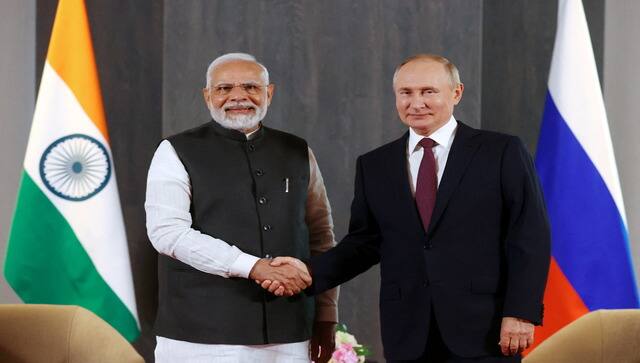 PM Narendra Modi and Russian president Vladimir Putin
attend a meeting on the sidelines of the Shanghai Cooperation Organization (SCO) summit in Uzbekistan's Samarkand last September. Reuters File Photo[/caption]Putin has also developed cordial ties with Modi as well as China’s Xi Jinping, who called the Russian leader his “best friend” in 2019. However, Putin’s relationship with India and other neutral countries has made the West anxious.A report by the Economist Intelligence Unit (EIU) published last April found that “two-thirds of the world’s population lives in neutral or Russia-leaning countries regarding the war in Ukraine.”According to CNBC, Agathe Demarais, the EIU’s global forecasting director, said on the research at the time that “in the coming years Russia (and China) will devote their efforts to courting non-aligned, neutral countries — which are mostly found in the developing world.”“Building on other instruments, such as vaccine diplomacy, the Russian and Chinese governments will hope to forge an opposing front to the West. The eventual result will be a waning influence and gradual retreat of Western countries from much of the developing world.”On its part, New Delhi has been courting a "multipolar world" where India would be a major powerhouse in the global arena.With inputs from agencies

Military drones & police check-ups: How Sri Lanka is fighting against worst dengue outbreak in a decade
How Facebook job ad lured 2 Karnataka men into Myanmar cyber scam camp
Why is India seeing 95% cloud cover despite a Super El Niño?
What is CJP’s fourth demand to the government as protests in Delhi intensify?
The new geography of war: Why the Houthis can no longer be ignored