


Viral at FIFA World Cup: The story of DR Congo’s ‘living statue’ and the leader he stands for
A motionless fan supporting DR Congo at the FIFA World Cup 2026 has everyone talking. Known as 'Lumumba Vea', Michel Nkuka Mboladinga pays tribute to Patrice Lumumba, Congo’s first prime minister. Here’s what we know about the African icon

The FIFA World Cup 2026 is underway.
We have seen it all from spectacular goal celebrations to a colourful section of fans.
And then in couple of matches in Mexico, we saw a man who barely moves at all.
Among the sea of cheering supporters following the Democratic Republic of Congo's (DRC) historic return to football's biggest tournament, Michel Nkuka Mboladinga has become impossible to ignore.
Standing on a small platform near the touchline, dressed in a distinctive suit inspired by his country's national colours and remaining motionless for almost the entire match, he has attracted attention from football fans around the world.
Known widely as "Lumumba Vea" — meaning "Lumumba Lives" — Mboladinga's unusual act is far more than a display of sporting support.
 More from Explainers
Every detail of his appearance, from his clothing to his pose, is intended to honour Patrice Lumumba, the first prime minister of an independent Congo and one of the most influential figures in modern African history.
How does Lumumba Vea personify DRC?
The FIFA World Cup is normally associated with noise, movement and emotion. Fans chant continuously, wave flags, sing national songs and celebrate every significant moment on the pitch.
Mboladinga represents a striking contrast to that atmosphere.
For more than a decade, he has attended matches involving the Democratic Republic of Congo and developed a unique form of support that has become famous throughout African football.
Rather than joining the singing and dancing around him, he climbs onto a small pedestal and assumes the appearance of a monument. Once in position, he remains almost entirely still.
His signature stance involves raising his right arm toward the sky while maintaining a serious expression. Throughout the match he avoids reacting to events on the field, whether they are goals, missed opportunities or controversial decisions.
Even during halftime, he largely maintains the ritual, returning to his position shortly after the interval before continuing until after the final whistle.
His dedication has turned him into a familiar figure at major international tournaments.
Global audiences first became widely aware of him during Africa Cup of Nations competitions, where television cameras frequently focused on the immobile supporter amid energetic crowds.
His profile increased significantly during the 2025 Africa Cup of Nations in Morocco, where images and videos of his unusual support style spread rapidly across social media platforms.
The visual impact of his appearance contributes significantly to his popularity. He wears a carefully constructed outfit inspired by both the Democratic Republic of Congo's national flag and the fashion associated with the country's early independence era.
A bright red jacket and tie, a yellow shirt and blue trousers reflect the colours of the national flag. Vintage horn-rimmed spectacles and a neatly styled haircut complete the look.
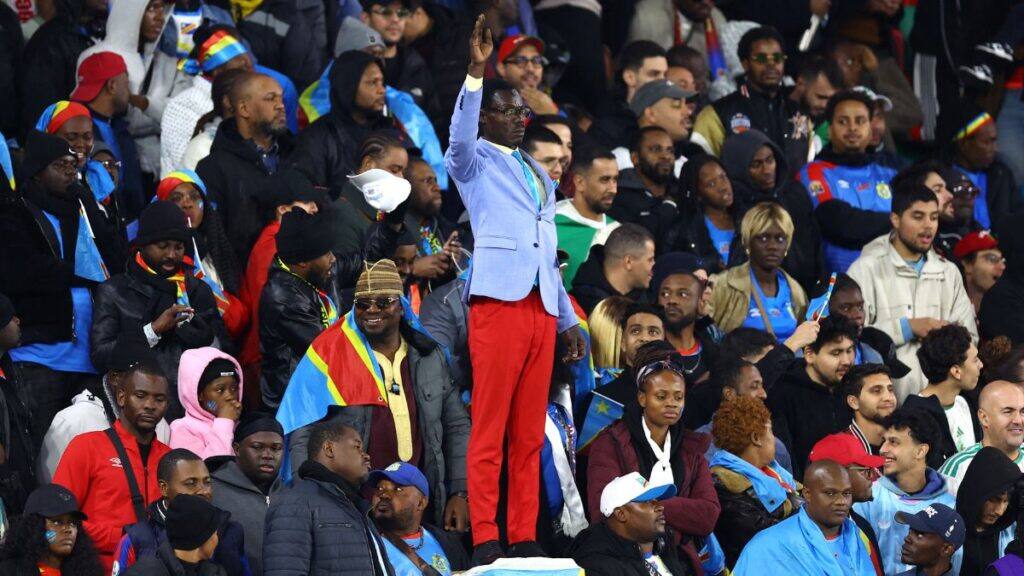
However, the most important aspect of his appearance is not the clothing itself but the historical figure it represents. Everything about the performance is designed to evoke Patrice Lumumba.
Who was Patrice Lumumba?
Patrice Lumumba occupies a unique place in African history.
Born in 1925, he emerged as one of the most prominent advocates for Congolese independence during the final years of Belgian colonial rule. At a time when anti-colonial movements were reshaping the African continent, Lumumba became a leading voice calling for national unity and self-government.
Unlike many political movements that were organised around regional or ethnic identities, Lumumba sought to create a broader national movement.
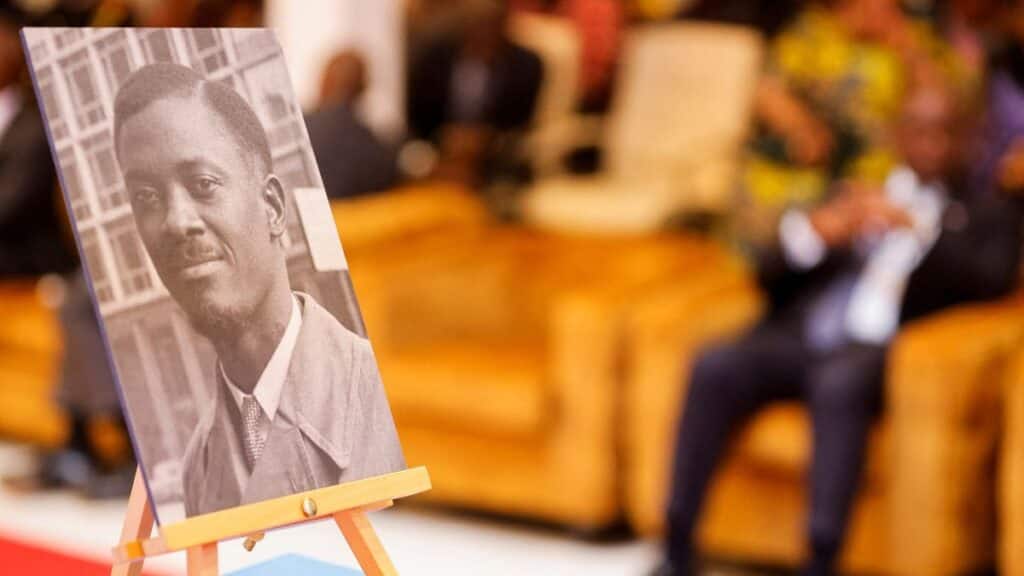
He co-founded the Mouvement National Congolais (MNC), a political organisation that aimed to bring together different communities under a common vision for an independent Congo. His political message, combined with his speaking ability and organisational skills, helped him become one of the most influential figures in the independence movement.
As pressure mounted on Belgium to relinquish control of the colony, Lumumba's prominence continued to grow. By the time independence arrived in 1960, he had become one of the country's most recognisable political leaders.
On June 30, 1960, the Republic of the Congo officially became independent. Lumumba, just 34 years old, assumed office as the country's first prime minister.
What happened during the independence ceremony would become one of the defining moments of his career.
Why is Lumumba's Independence Day speech still remembered today?
The independence ceremony took place in Leopoldville, today known as Kinshasa. Present at the event were senior Congolese officials, international representatives and Belgian King Baudouin, whose country had governed Congo for decades.
Many expected the occasion to be marked by diplomatic pleasantries and ceremonial speeches. Instead, Lumumba delivered remarks that directly addressed the realities of colonial rule.
His words immediately distinguished him from many contemporary leaders and transformed the ceremony into a historic moment. “No Congolese worthy of the name will ever be able to forget that it was by fighting that [our independence] has been won,” Lumumba said.
He then spoke about the experiences endured by Congolese people under colonial rule. “Slavery was imposed on us by force,” he continued, while the king looked on in shock. “We remember the blows that we had to submit to morning, noon and night because we were ‘negroes’.”
The speech was notable because it publicly challenged attempts to portray colonial rule as benevolent. Rather than focusing solely on independence celebrations, Lumumba highlighted the sacrifices, discrimination and hardships experienced by Congolese people.
At the same time, he outlined an ambitious vision for the country's future. “We shall show the world what the Black man can do when working in liberty, and we shall make the Congo the pride of Africa.”
The speech quickly became one of the most famous declarations associated with African decolonisation and helped establish Lumumba as an international symbol of anti-colonial resistance.
Yet the optimism expressed during the ceremony would soon collide with a rapidly deteriorating political situation.
How did the Congo Crisis lead to Lumumba's removal from power?
The transition to independence proved far more unstable than many had anticipated. Within days, the newly independent state was facing serious challenges.
An armed mutiny broke out, undermining confidence in the government's ability to maintain order. Soon afterwards, the mineral-rich province of Katanga declared its secession from the rest of the country.
Belgium intervened by deploying troops to Katanga. For Lumumba, the secession posed a direct threat to national unity.
Seeking assistance, Congo appealed to the United Nations. Although peacekeepers were deployed, they were not sent to confront the separatist movement in Katanga. Faced with a worsening crisis and dissatisfied with the UN response, Lumumba turned to the Soviet Union for logistical support.
This decision dramatically altered the international perception of his government.
The Cold War was escalating, and Western governments viewed Soviet involvement in Africa with increasing concern. Lumumba's outreach to Moscow alarmed both Belgium and the United States.
Political tensions inside Congo also heated up. In September 1960, President Joseph Kasavubu announced Lumumba's dismissal from office. Lumumba rejected the move, creating a constitutional dispute.
Soon afterwards, Colonel Joseph Mobutu launched a military coup that effectively removed Lumumba from power. Mobutu would later become one of Africa's longest-serving rulers, governing the country for decades under the name Mobutu Sese Seko and renaming the nation Zaïre.
Lumumba was placed under house arrest but attempted to escape. His freedom proved short-lived. He was captured by Mobutu's forces in December 1960, setting the stage for the final chapter of his life.
What happened during Lumumba's final days?
The circumstances surrounding Lumumba's death remained unclear for many years, but extensive historical research has since revealed much of what occurred.
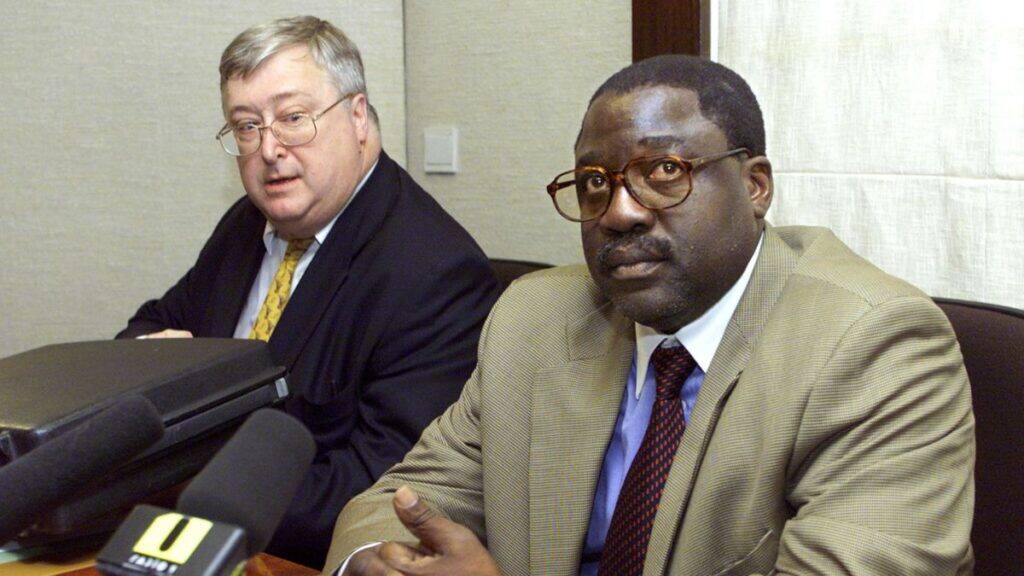
Following his capture, Lumumba was detained along with two associates, Joseph Okito and Maurice Mpolo.
On January 17, 1961, the three men were transported by aircraft to Katanga. Accounts later revealed that they suffered physical abuse during the journey and after arriving at their destination.
Later that day, Lumumba, Okito and Mpolo were executed by a firing squad composed of Katangan personnel operating under Belgian supervision. The treatment of their bodies became one of the most disturbing aspects of the case.
Initially buried in shallow graves, the remains were later exhumed. The bodies were cut apart and dissolved in acid in an effort to eliminate evidence and prevent burial sites from becoming places of political significance.
Only a single tooth survived. The tooth had been taken by a Belgian policeman and remained outside Congo for decades before being returned to Lumumba's relatives in 2022.
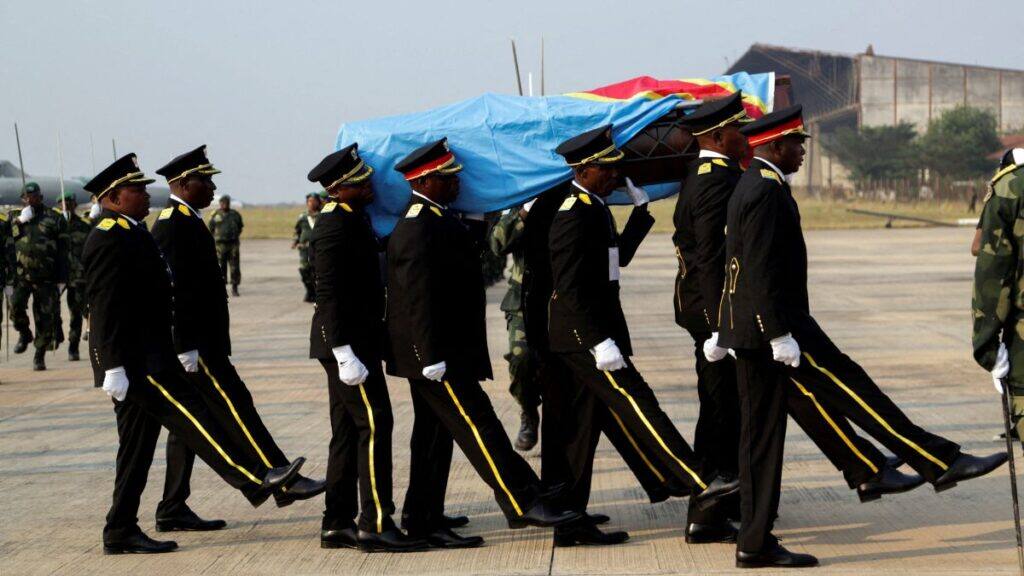
Investigations conducted over the decades shed further light on international involvement surrounding his death. Belgium eventually acknowledged that it carried "moral responsibility for circumstances leading to the death".
Information also emerged linking the United States Central Intelligence Agency to efforts aimed at removing Lumumba. His death transformed him from a political leader into a martyr whose influence extended far beyond Congo.
How does Lumumba's legacy continue to resonate across DRC today?
More than six decades after his assassination, Patrice Lumumba remains one of the most significant figures in Congolese history. For many, he represents the possibility of a united and independent Congo that was never fully realised.
His political career lasted only a few months after independence, yet his image continues to appear in public spaces, political discussions and cultural expressions throughout the country.
The Democratic Republic of Congo continues to face major challenges, including armed conflicts, insecurity, poverty and disputes linked to the exploitation of natural resources.
Despite possessing vast mineral wealth, many Congolese citizens have not benefited from the country's economic potential. For supporters of Lumumba, these conditions serve as reminders of the unfinished aspirations associated with independence.
Whether admired primarily as a nationalist leader, an anti-colonial figure or a symbol of sovereignty, Lumumba remains deeply embedded in the country's collective memory.
That enduring influence helps explain why Michel Nkuka Mboladinga's tribute resonates so strongly.
Why was Mboladinga's journey to the World Cup delayed?
The Democratic Republic of Congo's qualification for the FIFA World Cup represented a massive achievement.
The nation had not appeared at the tournament since 1974, when it competed under the name Zaïre. More than half a century later, the country's return to the global stage generated excitement among supporters both at home and abroad.
For Mboladinga, however, reaching the tournament proved almost as challenging as the qualification campaign itself.
His travel difficulties began before the World Cup finals. He was unable to attend a crucial qualifying playoff against Jamaica because of visa complications.
According to reports, he travelled through Kenya and Ethiopia in an attempt to complete the necessary administrative procedures, but the efforts were unsuccessful and he missed the match.
Additional obstacles emerged after DR Congo secured its place at the World Cup.
An Ebola outbreak in the country led to travel restrictions affecting arrivals from the Democratic Republic of Congo. The outbreak had infected more than 1,000 people and caused 254 deaths, resulting in enhanced controls and complications for travellers.
As a consequence, Mboladinga was unable to reach the tournament in time for his country's opening match.
That fixture produced one of the early surprises of the competition, with DR Congo holding Cristiano Ronaldo-led Portugal to a 1-1 draw in Houston. Yet one of the team's most recognisable supporters was absent.
His delayed arrival became a story in itself. Eventually, after overcoming the travel hurdles, Mboladinga reached Mexico and made his World Cup debut on June 23, at Guadalajara's Estadio Akron, where DR Congo faced Colombia.
More than an hour before kickoff, he took up his familiar position and recreated the pose that football fans across Africa had come to recognise. Despite DR Congo suffering a narrow 1-0 defeat, his appearance was widely celebrated by supporters who had followed his journey.
With that defeat and Portugal's trampling of Uzbekistan, DR Congo has effectively been knocked out of the World Cup with a match against Uzbekistan scheduled on June 27.
Why does this 'Living Statue' matter beyond football?
The pose adopted by Mboladinga is not an invention.
It directly recreates the posture depicted in a well-known monument dedicated to Lumumba in Kinshasa. The raised arm, formal attire and solemn expression all mirror representations of the independence leader that are familiar to many Congolese.
By reproducing that image inside football stadiums, Mboladinga effectively brings a piece of national history into one of the world's most-watched sporting events.
His act connects two very different moments in Congolese history: the struggle for political independence in the twentieth century and the country's return to the FIFA World Cup in the twenty-first.
While other supporters express themselves through songs and celebrations, Mboladinga chooses stillness.
That silence has become his message.
With inputs from agencies
Inhaling global affairs daily, Anmol covers foreign policy & defence with the occasional piece in lifestyle and the thrilling sport of polo, to keep things light when they get too tense. He has far too many disparate interests with a constant itch for travel. You can follow him on X (AnmolSingla001); and please feel free to reach out to him at anmol.singla@nw18.com for interviews, tips, feedback or travel recommendations.

Military drones & police check-ups: How Sri Lanka is fighting against worst dengue outbreak in a decade
How Facebook job ad lured 2 Karnataka men into Myanmar cyber scam camp
Why is India seeing 95% cloud cover despite a Super El Niño?
What is CJP’s fourth demand to the government as protests in Delhi intensify?
The new geography of war: Why the Houthis can no longer be ignored