
Advertisement


Sections
US court rules against affirmative action: What it means for students
The US Supreme Court has banned colleges from using race as admission criteria, essentially ending affirmative action. Introduced in 1960s as a means to enhance diversity in educational institutions, the court’s decision will have far-reaching effects on admission processes

Admissions in the United States will soon see a sea-change, courtesy a ruling by the Supreme Court. On Thursday, the US Supreme Court rejected affirmative action at colleges and universities around the nation, declaring that the race-conscious admissions programs at Harvard and the University of North Carolina were unlawful and sharply curtailing a policy that had long been a pillar of higher education.In a 6-3 ruling, the apex court said, “The Harvard and University of North Carolina admissions programs cannot be reconciled with the guarantees of the equal protection clause. Both programs lack sufficiently focused and measurable objectives warranting the use of race, unavoidably employ race in a negative manner, involve racial stereotyping, and lack meaningful end points.”The ruling is seen as a reflection of the court’s conservative majority – over the past year, the US apex court has upended legislation on issues that define American rights, from abortion rights to gun ownership.Following the court’s decision, US president Joe Biden in a televised address urged the country to make sure the decision was not “the last word” on affirmative action. “Discrimination still exists in America,” he said, repeating his words for emphasis. “Today’s decision does not change that.” Biden paused as a reporter asked if the court was “rogue.” “This is not a normal court,” he responded.Former US president, Barack Obama, also lamented the court’s decision, saying that affirmative action policies had “allowed generations of students” including him and his wife Michelle to “prove we belonged”. He argued that these policies were essential to ensuring that all students, regardless of race or ethnicity, have the opportunity to succeed.“Affirmative action was never a complete answer in the drive towards a more just society. But for generations of students who had been systematically excluded from most of America’s key institutions – it gave us the chance to show we more than deserved a seat at the table,” Obama wrote on social media.On the other hand, Donald Trump, running for president in the 2024 elections, called the decision ‘amazing’, saying it would help the US to “compete with the rest of the world”. “This is the ruling everyone was waiting and hoping for and the result was amazing. It will also keep us competitive with the rest of the world,” he said. “Our greatest minds must be cherished and that’s what this wonderful day has brought. We’re going back to all merit-based – and that’s the way it should be!”We take a closer look at what is affirmative action in colleges and how the court’s decision will impact college admissions.Affirmative action, explainedAffirmative action first made its way into policy in the 1960s, and has been defended as a measure to increase diversity. It was introduced in the United States under the administration of President Lyndon Johnson (1963–69) in order to improve opportunities for African Americans.It refers to the programs and policies in which certain facets of identity — such as race, ethnicity, gender, disability status, even veteran status — are considered in the distribution of resources or opportunities.In the matter of educational institutions, affirmative action refers to admissions policies aimed at increasing the number of Black, Hispanic and other minority students on campus. The end goal of such policies is to increase student diversity in order to enhance the educational experience for all students.[caption id="attachment_12808962" align="alignnone" width="640"]![]() A woman holds a sign as demonstrators for and against the US Supreme Court decision to strike down race-conscious student admissions programs at Harvard University and the University of North Carolina confront each other, in Washington. Reuters[/caption]In fact, in his 1964 book Why We Can’t Wait, prominent activist Martin Luther King Jr explained that Black people deserve “special, compensatory measures” in the workplace and in education due to the nature of American racism. Moreover, in an interview in 1965, he had said that he believed it was fair to “request a multibillion-dollar program of preferential treatment for the Negro, or for any other minority group.”While it is still unknown how colleges and universities in America choose applications, it is a known fact that race is considered a factor while selecting prospective students. A 2019 survey by the National Association for College Admission Counselling had revealed that about a quarter of schools said race had a “considerable” or “moderate” influence on admissions, while more than half reported that race played no role whatsoever.Those who support affirmative action in colleges state that American society has an obligation to correct past injustices, and that means lifting up racial and other groups that have historically been marginalised or worse.Critics, on the other hand, claim that giving advantages to one race is unconstitutional regardless of the motivation or circumstances, going against the principle of equality in the United States. Some have even argued that with the US’ increasing diversity, affirmative action “is not required” anymore.Interestingly, nine states across the US have already banned the use of race in admissions – Arizona, California, Florida, Idaho, Michigan, Nebraska, New Hampshire, Oklahoma and Washington.[caption id="attachment_12809022" align="alignnone" width="640"]
A woman holds a sign as demonstrators for and against the US Supreme Court decision to strike down race-conscious student admissions programs at Harvard University and the University of North Carolina confront each other, in Washington. Reuters[/caption]In fact, in his 1964 book Why We Can’t Wait, prominent activist Martin Luther King Jr explained that Black people deserve “special, compensatory measures” in the workplace and in education due to the nature of American racism. Moreover, in an interview in 1965, he had said that he believed it was fair to “request a multibillion-dollar program of preferential treatment for the Negro, or for any other minority group.”While it is still unknown how colleges and universities in America choose applications, it is a known fact that race is considered a factor while selecting prospective students. A 2019 survey by the National Association for College Admission Counselling had revealed that about a quarter of schools said race had a “considerable” or “moderate” influence on admissions, while more than half reported that race played no role whatsoever.Those who support affirmative action in colleges state that American society has an obligation to correct past injustices, and that means lifting up racial and other groups that have historically been marginalised or worse.Critics, on the other hand, claim that giving advantages to one race is unconstitutional regardless of the motivation or circumstances, going against the principle of equality in the United States. Some have even argued that with the US’ increasing diversity, affirmative action “is not required” anymore.Interestingly, nine states across the US have already banned the use of race in admissions – Arizona, California, Florida, Idaho, Michigan, Nebraska, New Hampshire, Oklahoma and Washington.[caption id="attachment_12809022" align="alignnone" width="640"]![]() A demonstrator holds a sign aloft as the affirmative action in university admissions case was being heard at the Supreme Court. Reuters[/caption]The litigation in courtThe US Supreme Court’s decision on Thursday stems from two cases filed by a group called Students for Fair Admissions. The group, led by Edward Blum, filed the cases against Harvard University and the University of North Carolina. In each suit, the plaintiff claimed that the elite college’s admissions practices which consider an applicant’s race were racially discriminatory.Blum, the president of Students for Fair Admissions, has argued that race-conscious admissions place either unfair advantages or disadvantages toward an applicant based on race. Instead of affirmative action, Blum believes colleges and universities should be using more merit-based systems where students are admitted solely on their academic qualifications.In the North Carolina matter, Students for Fair Admissions stated that the university discriminated against white and Asian applicants by giving preference to Black, Hispanic and Native American ones. They alleged that the adoption by UNC, a public university, of an admissions policy that is not race neutral violates the guarantee to equal protection of the law under the Constitution’s 14th Amendment. They alleged the same in the Harvard case, adding that the reputed institution was discriminating against Asian American students by using a subjective standard to gauge traits like likability, courage and kindness, and by effectively creating a ceiling for them in admissions.[caption id="attachment_12809042" align="alignnone" width="640"]
A demonstrator holds a sign aloft as the affirmative action in university admissions case was being heard at the Supreme Court. Reuters[/caption]The litigation in courtThe US Supreme Court’s decision on Thursday stems from two cases filed by a group called Students for Fair Admissions. The group, led by Edward Blum, filed the cases against Harvard University and the University of North Carolina. In each suit, the plaintiff claimed that the elite college’s admissions practices which consider an applicant’s race were racially discriminatory.Blum, the president of Students for Fair Admissions, has argued that race-conscious admissions place either unfair advantages or disadvantages toward an applicant based on race. Instead of affirmative action, Blum believes colleges and universities should be using more merit-based systems where students are admitted solely on their academic qualifications.In the North Carolina matter, Students for Fair Admissions stated that the university discriminated against white and Asian applicants by giving preference to Black, Hispanic and Native American ones. They alleged that the adoption by UNC, a public university, of an admissions policy that is not race neutral violates the guarantee to equal protection of the law under the Constitution’s 14th Amendment. They alleged the same in the Harvard case, adding that the reputed institution was discriminating against Asian American students by using a subjective standard to gauge traits like likability, courage and kindness, and by effectively creating a ceiling for them in admissions.[caption id="attachment_12809042" align="alignnone" width="640"]![]() People protest outside of the Supreme Court in Washington. The Supreme Court on Thursday struck down affirmative action in college admissions, declaring race cannot be a factor and forcing institutions of higher education to look for new ways to achieve diverse student bodies. AP[/caption]The US Supreme Court ruled that the educational institutions were illegally discriminating based on race and violating the 14th Amendment of the Constitution.However, the decision was not unanimous and Justices Sonia Sotomayor and Ketanji Brown Jackson expressed their dissent. Justice Sotomayor, along with Justice Elena Kagan, said, “Today, this court stands in the way and rolls back decades of precedent and momentous progress. The court cements a superficial rule of colourblindness as a constitutional principle in an endemically segregated society where race has always mattered and continues to matter.”How the decision will impact admissionsWhile some celebrated the court’s decision, some students who were applying for colleges pondered what the outcome would be on the ground. The ruling will force many universities, including their law and medical schools, to change admissions policies.However, some educational experts noted that it wouldn’t prevent them from pursuing diversity or giving extra consideration to students who have overcome hardships or discrimination. And that’s because of a passage near the end of the chief justice’s 40-page ruling wherein he writes – “Nothing in this opinion should be construed as prohibiting universities from considering an applicant’s discussion of how race affected his or her life, be it through discrimination, inspiration, or otherwise.”As per a New York Times report, the decision could lead to an admissions system that is even more subjective and mysterious, as colleges try to follow the law but also admit a diverse class of students. The report added that universities that owing to the lack of affirmative action, officials would place less emphasis on standardised metrics and more on personal qualities – the exact opposite of what opponents of affirmative action had hoped for.Other experts note that the essay that applicants pen during the admission process would become even more important and would include how race had affected their lives.[caption id="attachment_12809072" align="alignnone" width="640"]
People protest outside of the Supreme Court in Washington. The Supreme Court on Thursday struck down affirmative action in college admissions, declaring race cannot be a factor and forcing institutions of higher education to look for new ways to achieve diverse student bodies. AP[/caption]The US Supreme Court ruled that the educational institutions were illegally discriminating based on race and violating the 14th Amendment of the Constitution.However, the decision was not unanimous and Justices Sonia Sotomayor and Ketanji Brown Jackson expressed their dissent. Justice Sotomayor, along with Justice Elena Kagan, said, “Today, this court stands in the way and rolls back decades of precedent and momentous progress. The court cements a superficial rule of colourblindness as a constitutional principle in an endemically segregated society where race has always mattered and continues to matter.”How the decision will impact admissionsWhile some celebrated the court’s decision, some students who were applying for colleges pondered what the outcome would be on the ground. The ruling will force many universities, including their law and medical schools, to change admissions policies.However, some educational experts noted that it wouldn’t prevent them from pursuing diversity or giving extra consideration to students who have overcome hardships or discrimination. And that’s because of a passage near the end of the chief justice’s 40-page ruling wherein he writes – “Nothing in this opinion should be construed as prohibiting universities from considering an applicant’s discussion of how race affected his or her life, be it through discrimination, inspiration, or otherwise.”As per a New York Times report, the decision could lead to an admissions system that is even more subjective and mysterious, as colleges try to follow the law but also admit a diverse class of students. The report added that universities that owing to the lack of affirmative action, officials would place less emphasis on standardised metrics and more on personal qualities – the exact opposite of what opponents of affirmative action had hoped for.Other experts note that the essay that applicants pen during the admission process would become even more important and would include how race had affected their lives.[caption id="attachment_12809072" align="alignnone" width="640"]![]() Proponents for affirmative action in higher education rally in front of the US Supreme Court before oral arguments in Students for Fair Admissions v President and Fellows of Harvard College and Students for Fair Admissions v University of North Carolina. AFP[/caption]Angie Gabeau, the president of the Harvard Black Students Association, told the BBC that “students that are affected by their race in this country will now feel obligated to trauma-dump in their applications to show how race is affecting their lives”.Natasha Warikoo, Lenore Stern Professor in the Humanities and Social Sciences in the Department of Sociology at Tufts University in Massachusetts, told USNews that the Supreme Court decision would be “pretty devastating in terms of higher education”. “I think we will start to see a decline in representation at a lot of different levels as a result.”The worry of the removal of affirmative action was concisely put forth by 16-year-old student Danyael Morales. Speaking to New York Times, he said, “It makes me more stressed about the whole concept of college. And with the whole agenda of not seeing race, I feel like colleges are not going to see me.”With inputs from agenciesRead all the Latest News, Trending News, Cricket News, Bollywood News,India News and Entertainment News here. Follow us on Facebook, Twitter and Instagram.
Proponents for affirmative action in higher education rally in front of the US Supreme Court before oral arguments in Students for Fair Admissions v President and Fellows of Harvard College and Students for Fair Admissions v University of North Carolina. AFP[/caption]Angie Gabeau, the president of the Harvard Black Students Association, told the BBC that “students that are affected by their race in this country will now feel obligated to trauma-dump in their applications to show how race is affecting their lives”.Natasha Warikoo, Lenore Stern Professor in the Humanities and Social Sciences in the Department of Sociology at Tufts University in Massachusetts, told USNews that the Supreme Court decision would be “pretty devastating in terms of higher education”. “I think we will start to see a decline in representation at a lot of different levels as a result.”The worry of the removal of affirmative action was concisely put forth by 16-year-old student Danyael Morales. Speaking to New York Times, he said, “It makes me more stressed about the whole concept of college. And with the whole agenda of not seeing race, I feel like colleges are not going to see me.”With inputs from agenciesRead all the Latest News, Trending News, Cricket News, Bollywood News,India News and Entertainment News here. Follow us on Facebook, Twitter and Instagram.
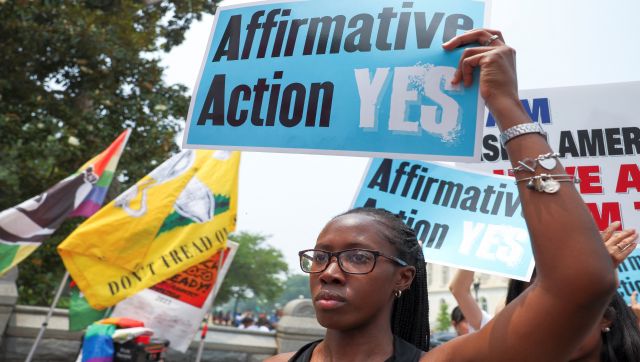 A woman holds a sign as demonstrators for and against the US Supreme Court decision to strike down race-conscious student admissions programs at Harvard University and the University of North Carolina confront each other, in Washington. Reuters[/caption]In fact, in his 1964 book Why We Can’t Wait, prominent activist Martin Luther King Jr explained that Black people deserve “special, compensatory measures” in the workplace and in education due to the nature of American racism. Moreover, in an interview in 1965, he had said that he believed it was fair to “request a multibillion-dollar program of preferential treatment for the Negro, or for any other minority group.”While it is still unknown how colleges and universities in America choose applications, it is a known fact that race is considered a factor while selecting prospective students. A 2019 survey by the National Association for College Admission Counselling had revealed that about a quarter of schools said race had a “considerable” or “moderate” influence on admissions, while more than half reported that race played no role whatsoever.Those who support affirmative action in colleges state that American society has an obligation to correct past injustices, and that means lifting up racial and other groups that have historically been marginalised or worse.Critics, on the other hand, claim that giving advantages to one race is unconstitutional regardless of the motivation or circumstances, going against the principle of equality in the United States. Some have even argued that with the US’ increasing diversity, affirmative action “is not required” anymore.Interestingly, nine states across the US have already banned the use of race in admissions – Arizona, California, Florida, Idaho, Michigan, Nebraska, New Hampshire, Oklahoma and Washington.[caption id="attachment_12809022" align="alignnone" width="640"]
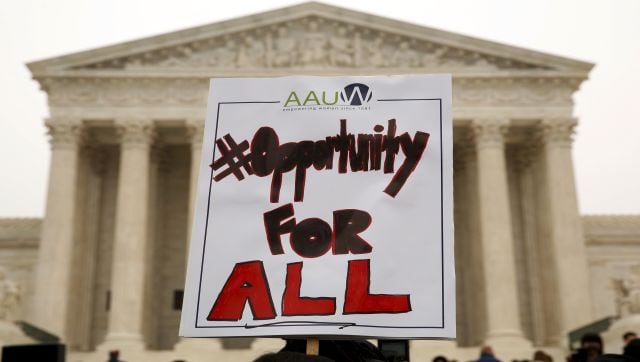 A demonstrator holds a sign aloft as the affirmative action in university admissions case was being heard at the Supreme Court. Reuters[/caption]The litigation in courtThe US Supreme Court’s decision on Thursday stems from two cases filed by a group called Students for Fair Admissions. The group, led by Edward Blum, filed the cases against Harvard University and the University of North Carolina. In each suit, the plaintiff claimed that the elite college’s admissions practices which consider an applicant’s race were racially discriminatory.Blum, the president of Students for Fair Admissions, has argued that race-conscious admissions place either unfair advantages or disadvantages toward an applicant based on race. Instead of affirmative action, Blum believes colleges and universities should be using more merit-based systems where students are admitted solely on their academic qualifications.In the North Carolina matter, Students for Fair Admissions stated that the university discriminated against white and Asian applicants by giving preference to Black, Hispanic and Native American ones. They alleged that the adoption by UNC, a public university, of an admissions policy that is not race neutral violates the guarantee to equal protection of the law under the Constitution’s 14th Amendment. They alleged the same in the Harvard case, adding that the reputed institution was discriminating against Asian American students by using a subjective standard to gauge traits like likability, courage and kindness, and by effectively creating a ceiling for them in admissions.[caption id="attachment_12809042" align="alignnone" width="640"]
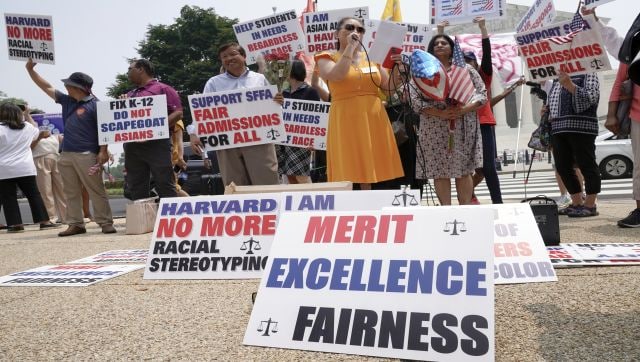 People protest outside of the Supreme Court in Washington. The Supreme Court on Thursday struck down affirmative action in college admissions, declaring race cannot be a factor and forcing institutions of higher education to look for new ways to achieve diverse student bodies. AP[/caption]The US Supreme Court ruled that the educational institutions were illegally discriminating based on race and violating the 14th Amendment of the Constitution.However, the decision was not unanimous and Justices Sonia Sotomayor and Ketanji Brown Jackson expressed their dissent. Justice Sotomayor, along with Justice Elena Kagan, said, “Today, this court stands in the way and rolls back decades of precedent and momentous progress. The court cements a superficial rule of colourblindness as a constitutional principle in an endemically segregated society where race has always mattered and continues to matter.”How the decision will impact admissionsWhile some celebrated the court’s decision, some students who were applying for colleges pondered what the outcome would be on the ground. The ruling will force many universities, including their law and medical schools, to change admissions policies.However, some educational experts noted that it wouldn’t prevent them from pursuing diversity or giving extra consideration to students who have overcome hardships or discrimination. And that’s because of a passage near the end of the chief justice’s 40-page ruling wherein he writes – “Nothing in this opinion should be construed as prohibiting universities from considering an applicant’s discussion of how race affected his or her life, be it through discrimination, inspiration, or otherwise.”As per a New York Times report, the decision could lead to an admissions system that is even more subjective and mysterious, as colleges try to follow the law but also admit a diverse class of students. The report added that universities that owing to the lack of affirmative action, officials would place less emphasis on standardised metrics and more on personal qualities – the exact opposite of what opponents of affirmative action had hoped for.Other experts note that the essay that applicants pen during the admission process would become even more important and would include how race had affected their lives.[caption id="attachment_12809072" align="alignnone" width="640"]
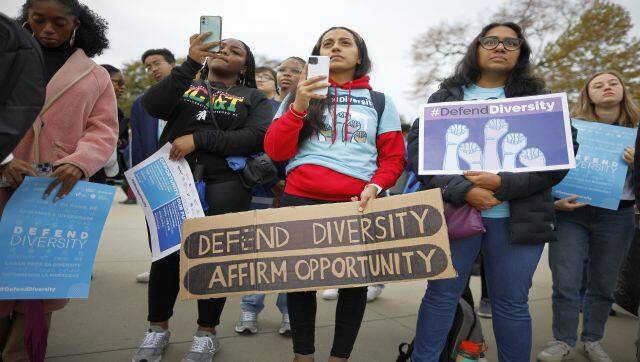 Proponents for affirmative action in higher education rally in front of the US Supreme Court before oral arguments in Students for Fair Admissions v President and Fellows of Harvard College and Students for Fair Admissions v University of North Carolina. AFP[/caption]Angie Gabeau, the president of the Harvard Black Students Association, told the BBC that “students that are affected by their race in this country will now feel obligated to trauma-dump in their applications to show how race is affecting their lives”.Natasha Warikoo, Lenore Stern Professor in the Humanities and Social Sciences in the Department of Sociology at Tufts University in Massachusetts, told USNews that the Supreme Court decision would be “pretty devastating in terms of higher education”. “I think we will start to see a decline in representation at a lot of different levels as a result.”The worry of the removal of affirmative action was concisely put forth by 16-year-old student Danyael Morales. Speaking to New York Times, he said, “It makes me more stressed about the whole concept of college. And with the whole agenda of not seeing race, I feel like colleges are not going to see me.”With inputs from agenciesRead all the Latest News, Trending News, Cricket News, Bollywood News,India News and Entertainment News here. Follow us on Facebook, Twitter and Instagram.
First Published:Jun 30, 2023, 13:52:01 IST
Advertisement
Advertisement

Military drones & police check-ups: How Sri Lanka is fighting against worst dengue outbreak in a decade
Sri Lanka is fighting its most severe dengue outbreak in nearly a decade, with infections rising sharply across the nation. Military drones have been deployed to tackle the outbreak, which has claimed 56 lives. Health officials said the outbreak is being driven primarily by the DENV-2 variant of the virus
3 min read
How Facebook job ad lured 2 Karnataka men into Myanmar cyber scam camp
The Karnataka Cyber Command has rescued two youths from a scam compound in Myanmar operated by Chinese fraudsters. The duo from Karnataka were lured on the pretext of data-entry jobs. They were asked to work for 16 hours a day and were expected to sleep for six hours daily
4 min read
Why is India seeing 95% cloud cover despite a Super El Niño?
India is witnessing nearly 95 per cent cloud cover despite a Super El Niño, a climate event usually linked to weaker monsoons. Regional weather systems, cyclonic circulations, the monsoon trough and moisture from two seas are temporarily overpowering one of the world's strongest climate phenomena
5 min read
What is CJP’s fourth demand to the government as protests in Delhi intensify?
The protest by the Cockroach Janta Party at Delhi’s Jantar Mantar refuses to die down. The group have made a fourth demand to the Centre, asking that no FIRs are filed against the agitators and that no legal action be taken. The government has expressed willingness to speak to the protesters, but refused to accede on the resignation of Education Minister Dharmandra Pradhan
5 min read
The new geography of war: Why the Houthis can no longer be ignored
The rise of the Houthis marks the emergence of a new geography of war — one in which influence flows not only from capitals and conventional armies, but also from rugged mountains overlooking vital sea lanes
6 min read
Advertisement
Advertisement