
Advertisement


Sections
US celebrates Kwanzaa: What this seven-day holiday means for Black Americans
Kwanzaa is a seven-day celebration of African American and Pan-African culture and meant to unite Black Americans. Since its creation in 1966, it is marked every year from 26 December until 1 January

It's the season of holidays! Amid the Christmas cheer, the US First Family of Joe and Jill Biden also wished a happy Kwanzaa to those celebrating, as the first day of the holiday kicked off on Monday.“Jill and I wish everyone a happy Kwanzaa,” Biden said in a video with the first lady, adding that they “give thanks to the rich heritage of African Americans, which is deep in the story of our nation.”Vice President Kamala Harris also took the opportunity to share her own experience with Kwanzaa as a child.“Growing up, Kwanzaa was always a special time – we came together with generations of friends and family and neighbors,” Harris said. “There were never enough chairs, so my sister and I and the other children would often sit on the floor, and together we lit the candles of the kinara, and then the elders would talk about how Kwanzaa is a time to celebrate culture, community and family, and they of course taught us about the seven principles.”But what exactly is this holiday? Who celebrates it and what's the significance of this day? Here's a look at all things Kwanzaa.What is Kwanzaa?The name Kwanzaa has been derived from the phrase ‘matunda ya kwanza’ which means first fruits or harvest in Swahili, as per the non-profit international exchange organisation, Interexchange.This holiday, which has links to harvest festivals in Africa and communities across the world, was started by Dr Maulana Karenga, professor, and chair of the department of African Studies at California State University, Long Beach.The festival is based on the first fruit celebrations and cultures throughout Africa. It is meant to unite Black Americans in the community.The report suggests Dr Karenga was inspired by Africa’s harvest culture and combined aspects of various other celebrations such as Ashanti and those of Zulu to create Kwanzaa.He created the festival in response to the 1965 Watts Riots in Los Angeles, which was in parallel to the Black Freedom Movement in America.It is secular in nature and does not associate with any religion in particular. It aims at bringing African-Americans together as a community.Ever since it was created back in 1966, Black families celebrate Kwanzaa every year from 26 December until 1 January.[caption id="attachment_11889251" align="alignnone" width="640"]![]()
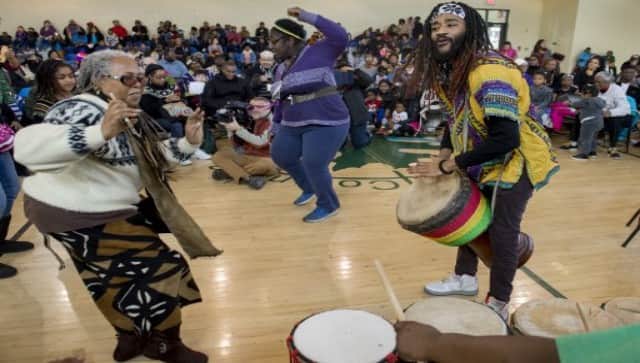
Performers with the African Heritage Dancers and Drummers hold a Kwanzaa celebration in Washington, DC. AFP[/caption]What are the seven core principles of Kwanzaa?Each day of the special week represents seven guiding principles, also known as “Nguzo Saba,” created by Dr Karenga.The principles represent seven values of African culture that “help build and reinforce community among African-Americans.”The seven core principles of the festival are as follows:
- Umoja, which means unity
- Kujichagulia, which means self-determination
- Ujima, which means collective work and responsibility
- Ujamaa, meaning cooperative economics
- Nia means purpose
- Kuumba means creativity
- Imani means faith
- Mazao (Crops) - It symbolises the fruits of collective planning and work, and the resulting joy, sharing, unity, and thanksgiving of African harvest festivals.
- Mkeka (Place Mat) - This symbolises the historical and traditional foundation for people to stand on and build their lives.
- Muhindi (Ear of Corn) - This represents fertility and the idea that through children, the future hopes of the family are brought to life.
- Mishumaa Saba (The Seven Candles) - Candles have the power to recreate the sun’s power and to provide light. The three different colour candles used during the festival - three red, three green, and one black.
- Kinara (the Candleholder) - It represents ancestry, and the original stalk from which people come from.
- Kikombe Cha Umoja (The Unity Cup) - On the sixth day, each family member come together for a drink as a sign of unity and remembrance.
- Zawadi (Gifts)- On the final day of Kwanzaa, gifts are given to encourage growth, achievement, and success. Additionally, handmade gifts are given to promote self-determination, purpose, and creativity.
First Published:Dec 28, 2022, 17:15:47 IST
Advertisement
Advertisement

Military drones & police check-ups: How Sri Lanka is fighting against worst dengue outbreak in a decade
Sri Lanka is fighting its most severe dengue outbreak in nearly a decade, with infections rising sharply across the nation. Military drones have been deployed to tackle the outbreak, which has claimed 56 lives. Health officials said the outbreak is being driven primarily by the DENV-2 variant of the virus
3 min read
How Facebook job ad lured 2 Karnataka men into Myanmar cyber scam camp
The Karnataka Cyber Command has rescued two youths from a scam compound in Myanmar operated by Chinese fraudsters. The duo from Karnataka were lured on the pretext of data-entry jobs. They were asked to work for 16 hours a day and were expected to sleep for six hours daily
4 min read
Why is India seeing 95% cloud cover despite a Super El Niño?
India is witnessing nearly 95 per cent cloud cover despite a Super El Niño, a climate event usually linked to weaker monsoons. Regional weather systems, cyclonic circulations, the monsoon trough and moisture from two seas are temporarily overpowering one of the world's strongest climate phenomena
5 min read
What is CJP’s fourth demand to the government as protests in Delhi intensify?
The protest by the Cockroach Janta Party at Delhi’s Jantar Mantar refuses to die down. The group have made a fourth demand to the Centre, asking that no FIRs are filed against the agitators and that no legal action be taken. The government has expressed willingness to speak to the protesters, but refused to accede on the resignation of Education Minister Dharmandra Pradhan
5 min read
The new geography of war: Why the Houthis can no longer be ignored
The rise of the Houthis marks the emergence of a new geography of war — one in which influence flows not only from capitals and conventional armies, but also from rugged mountains overlooking vital sea lanes
6 min read
Advertisement
Advertisement