


US Boeing KC-135 disappears over Qatar. What do we know about ‘flying gas station’?
A Boeing KC-135 Stratotanker has gone missing over Qatar. The plane had issued an emergency distress signal while flying over the Persian Gulf near Iran. The aircraft, which is known as a ‘flying gas station’, had been providing support to US operations in West Asia. But what happened?

A Boeing KC-135 Stratotanker has gone missing over Qatar, according to several media reports.
The plane issued an emergency distress signal while flying over the Persian Gulf near Iran. The aircraft, which is known as a ‘flying gas station’, had been providing support to US operations in West Asia.
But what happened? What do we know about the KC-135?
Let’s take a closer look.
KC-135 goes missing
Hindustan Times cited Flightradar24 data and Tasnim News Agency as saying that the Boeing KC-135 Stratotanker issued a “7700” distress call near Iran. The aircraft took off from Al Dhafra Air Base in the United Arab Emirates (UAE) and went off the radar over Qatar.
 More from Explainers
According to the newspaper, while this denotes an in-flight emergency, there is no confirmation from the Pentagon or CENTCOM that the Stratotanker has crashed. What’s more, the “7700” distress signal is common given the GPS/electronic jamming amid regional tensions.
Flight tracking data shows that the plane went in a circular pattern before beginning its descent. The incident was reported by Iran’s semi-official Fars News Agency. Neither Iran nor the United States has officially commented on the disappearance of the Stratotanker.
The US previously lost a KC-135 Stratotanker in western Iraq during Operation Epic Fury in March. The incident saw six US service members being killed. The Islamic Resistance of Iraq had claimed to have downed the aircraft. The group said that it shot down the aircraft "in defence of our country's sovereignty and airspace".
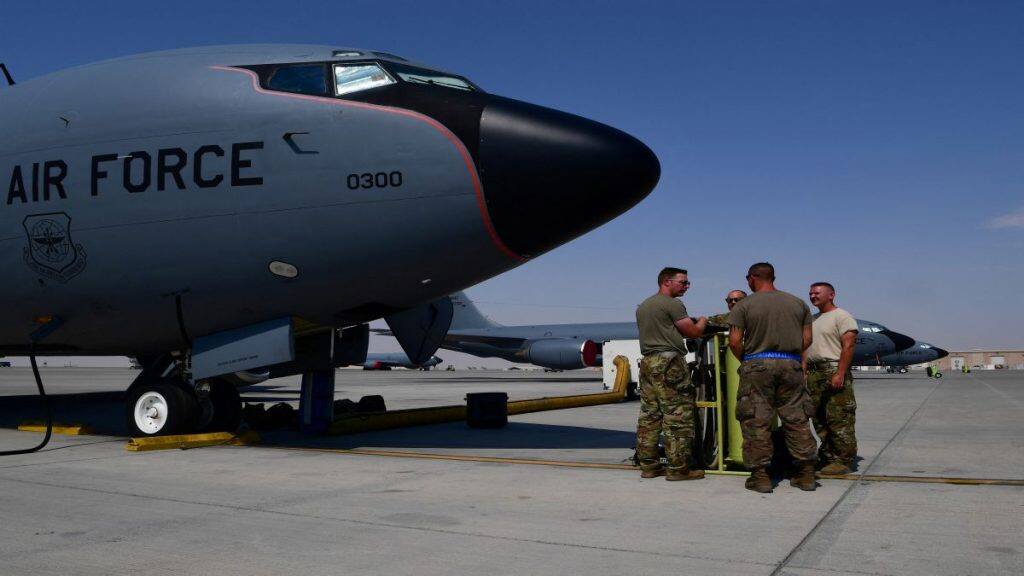
Iran’s Islamic Revolutionary Guard Corps (IRGC) also said the Boeing KC-135 Stratotanker was taken down by air defence systems of the “Resistance Front” while it was refuelling a fighter jet. However, CENTCOM insisted that the incident was “not due to hostile fire or friendly fire”. The US has lost multiple aircraft, including three fighter jets, during Operation Epic Fury.
All about the ‘flying gas station’
The KC-135 Stratotanker has been the backbone of US aerial refuelling operations for more than six decades. Its core function is to extend the range of US aircraft by refuelling them mid-air. This capability allows fighter jets, bombers and surveillance aircraft to remain operational for far longer without needing to land.
The aircraft uses a specialised refuelling system known as a flying boom. A crew member, called the boom operator, lies or sits at the rear of the aircraft and manually guides the boom into a receiving aircraft during flight. In addition to this, the KC-135 can be fitted with a hose-and-drogue system, enabling it to refuel aircraft designed with probe systems, including those used by allied forces.
Powered by four turbofan engines mounted beneath swept wings, the aircraft combines range with payload capability. It can also be configured to carry cargo, personnel or medical patients. In aeromedical evacuation roles, it is capable of transporting both stretcher-bound and ambulatory patients, supported by onboard medical teams.
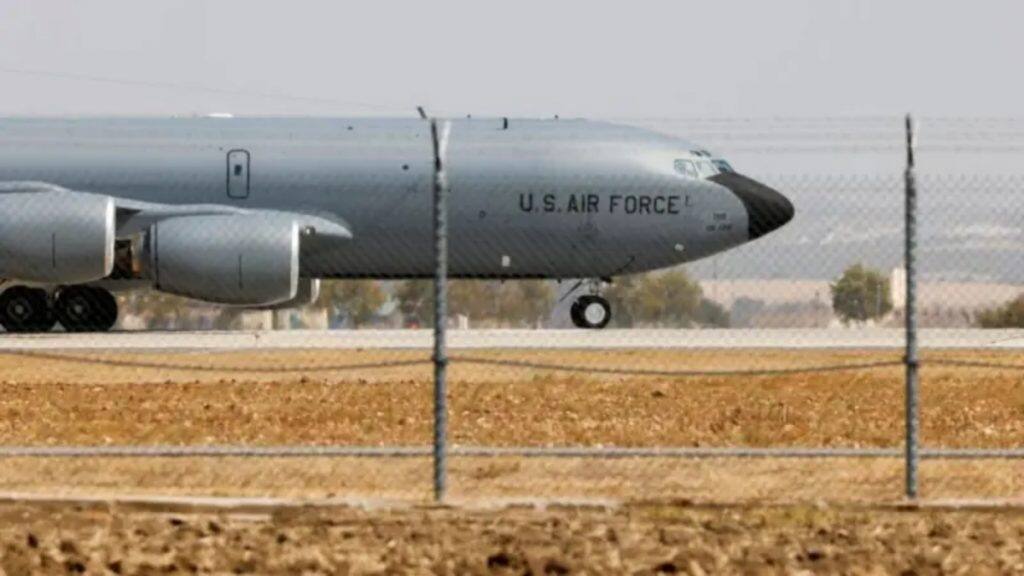
As per NDTV, the KC-135 traces its origins to Boeing’s 367-80 prototype, which also led to the development of the Boeing 707 passenger jet. First ordered by the US Air Force in 1954, the aircraft entered service in 1957. Over time, the fleet expanded significantly, with hundreds produced before manufacturing ended in 1965.
Several upgrades have kept the aircraft relevant. The KC-135R and KC-135T variants, fitted with more efficient CFM56 engines, offer improved fuel efficiency, lower operating costs and reduced noise levels. These upgraded versions can offload significantly more fuel compared to earlier models. Older variants such as the KC-135E were retired by 2009.
Today, the US continues to operate hundreds of Stratotankers across active duty, reserve and Air National Guard units. Despite its age, the aircraft remains a crucial part of US military logistics, although it is gradually being supplemented by newer platforms.
FAQs
1. What does a “7700” distress signal mean?
A “7700” squawk code is a universal emergency signal used by aircraft to indicate a general emergency.
2. Why is the KC-135 called a ‘flying gas station’?
The KC-135 earns this nickname because its primary role is to refuel other aircraft mid-air, allowing them to fly longer missions without landing. It effectively acts as an airborne fuel tanker.
3. Is the KC-135 still in active service?
Yes, the KC-135 remains in active service with the US Air Force, including reserve and National Guard units.
With inputs from agencies
Tags

Military drones & police check-ups: How Sri Lanka is fighting against worst dengue outbreak in a decade
How Facebook job ad lured 2 Karnataka men into Myanmar cyber scam camp
Why is India seeing 95% cloud cover despite a Super El Niño?
What is CJP’s fourth demand to the government as protests in Delhi intensify?
The new geography of war: Why the Houthis can no longer be ignored