


Hottest May in the UK, France: Why temperatures are soaring above 35°C
The United Kingdom and France are witnessing their hottest May as temperatures cross 35 degrees Celsius and even beyond. Early summer heat is making parts of Europe sweat, with Spain and Italy also being baked. But what is behind such high temperatures?

Europe is experiencing scorching temperatures as it braces for mercury to soar further this week. The United Kingdom, Spain, France and Italy are sweltering as extreme early summer heat hits parts of the continent.
Forecasters in Europe warned temperatures would rise on Tuesday (May 26) and could remain high until the end of the week. These record temperatures are being driven by a so-called "heat dome".
We explain.
Temperatures shatter records in UK
The UK witnessed its hottest May day on record as temperatures touched 34.8 degrees Celsius at Kew Gardens in southwest London on Monday.
Wales also recorded its hottest May day, with temperatures hitting 32.2 degrees Celsius at Hawarden Airport in Flintshire.
"This heat would be exceptional in the UK even in mid-summer, let alone May," the Met Office weather agency said on X.
 More from Explainers
The UK reported its warmest May night on Sunday, reaching as high as 19.4 degrees Celsius in London, as per BBC.
These extreme temperatures have been caused by "the influence of warmth building under an area of high pressure near the UK", Met Office chief operational meteorologist Dan Suri said.
On Tuesday, temperatures could reach 35 degrees Celsius in the warmest parts of southeast England, while some thunderstorms could occur by evening, forecasters say.
Temperatures are predicted to touch 30 degrees Celsius on Wednesday and Thursday in England and Wales before plunging into the high 20s on Friday.
In 2022, temperatures in the UK had jumped above 40 degrees Celsius for the first time.
The Met Office's State of the UK Climate report has found that the number of days in the country with temperatures above 28 degrees Celsius has more than doubled and those with temperatures above 30 degrees Celsius have more than tripled in the most recent decade, compared with the 1961-1990 average.
Last week, climate advisers warned the UK government that the country was "built for a climate that no longer exists", urging it to adapt infrastructure like schools and hospitals for a warming planet.
Air conditioners (ACs) are not common in Europe. In the UK, only about five per cent of homes have cooling systems, mostly portable AC units. Most homes in the UK are heavily insulated for winter, as double-glazed windows and dark roofs trap heat.
France simmers in heat
The punishing heat in parts of Western Europe is also boiling France. The country recorded its hottest day in May on Monday.
According to the national weather agency Météo France, 352 weather stations mainly in western France logged new monthly highs for May on Monday, with the highest – 37.1 degrees Celsius – recorded near Hossegor in Landes.
It said that for France as a whole, "Monday was the hottest day recorded for the month of May since measurements began". The soaring mercury even made tennis fans at Roland-Garros in Paris sweat.
Temperatures across the west of France could surpass 36 degrees Celsius on Tuesday.
The weather agency further warned that temperatures of 33 degrees Celsius to 36 degrees Celsius were expected and could last until the end of the week.
“This is an unprecedented event with a one in 1,000 chance of happening at this time of year based on the climate from 1979 to 2025 and virtually impossible in the preindustrial era,” Christophe Cassou, a climate scientist, told Le Monde.
French Prime Minister Sebastien Lecornu is set to convene a meeting on Thursday with key ministers to assess the government's preparations for the heatwave.
A man died during a 10-kilometre running race in the Paris suburb of Maisons-Alfort on Sunday, a day after the city saw its first temperature above 30 degrees Celsius this year. Ten other runners had to be taken to the hospital in critical condition after the race.
A woman participating in a Hyrox fitness competition in Lyon on Sunday died of hyperthermia. Both deaths have been linked to the extreme heat.
Of the 96 administrative departments of metropolitan France, 31 are on high-temperature alert until Tuesday. The orange alert has been issued for eight of these departments, as residents have been urged to “take precautions”.
Spain, Italy and other European nations sizzle
In Spain, mercury climbed to 38 degrees Celsius over the weekend in some southern areas, between 5 degrees Celsius and 10 degrees Celsius higher than normal.
Speaking to The Guardian, Rubén del Campo of the state meteorological office Aemet said that this hot spell is likely to continue through the week.
“The other really notable thing is that the situation is going to last until at least the end of the week. In fact, it could get even hotter on Thursday and Friday, with temperatures of at least 34 degrees Celsius across most of the country,” del Campo said.
The Guadiana, Guadalquivir and Ebro valleys could experience highs of 36-38 degrees Celsius between Wednesday and Friday, he said, adding that “in some of those areas, temperatures could reach 40 degrees Celsius ”.
According to del Campo, much of Spain could expect “tropical nights”, in which the night-time temperature does not fall below 20 degrees Celsius.
Southern and southwestern regions in Europe, including Portugal, Spain and France, are set to bake as temperatures surge to 38 degrees Celsius.
Northern countries such as Germany are recording maximum temperatures over 30 degrees Celsius.
Temperatures across France, Germany, Switzerland, Spain and northern Italy have been 10 to 15 degrees Celsius above average for late May.
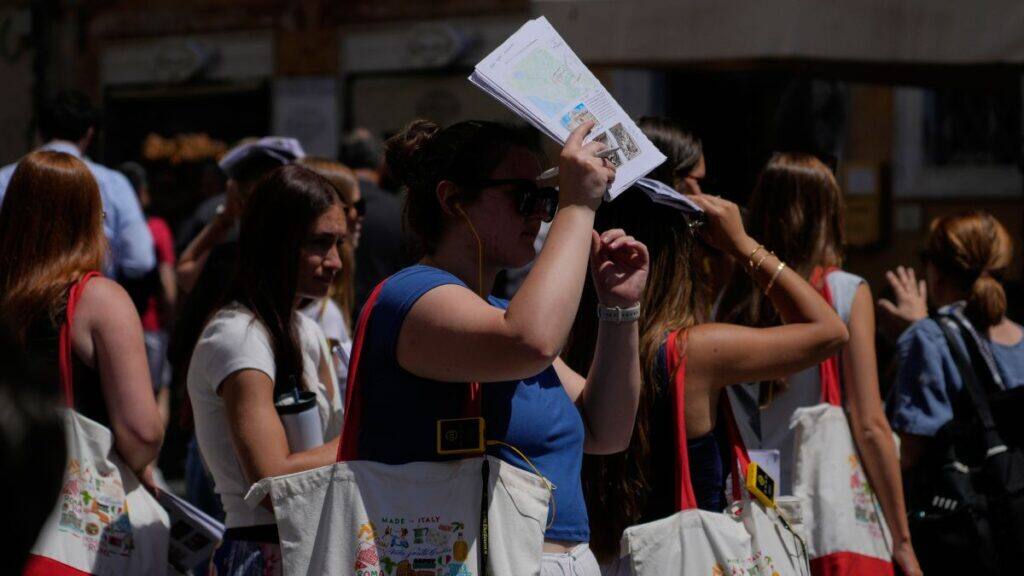
In Italy’s Lazio region, which includes Rome, restrictions on work in conditions “with prolonged exposure in the sun” have been announced, for instance, on farms, construction sites and in the delivery sector, between 12:30 pm and 4 pm.
What’s behind Europe’s extreme heat?
Scientists blame climate change for extreme weather events like heatwaves, droughts and floods becoming more intense.
Ioanna Vergini of WFY24, a weather forecaster, told Euronews Earth that the European summer is getting hotter and longer.
“What we used to call a July phenomenon is now arriving in mid-May,” she warned. “Climate attribution studies estimate that June heatwaves in Europe are around 10 times more likely today than they were in pre-industrial conditions, and the same trajectory is becoming visible for May."
“This extension of the heatwave season is entirely characteristic of the effects of climate change,” Robert Vautard, a climate researcher, was quoted as saying by Agence France-Presse (AFP). “Eventually, we will be seeing similar heat events in April and October.”
Met Office meteorologist Greg Dewhurst warned that the jump in extreme temperatures was "a good indication of climate change in action" and more likely to become "the new norm".
According to France’s national weather agency, the record temperatures can be attributed to a heat dome, with hot air from Morocco trapped under an area of high pressure. It sounded an alarm that Europe could expect such events to “occur more and more often and earlier and earlier, and to be more and more intense”.
Heat domes develop when a high-pressure system forms in the upper atmosphere, leading to air below it to sink and compress, increasing temperatures in the lower atmosphere.
As the hot air expands, it creates a bulging dome, entrapping heat. Winds can normally move high pressure around, but given the extent of heat domes stretching into the atmosphere, the weather system turns nearly stationary, as per Euronews.
Heat domes cause temperatures to consistently rise well above normal, drying out the ground and enhancing the risk of more wildfires.
Severe Weather Europe has warned that temperatures are increasing by 12-16°C above “long-term climatological norms”.
“Air mass will be even hotter in the coming days for many countries, as the Heat Dome aloft intensifies further,” the weather forecaster reportedly said. “Because this pattern restricts vertical mixing and cloud cover, maximum and minimum temperatures alike will challenge historical monthly records across hundreds of stations in Western Europe.”
With inputs from agencies

Military drones & police check-ups: How Sri Lanka is fighting against worst dengue outbreak in a decade
How Facebook job ad lured 2 Karnataka men into Myanmar cyber scam camp
Why is India seeing 95% cloud cover despite a Super El Niño?
What is CJP’s fourth demand to the government as protests in Delhi intensify?
The new geography of war: Why the Houthis can no longer be ignored