


The row over JNU banning protests on campus
Delhi's Jawaharlal Nehru University has banned protests within 100 metres of academic buildings. As per the manual, such activities can lead to a fine of up to Rs 20,000 or expulsion. The Students’ Union has opposed the rules, passed last month, calling them 'an effort to suppress the vibrant campus

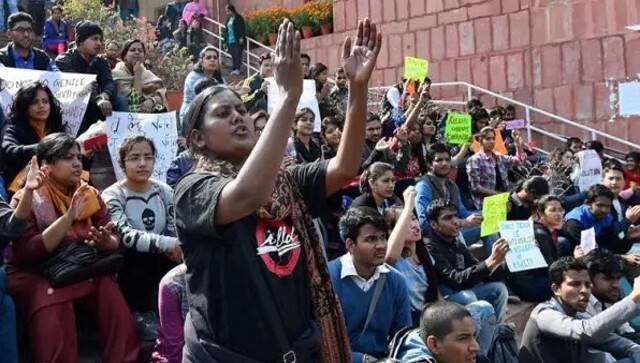
JNU has barred protests within 100 metres of academic buildings as well where classes are conducted. PTI[/caption]"All forms of coercion such as gheraos, sit-ins or any variation of the same which disrupt the normal academic and administrative functioning of the university or any act inciting violence will be punished as well," it added.The move comes after an “anti-national” slogan was scribbled on the university’s School of Languages building wall. The administration had later announced to set up a committee to look into the repeated nature of such incidents on the campus.Notably, previously protests within 100 metres of the administrative blocks, which house the offices of the Vice-Chancellor, registrar, and proctors, among others, was prohibited as per a High Court order.JNU has prohibited printing, circulating or pasting posters or pamphlets carrying any kind of derogatory religious, communal, casteist or anti-national remarks.The heavy fineAny act to incite intolerance towards a religion, caste, or community or an activity which is deemed "anti-national" will be imposed with a fine of Rs 10,000, as per PTI.A student who has received five or more punishments during the duration of their study shall be expelled from the university, the manual noted.In case a student is found guilty of being involved in any of the prohibited activities and is given a punishment, he or she will not be allowed to register for the semester and they would not be given a 'no-dues' certificate until the imposed fine is cleared.The administration will also send a copy of the punishment to the parents or guardian of the student besides uploading it on the official website.If a student fails to appear before the proctorial enquiry, the committee will assume that the complaint was filed with a malafide intention and the student may be asked to perform community service in JNU.Any false allegation against any student by the complainant can also lead to rustication from the university.Furthermore, the university now will not allow cross-examination between defendant and complainant or the witness, which use to be an important rule of the proctorial enquiry earlier.The Vice-Chancellor Santishree Dhulipudi Pandit’s or the competent authority’s decision will be the final call, in case any dispute arises with regard to the interpretation of any of these rules, the manual said.Students oppose the ruleThe JNU Students’ Union (JNUSU) is calling for the immediate revocation of the manual. It says that considering diverse perspectives, decisions affecting the entire student community should be made collectively.“The stringent measures outlined in the manual are aimed at stifling the vibrant campus culture that has defined JNU for decades. The JNUSU demands that the university administration immediately revoke the manual of the office of the Chief Proctor Manual,” the students’ union said, as per PTI.“Such excessive regulations are intended to discourage open discussions, dissent, and intellectual exploration, which are fundamental to the spirit of our university,” the students’ union said, according to Scroll.in, adding, "The JNU chief proctor manual lacks clarity on several crucial aspects, leaving room for misinterpretation and arbitrary implementation. Such ambiguous rules can lead to unfair and discriminatory practices, jeopardizing the rights of individual students.According to Swarajya magazine, earlier, the administration faced opposition for penalising two students in August for alleged misbehaviour with a hostel warden. They were intially fined Rs 10,000 each, which was later withdrawn.VC Pandit told PTI, "This is old not new. Passed unanimously by the EC last month as the manual had to be made legally sound. The fines are on indiscipline of drinking, drugs and misbehavior in hostels and towards women. The proctor's office since 1969 has been taking action, imposing fines and rustications."Similar move in Lucknow collegeIn July 2022, the Lucknow University imposed a ban on all protests, dharma and processions on campus. The authorities, according to Hindustan Times, said the decision was initiated due to the proposed visit by the National Assessment and Accreditation Council (NAAC) team.The university also issued a list of dos and don’t, while seeking cooperation from students, teachers and staff.In December 2022, Jai Narain Misra Postgraduate College in Lucknow had banned students from protesting on campus, reported The Times of India.Principal Meeta Shah issued an order citing the implementation of Section 144 in the city until 10 January this year by the office of the joint commissioner of police (law and order) to maintain law and order.The prohibition on protests came in the wake of a recent demonstration on the college campus where students were advocating for student union elections.LUACTA president Manoj Pandey said that the decision was made in response to the demands for student union elections.

Military drones & police check-ups: How Sri Lanka is fighting against worst dengue outbreak in a decade
How Facebook job ad lured 2 Karnataka men into Myanmar cyber scam camp
Why is India seeing 95% cloud cover despite a Super El Niño?
What is CJP’s fourth demand to the government as protests in Delhi intensify?
The new geography of war: Why the Houthis can no longer be ignored