


The sun is reaching solar maximum: What does this mean? What should the Earth be prepared for?
Solar maximum might arrive in 2024, a year earlier than expected. The sun will reach the peak of its current solar cycle. It can lead to large-scale blackouts and disrupt radio communications across the world. The increased radiation activity can have serious health consequences for astronauts

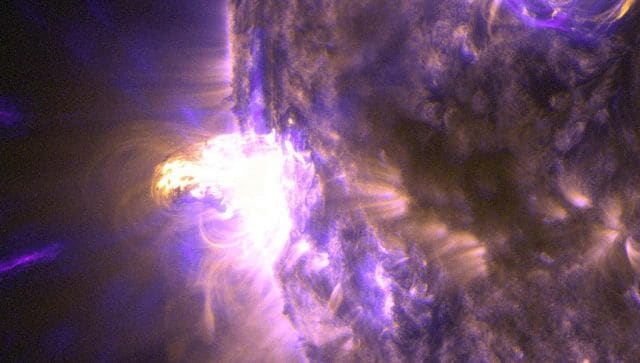 This image obtained in August 2014 shows a close-up of a moderate sun flare of light. NASA/AFP[/caption]What do we know about the latest solar cycle? The current solar cycle is the 25th since the records began in 1755 and started in 2019.Now the cycle is nearing its peak. In April, the sun exploded with three major solar flares. There were 23 coronal mass ejections and a massive geomagnetic storm that struck Earth and raged for over two days, NASA informed. Solar physicists also found 96 sunspots on its surface.While official predictions by NASA and National Oceanic and Atmospheric Administration (NOAA) say that the sun will reach the peak of its activity in 2025, new research led by NASA research scientist Robert Leamon and Scott McIntosh, the deputy director at US National Center for Atmospheric Research (NCAR), suggests this might happen next year.According to the finalised forecast, the current cycle is expected to reach its peak in 2024. The cycle, the team of researchers thinks, will reach about 185 monthly sunspots during its maximum and thus be somewhat milder than what the team originally forecasted. This peak intensity will place this cycle at about the average compared to the historical record, reports Space.com.The cycles vary in activity. The weakest on record has produced less than 100 sunspots and the strongest nearly 300.[caption id="attachment_12543232" align="alignnone" width="640"]
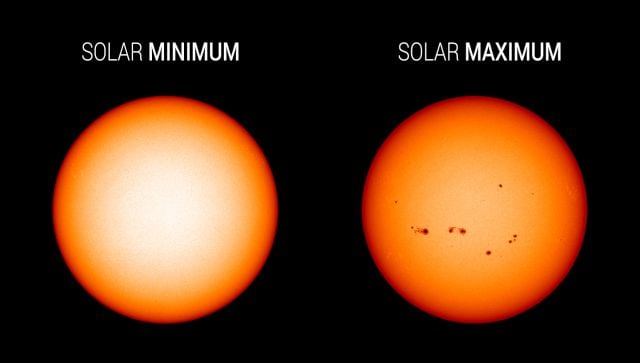 Images from NASA's Solar Dynamics Observatory show the sun at solar minimum in December 2019 and the solar maximum in April 2014. Sunspots freckle the sun during solar maximum; the dark spots are associated with solar activity.
Auroras, caused by a coronal mass ejection on the sun, illuminate the skies over Lapland in Rovaniemi, Finland on 15 March 2023. Image courtesy: All About Lapland/Alexander Kuznetsov/Handout via Reuters ATTENTION EDITOS - THIS IMAGE HAS BEEN SUPPLIED BY A THIRD PARTY. MANDATORY CREDIT TPX IMAGES OF THE DAY[/caption]Does the sun’s activity affect other planets?During the solar cycle, when the sun’s magnetic poles flip, the effects ripple through the solar system.Planets without a protective magnetosphere such as Venus feel the full impact. In 2006, the sun ejected a small coronal mass ejection (CME) — a release of plasma and magnetic field — which hit Venus and stripped the planet's atmosphere of vast amounts of oxygen, the Space.com report says.With inputs from agencies Read all the Latest News, Trending News, Cricket News, Bollywood News,India News and Entertainment News here. Follow us on Facebook, Twitter and Instagram.

Military drones & police check-ups: How Sri Lanka is fighting against worst dengue outbreak in a decade
How Facebook job ad lured 2 Karnataka men into Myanmar cyber scam camp
Why is India seeing 95% cloud cover despite a Super El Niño?
What is CJP’s fourth demand to the government as protests in Delhi intensify?
The new geography of war: Why the Houthis can no longer be ignored