


Where’s Santa? How Norad uses satellites and AI to track Father Christmas
As Santa gets ready for his journey to deliver gifts this year for Christmas, the most asked question is — how does Norad track him? It’s been 70 years since this tradition first began

Christmas Eve is an extraordinary night for Santa Claus as he aims to deliver presents all around the world.
However, how can we keep track of the patron of the festival on Christmas Eve? The answer is Norad (North American Aerospace Defence) — the longest-running Santa tracker in the world, which came into effect in December 1955.
But why does a military organisation run together by the US and Canada, track Santa each year? And more importantly, how do they do it?
Norad follows Santa Claus, but how?
The tracking of Santa’s operation begins before Christmas. Norad has a system of satellites, which is called the Space-Based Infrared Systems (SBIRs). This is a series of satellites that can detect infrared (a form of electromagnetic radiation) signatures. Another approach of Norad to detect Santa is Radar (Radio Detection and Ranging). In this case, Radar uses radio waves, another form of electromagnetic radiation.
 More from Explainers
The organisation goes live and takes questions from families. As per Meritalk, around 50 nationals and local partners help in maintaining the website, and the scale rises on Christmas Eve. Tracking depends on the North Warning System, which is a network of 49 radar stations spread across northern Canada and Alaska. After Santa departs the North Pole, Norad switches to infrared sensors, a globally integrated satellites.
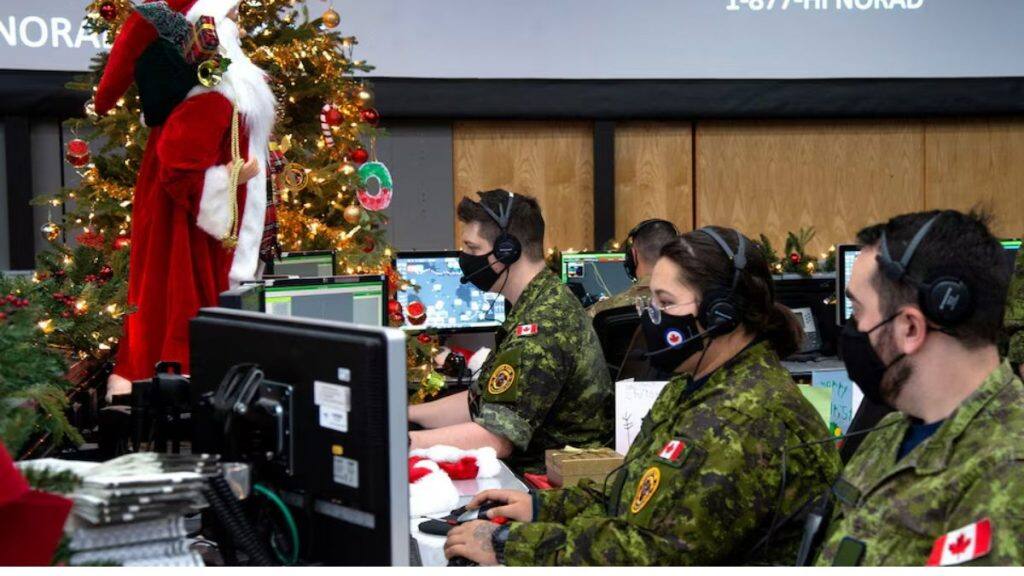
The US Air Force F-15, F-16 and F-22 fighter jets, and Canadian CF-18 aircraft are also used by Nord to escort Santa at various points of his journey, according to an Economic Times report. Recently, several elements of artificial intelligence have been introduced to assist in refining Santa’s route.
How did the tracking tradition begin?
This tracking tradition began in 1955, all thanks to a mistake by Colorado Springs newspaper. In 1955, Sears Roebuck & Co advertised in the paper, presenting an opportunity for children to call Santa through a phone number. However, the number was misprinted, and the calls went to the Continental Air Defence (Conad) Command’s director of operations, Colonel Harry Shoup.
In one instance, when a boy called the number instead of turning the boy away, Shoup provided updates on Santa’s whereabouts, according to the Journal. Shoup even directed his staff members to check the radar for indications of Santa making his way south from the North Pole. And so a tradition was born.
Why does Norad track Santa Claus?
According to several reports, Norad wants to protect Santa, so nobody mistakes him for a rocket or a missile. Secondly, with the use of several technologies, Norad warns Santa about other aircraft in his vicinity. It also helps in the detection of dangerous weather and relays the information to Santa Claus and his central control in the Arctic Circle.
Does Santa visit everyone? What Norad says
Santa visits every house on Christmas where kids believe in him, as per Norad. According to an intelligence report, Santa cannot experience time in a way humans do. The journey seems to take 24 hours from Earth; however, it may be longer than that in Santa's time-space when he delivers presents without rushing.
Researchers suggest that Santa's sleigh is quite fast. They also estimated that Santa would need to travel around 650 miles per second to finish the worldwide gift delivery, and that too before sunrise on December 25, Christmas morning.
Kids can track Santa through NORADSanta.org and social media platforms, as well as a mobile app featuring games, videos, and a countdown clock in several languages.
With inputs from agencies
Tags

Military drones & police check-ups: How Sri Lanka is fighting against worst dengue outbreak in a decade
How Facebook job ad lured 2 Karnataka men into Myanmar cyber scam camp
Why is India seeing 95% cloud cover despite a Super El Niño?
What is CJP’s fourth demand to the government as protests in Delhi intensify?
The new geography of war: Why the Houthis can no longer be ignored