


DRDO’s hypersonic glide missile, drones & more: How India stunned with its military might at R-Day Parade
India displayed its defence capabilities at this year’s Republic Day Parade, the first since Operation Sindoor. Indigenous weapons, such as DRDO’s Long Range Anti-Ship Hypersonic Missile (LR-AShM) and the Universal Rocket Launcher System (URLS) Suryastra, took centre stage at the celebrations. For the first time, the Indian Army personnel moved down the Kartavya Path in a ‘phased battle array formation’

India is celebrating its 77th Republic Day today (January 26). The majestic parade at the Kartavya Path in Delhi showcased India’s culture, diversity, as well as military prowess.
European Council President Antonio Costa and European Commission President Ursula von der Leyen were the chief guests at the grand Republic Day parade, where India displayed its military might with elite marching contingents, missiles and indigenous weapon systems.
From battle tanks and drones to hypersonic glide missiles, here’s how India stunned with its defence capabilities at this year’s parade.
Battle tanks, drones & more
At the 77th Republic Day Parade, the Indian Army personnel moved down the Kartavya Path in a “phased battle array formation” for the first time.
The Reconnaissance element featured the 61 Cavalry in active combat uniform, with military assets exhibited in the sequence as they would appear in actual combat.
 More from Explainers
India displayed its first indigenously designed High Mobility Reconnaissance Vehicle (HMRV) mounted on the Takshak platform.
Its Battle Field Surveillance Radars can detect men, vehicles, and low-flying helicopters. The HMRV is equipped with drones to cover radar blind zones, advanced communications, and anti-drone guns, as per ANI.
Powered by Stanag-level ballistic protection, 4x4 mobility, and a modular design, it is capable of deep reconnaissance, special operations, and precision engagement using Anti-Tank Guided Missiles and an integrated tethered drone.
Next, the homegrown Advanced Light Helicopter Dhruv showcased India's expanding defence strength. These choppers feature long-range radars and day-night cameras for reconnaissance and fire-support missions.
Designed and manufactured by Hindustan Aeronautics Limited, Dhruv has been deployed across high-altitude, desert, maritime, and battlefield environments. It has also enhanced operational reach, air-ground synergy, and combat effectiveness of the ground forces, reflecting India's technological prowess and increasing self-reliance in the defence sector.
Dhruv and its armed variant, Rudra, flew in Prahar formation to demonstrate battlefield readiness.
The combat element featured T-90 Bhisma tanks and the indigenous Main Battle Tank Arjun rolling past the saluting dais. The aerial support was provided by Apache AH-64E attack helicopters and the Prachand light combat helicopter.
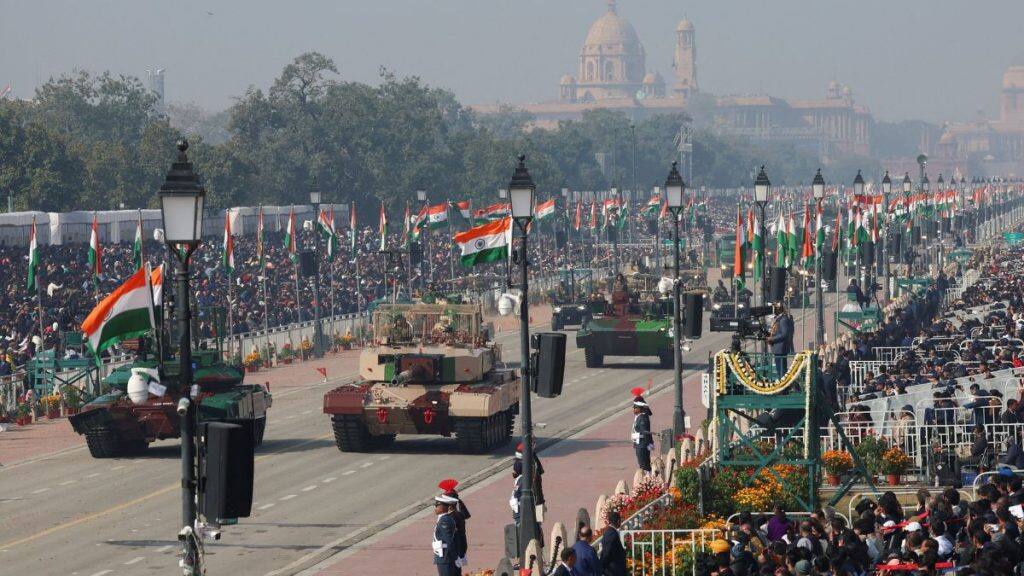
Other platforms seen during the parade were the BMP-II Infantry Combat Vehicle and the Nag missile system (Tracked) Mk-2.
Also known as BMP-II ‘Sarath’, the combat vehicle boasts amphibious capabilities and firepower. It is equipped with a turret-mounted anti-tank guided missile (ATGM) launcher, precision targeting systems, and armoured shielding.
The Nag Mark 2 anti-tank guided missiles are developed by Bharat Dynamics Limited.
India also displayed several key weapons, including BrahMos cruise missile, Akash air defence system, Medium Range Surface-to-Air Missile (MRSAM), Advanced Towed Artillery Gun System (ATAGS), Dhanush artillery gun, Divyastra Battery and select drones.
The Akash Weapon System and the Abhra Medium Range Surface-to-Air Missile System have been described as reflecting "India's growing indigenous strength in air defence".
Robotic mules and unmanned ground vehicles (UGVs) deployed by the Indian Army for logistics support were also on display.
A glass-cased Integrated Operational Centre tableau depicted Operation Sindoor, underlining the Indian military's offensive and defensive capabilities, with BrahMos strikes, Akash missile defence, and S-400 systems creating a protective shield — reflecting Prime Minister Narendra Modi's Sudarshan Chakra vision.
Aerial prowess wows R-Day parade audience
The Republic Day Parade is incomplete without the much-anticipated aerial flypast. In a first, the aerial display was carried out in two separate blocks during the parade.
It featured 29 aircraft, including 16 fighter jets, four transport aircraft and nine helicopters.
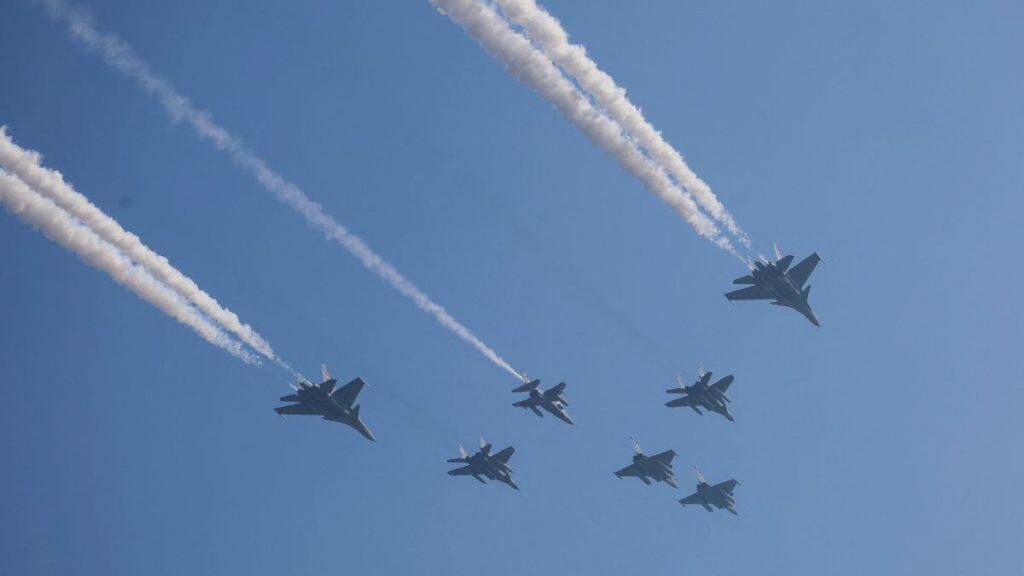
Rafale, Su-30 MKI, MiG-29 and Jaguar fighters, along with transport and surveillance assets such as the C-130, C-295 and the Indian Navy’s P-8I aircraft, were part of the demonstration.
The flypast was carried out in formations named Arjan, Vajraang, Varuna and Vijay.
Key debuts at R-Day Parade
A key highlight of the 2026 Republic Day Parade was the Defence Research and Development Organisation’s (DRDO) display of the Long Range Anti-Ship Hypersonic Missile (LR-AShM).
The hypersonic glide missile, which starts at a speed of Mach 10 and maintains an average Mach 5, can engage both moving and static targets. The LR-AShM has been developed to meet the coastal battery requirements of the Indian Navy, as per Indian Express.
The missile flies at low altitudes with high speed and manoeuvrability, covering a range of around 1,500 kilometres in 15 minutes. Its hypersonic speed offers a great advantage as enemy ground and ship-based radars cannot detect it.
A senior DRDO scientist told the newspaper, "All classes of warships can be neutralised with the missile. This variant and the upcoming ranges will be a key asset for sea denial operations, which prevent an adversary from using a maritime area for military or commercial purposes. This capability will be crucial for the strategically significant Indian Ocean region. Army and Air Force versions of these missile and ship-fired versions for the Navy are also said to be either under consideration or under development. With its versatility, it could well place India in the hypersonic arms domain."
India also showcased its Universal Rocket Launcher System (URLS) Suryastra, capable of carrying out surface-to-surface strikes up to 300 km, for the first time. The system is the first Made-in-India universal multi-calibre rocket launcher, which aims to enhance the Indian Army’s deep-strike artillery firepower and operational reach.
Suryastra is designed to engage multiple targets simultaneously at varying ranges. It can also fire loitering munitions up to a range of 100 km, increasing operational flexibility, reported The Hindu.
The Shaktiban Regiment, an artillery unit equipped with drones, counter-drone systems and loitering munitions, made its debut at the Republic Day Parade. The Bhairav Light Commando Battalion also participated in the parade for the first time.
With inputs from agencies
Tags

Military drones & police check-ups: How Sri Lanka is fighting against worst dengue outbreak in a decade
How Facebook job ad lured 2 Karnataka men into Myanmar cyber scam camp
Why is India seeing 95% cloud cover despite a Super El Niño?
What is CJP’s fourth demand to the government as protests in Delhi intensify?
The new geography of war: Why the Houthis can no longer be ignored