
Advertisement


Sections
Pay, inflation, workload: Why teachers in the UK are striking again
Recent polling by YouGov suggests that about half of the British public support striking teachers and a significant number blame the government for the strike, rather than the teachers or unions themselves

On 1 February 2023, teachers in England and Wales joined their Scottish counterparts by going on strike, resulting in widespread school closures. Teachers made up part of an estimated half a million workers on strike across the UK. They are striking for improved pay and working conditions.Recent polling by YouGov suggests that about half of the British public support striking teachers and a significant number (44 per cent) blame the government for the strike, rather than the teachers or unions themselves. Only nurses, ambulance staff and firefighters enjoy more public support for their action.[caption id="attachment_12098852" align="alignnone" width="640"]![]() Even though teachers received pay rises in the 2022-2023 economic year, this has failed to match inflation. AP[/caption]Teachers are, of course, aware of the effect of the action on children and their education. To minimise disruption, no school will be closed for more than four days in England, but longstanding issues in the profession have now reached a critical point.Gillian Keegan is the fifth secretary of state for education in the last 12 months. In recent days she has made it clear that she is talking to the teachers’ representatives, but she continues to face significant challenges in ensuring that the education system is meeting pupils’ needs.Pay and workloadA headline issue for the strikes is pay. Despite pay rises for teachers in the 2022-23 academic year, these do not meet the current rate of inflation.
Even though teachers received pay rises in the 2022-2023 economic year, this has failed to match inflation. AP[/caption]Teachers are, of course, aware of the effect of the action on children and their education. To minimise disruption, no school will be closed for more than four days in England, but longstanding issues in the profession have now reached a critical point.Gillian Keegan is the fifth secretary of state for education in the last 12 months. In recent days she has made it clear that she is talking to the teachers’ representatives, but she continues to face significant challenges in ensuring that the education system is meeting pupils’ needs.Pay and workloadA headline issue for the strikes is pay. Despite pay rises for teachers in the 2022-23 academic year, these do not meet the current rate of inflation.![]() Teachers are also complaining about facing heavy workloads. AP[/caption]Another problem facing the minister is teachers’ workload. A pre-pandemic survey in England found that secondary teachers working with children aged 11-14 were reporting a working week of, on average, nearly 50 hours. Full-time primary teachers were working over 52 hours a week.Over half of teachers felt their workload was unmanageable. There is no doubt that the working conditions for teachers must be addressed to improve teacher retention and prevent further attrition.Feeling the effects of lockdownMeanwhile, the failure of the government’s post-school closures catch up programme is well-documented. The effect of the pandemic school closures and remote learning are still being felt by children. As a result gaps in attainment persist, especially for children already at risk of disadvantage. This puts further pressure on teachers.In addition, the long-term impact of the pandemic is still felt in schools: with mental health services remaining stretched, many teachers are faced with additional challenges in pastoral care. Recently, charities called on the government to develop a comprehensive mental healthcare plan, including for children.
Teachers are also complaining about facing heavy workloads. AP[/caption]Another problem facing the minister is teachers’ workload. A pre-pandemic survey in England found that secondary teachers working with children aged 11-14 were reporting a working week of, on average, nearly 50 hours. Full-time primary teachers were working over 52 hours a week.Over half of teachers felt their workload was unmanageable. There is no doubt that the working conditions for teachers must be addressed to improve teacher retention and prevent further attrition.Feeling the effects of lockdownMeanwhile, the failure of the government’s post-school closures catch up programme is well-documented. The effect of the pandemic school closures and remote learning are still being felt by children. As a result gaps in attainment persist, especially for children already at risk of disadvantage. This puts further pressure on teachers.In addition, the long-term impact of the pandemic is still felt in schools: with mental health services remaining stretched, many teachers are faced with additional challenges in pastoral care. Recently, charities called on the government to develop a comprehensive mental healthcare plan, including for children.![The Conversation]() This article is republished from The Conversation under a Creative Commons license. Read the original article.Read all the Latest News, Trending News, Cricket News, Bollywood News,India News and Entertainment News here. Follow us on Facebook, Twitter and Instagram.
This article is republished from The Conversation under a Creative Commons license. Read the original article.Read all the Latest News, Trending News, Cricket News, Bollywood News,India News and Entertainment News here. Follow us on Facebook, Twitter and Instagram.
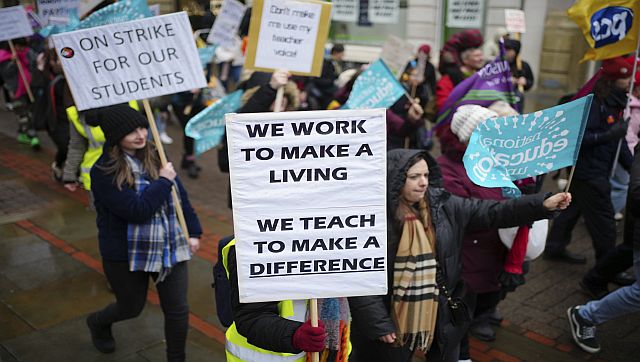 Even though teachers received pay rises in the 2022-2023 economic year, this has failed to match inflation. AP[/caption]Teachers are, of course, aware of the effect of the action on children and their education. To minimise disruption, no school will be closed for more than four days in England, but longstanding issues in the profession have now reached a critical point.Gillian Keegan is the fifth secretary of state for education in the last 12 months. In recent days she has made it clear that she is talking to the teachers’ representatives, but she continues to face significant challenges in ensuring that the education system is meeting pupils’ needs.Pay and workloadA headline issue for the strikes is pay. Despite pay rises for teachers in the 2022-23 academic year, these do not meet the current rate of inflation.
But pay is only one of the problems.Continuing challenges in recruitment and retention are particularly important. In their first two years after qualifying, 17 per cent of teachers leave the profession. And the government is unable to recruit enough new teachers to replace them.There are serious shortages in recruitment for some key secondary school subjects. In the academic year 2022-23, recruitment for computing teachers was 70 per cent under target. For physics teachers, it was 83 per cent under target. There is an overall picture of under-recruitment across the sector.[caption id="attachment_12098942" align="alignnone" width="640"]
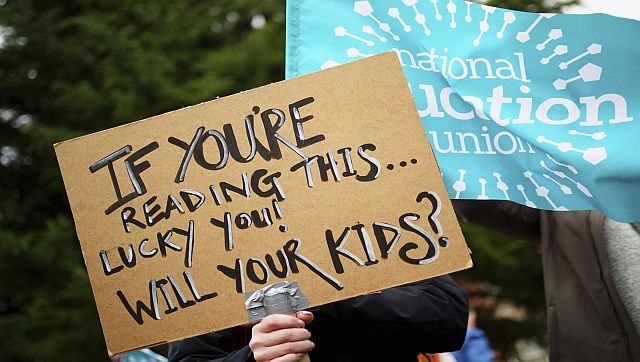 Teachers are also complaining about facing heavy workloads. AP[/caption]Another problem facing the minister is teachers’ workload. A pre-pandemic survey in England found that secondary teachers working with children aged 11-14 were reporting a working week of, on average, nearly 50 hours. Full-time primary teachers were working over 52 hours a week.Over half of teachers felt their workload was unmanageable. There is no doubt that the working conditions for teachers must be addressed to improve teacher retention and prevent further attrition.Feeling the effects of lockdownMeanwhile, the failure of the government’s post-school closures catch up programme is well-documented. The effect of the pandemic school closures and remote learning are still being felt by children. As a result gaps in attainment persist, especially for children already at risk of disadvantage. This puts further pressure on teachers.In addition, the long-term impact of the pandemic is still felt in schools: with mental health services remaining stretched, many teachers are faced with additional challenges in pastoral care. Recently, charities called on the government to develop a comprehensive mental healthcare plan, including for children.
Some parents may regard the strikes as disruptive.This action comes as many pupils’ learning and wellbeing remains affected by COVID, so some will question whether teachers are right to strike now. However, teachers argue that they are taking action to protect vital public services rather than to threaten them.Undoubtedly, teachers in our schools face significant challenges to meet the educational and pastoral needs of children and young people. Yet the success of our educational system has never been more important as we recover from the economic and social shocks of the last few years.To produce a generation of young people with the skills, knowledge and ability to meet the needs of the country, the minister for education will need to be able to create the conditions under which teachers can be trained, recruited and retained in the profession.
 This article is republished from The Conversation under a Creative Commons license. Read the original article.Read all the Latest News, Trending News, Cricket News, Bollywood News,India News and Entertainment News here. Follow us on Facebook, Twitter and Instagram.
First Published:Feb 03, 2023, 17:30:39 IST
Advertisement
Advertisement

Military drones & police check-ups: How Sri Lanka is fighting against worst dengue outbreak in a decade
Sri Lanka is fighting its most severe dengue outbreak in nearly a decade, with infections rising sharply across the nation. Military drones have been deployed to tackle the outbreak, which has claimed 56 lives. Health officials said the outbreak is being driven primarily by the DENV-2 variant of the virus
3 min read
How Facebook job ad lured 2 Karnataka men into Myanmar cyber scam camp
The Karnataka Cyber Command has rescued two youths from a scam compound in Myanmar operated by Chinese fraudsters. The duo from Karnataka were lured on the pretext of data-entry jobs. They were asked to work for 16 hours a day and were expected to sleep for six hours daily
4 min read
Why is India seeing 95% cloud cover despite a Super El Niño?
India is witnessing nearly 95 per cent cloud cover despite a Super El Niño, a climate event usually linked to weaker monsoons. Regional weather systems, cyclonic circulations, the monsoon trough and moisture from two seas are temporarily overpowering one of the world's strongest climate phenomena
5 min read
What is CJP’s fourth demand to the government as protests in Delhi intensify?
The protest by the Cockroach Janta Party at Delhi’s Jantar Mantar refuses to die down. The group have made a fourth demand to the Centre, asking that no FIRs are filed against the agitators and that no legal action be taken. The government has expressed willingness to speak to the protesters, but refused to accede on the resignation of Education Minister Dharmandra Pradhan
5 min read
The new geography of war: Why the Houthis can no longer be ignored
The rise of the Houthis marks the emergence of a new geography of war — one in which influence flows not only from capitals and conventional armies, but also from rugged mountains overlooking vital sea lanes
6 min read
Advertisement
Advertisement