


Pannun ‘assassination’ plot: Why US efforts to extradite ex-spy Vikash Yadav may take years
The US has reportedly sought the whereabouts of Vikash Yadav, the former Indian spy, who has been charged with plotting the failed assassination of Khalistani terrorist Gurpatwant Singh Pannun. Experts note his possible extradition from India will take years because of the Delhi Police’s case against him. Here’s why

The buzz around the alleged plot to assassinate Khalistani terrorist Gurpatwant Singh Pannun, also the leader of the Sikhs for Justice (SFJ) group, on American soil refuses to die down.
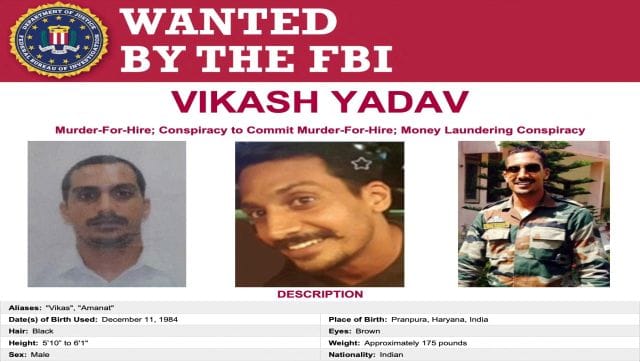
Reports are emerging that the United States will now seek the extradition of Vikash Yadav, the former Research and Analysis Wing (R&AW) employee, who has been placed on the Federal Bureau of Investigation’s most wanted list for his alleged involvement in the plotting and planning of Pannun.
According to a report by the Economic Times, the US authorities have already sought his whereabouts in India, and may also approach the consular section of the Ministry of External Affairs on the matter.
However, Yadav’s extradition will not be an easy process. A Times of India report even went as far as saying that it will be years before the the US’ request for extradition is cleared.
 More from Explainers
Want to know why? We get you the answers.
Who is Vikash Yadav?
Before we deep dive into the possible extradition of Vikash Yadav, here’s a recap of who is Vikash Yadav.
Last week, a secondary indictment by the US Department of Justice named Vikash Yadav as one of the planners in the Gurpatwant Singh Pannun assassination plot. The US indictment stated that Yadav is a former official of India’s Research and Analysis Wing and before his tenure at R&AW, he was a member of the Central Reserve Police Force (CRPF) and had received specialised training in battlecraft and weaponry.
US authorities allege that Yadav directed the assassination plot remotely from India. He reportedly provided Nikhil Gupta, another Indian, with detailed personal information about the target, including their New York home address, phone numbers, and other identifying details, which Gupta passed on to an undercover agent.
Yadav was put on the FBI’s wanted list after he was charged with conspiracy to commit murder-for-hire and conspiracy to commit money laundering.
The Ministry of External Affairs has claimed that Yadav is “no longer” a government official.
Will the US request for Yadav’s extradition?
After being placed on the FBI’s most wanted list, many experts believe that it’s only a matter of time before the United States seeks Yadav’s extradition.
This comes after FBI Director Christopher Wray had earlier stated that the FBI would not condone violent acts or any attempts to intimidate individuals exercising their constitutional rights within the United States.
The Economic Times reported that Washington had sought Yadav’s information from New Delhi and would soon approach the consular section of the Ministry of External Affairs on the matter.
India and the US have an extradition treaty in place, which was signed on June 25, 1997 in Washington, DC. According to the treaty, while extradition shall not be granted for a political offence, it can be done for charges including murder or other wilful crimes against a Head of State or Head of Government or a member of their family, aircraft hijacking offences, aviation sabotage, crimes against internationally protected persons including diplomats, hostage-taking, offences related to illegal drugs, or any other offences for which both India and US have an obligation to extradite the person pursuant to a multilateral international agreement.
How long before Yadav is extradited then?
While the US hasn’t formally made an extradition request yet, some note that even if it did, it would take years for India to agree.
Why? Because of Delhi Police’s attempted murder and kidnapping case against Yadav. An Indian Express report states that Yadav was arrested in an extortion case by the Delhi Police Special Cell, just three weeks after he was initially mentioned by the US Department of Justice. His arrest came on the basis of a complaint by a Rohini resident, accusing him of extortion and kidnapping and linking him to gangster Lawrence Bishnoi. Records revealed he was released on bail in April after being lodged in Tihar Jail for four months.
With Yadav facing charges in India, each of them being punishable with 10 years, India is under no obligation to extradite Yadav until his trial for these charges are completed. Moreover, if he is found guilty of these charges, then he will have to serve out his sentences. This means that it would be years before Yadav is extradited to the US.
Speaking on the same, Professor VG Hegde of the Centre for International Legal Studies (CILS) at Jawaharlal Nehru University (JNU) told The Print that when an individual is facing grave charges in India, their extradition is difficult. “The cases here need to be resolved here first,” he said.
Senior advocate Vikas Pahwa echoed similar remarks, telling The Print that Section 31 of India’s Extradition Act allows the postponement of extradition until the completion of domestic proceedings.
Moreover, extradition requests also depend on diplomacy and reciprocity. What does this mean? India could urge Washington to push through their request for the extradition of David Coleman Headley for the role he played in the 2008 Mumbai terror attacks.
India could also push for a quicker extradition of Tahawwur Rana, a Canadian travel agent of Pakistani origin, who helped the Lashkar plot by arranging for tickets for Headley. While the US court has cleared him for extradition, his lawyers have made appeals to stop or defer the process. Moreover, reports state that India’s 61 extradition requests to the US are yet to be honoured.
Where is Vikash Yadav now?
The current whereabouts of Vikash Yadav are unknown. His family in Haryana say they haven’t seen him for the past year; the last time they saw him was after his daughter was born. His brother told the Indian Express, “The last time he came home was last year. We haven’t talked to him over the phone. We do not know much about what’s happening with him. It’s a very sensitive issue, and we cannot speak about it. The government will do what it has to do.”
They also reject the allegations that he allegedly orchestrated the assassination of Pannun. His cousin, Avinash Yadav, was quoted as telling Reuters, “For us, he is still working for the CRPF. He told us he was a deputy commandant and was trained as a paratrooper.
His mother, Sudesh Yadav, 65, said she was still in shock. “What can I say? I do not know whether the US government is telling the truth or not.”
“He has been working for the country,” she said.
With inputs from agencies

Military drones & police check-ups: How Sri Lanka is fighting against worst dengue outbreak in a decade
How Facebook job ad lured 2 Karnataka men into Myanmar cyber scam camp
Why is India seeing 95% cloud cover despite a Super El Niño?
What is CJP’s fourth demand to the government as protests in Delhi intensify?
The new geography of war: Why the Houthis can no longer be ignored