


Not just tomatoes: Why are vegetable prices seeing a rise?
From Rajasthan to Kerala, everyday kitchen staples like lemons, ginger, green chillies, and more have substantially increased in price this monsoon. Tomatoes, of course, are the most expensive. Costs are rising because of insufficient rains, climate change and disruptions in supply chains

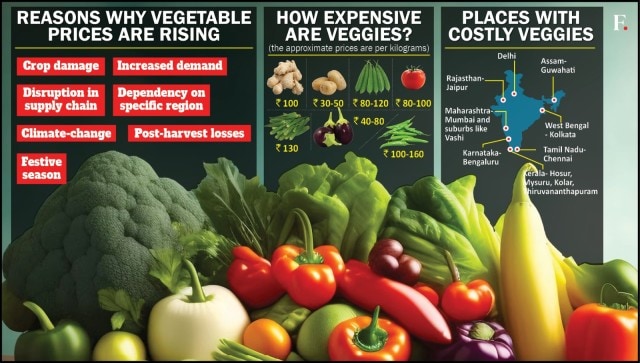
Graphic: Pranay Bhardwaj[/caption]Several factors are at playIn Bengaluru, vegetable prices have gone up due to insufficient rains in the state, according to traders. "We did not receive proper rains. Also, the temperature is high. Due to these two reasons, many vegetable crops were damaged. The variation in temperature and lack of proper rain led to pest attacks on tomatoes," Manjunath, a trader in KR Market told PTI.While in Mumbai, traders have attributed the steep hike to a shortage in production due to severe heat conditions and delayed rain apart from farmers choosing other crops.Wholesalers report a sharp increase in tomato and other vegetable prices across Rajasthan as a result of a number of causes, including the cyclonic storm Biparjoy's heavy rainfall. The high rainfall brought on by the Biparjoy cyclonic activity, followed by the start of the monsoon season, which resulted in the devastation of farmers' crops, caused tomato prices to rise four to five times, according to wholesalers. Additionally, they said that all vegetable costs had jumped by one to two times.As a result, Bangalore, Nashik, Himachal Pradesh, Maharashtra, Uttar Pradesh, and Madhya Pradesh are now the primary sources for most vegetables, including tomatoes.According to an article in Hindustan Times, Ashok Kaushik, president of the Tomato Traders Association (TTA) at Delhi's Azadpur Mandi, says that from March to June, the majority of the tomatoes consumed in the national capital are produced in Haryana, Rajasthan, and Uttar Pradesh. However, unseasonal rainstorms in May and the early start of the monsoon caused tomato production in these states to fail, which limited supplies.According to Indian Express, the abrupt price drop in April and May caused many growers to give up on their crops, which is what led to the present high prices. In addition to the extreme temperatures in March and April, bug assaults had a negative impact on yield.The agricultural region of India is the one that is most vulnerable to climate change. The primary cause of this is that a region's or nation's climate affects the type and qualities of flora and crops. According to a study titled Impact of Climate Change on Vegetable Crops and its Mitigation, crop failures, low yields, decreased quality, and an increase in pest and disease issues are frequent under changing climatic conditions, making vegetable production unprofitable.Festive celebrations like the two-month-long Shravan and the three-day feast of Eid ul' Zuha may also be impacted by the costs of the vegetables even if ginger has remained pricey in major cities for nearly two months.Also read: Govt to launch 'Tomato Grand Challenge' to tackle sudden spike in pricesMonsoon also plays a roleWhen the monsoon season arrives, vegetable prices frequently increase for a number of reasons, such as crop damage, supply chain disruption, increased demand, dependency on particular regions, and post-harvest losses, according to News18.Crop damage: During the monsoon, heavy rains can cause waterlogging and flooding, which can harm crops and diminish their production or render them unfit for human consumption. Prices rise as a result of the scarcity of veggies.In Guwahati, floodwaters have damaged crops in over 10,000 hectares of land, according to Times of India.Supply chain disruption: It may be challenging to convey vegetables from farmers to markets due to logistical and transportation issues brought on by monsoon rains. The movement of goods may be hampered and roads may become inaccessible. Vegetable availability may be decreased as a result, raising the cost of certain veggies.Increased Demand: During the monsoon season, there is frequently a spike in demand for specific vegetables that are necessary for dishes made specifically for the season or that people prefer to consume when it is raining. As a result of the increasing demand, prices may rise since there may not be enough supply to match the rise in consumption.Dependence on Particular Regions: For the supply of some vegetables, some regions are very dependent on particular regions. If the monsoon has a negative impact on such places, such as causing agricultural damage or transportation problems, it may result in a shortage on the market and increased costs.For instance, tomatoes from Bangalore and Nashik are sold at wholesale rates of Rs 60–65 per kg, and the cost increases to about Rs 80–85 per kg when taxes, commissions, and wages are taken into account. Tomatoes are being offered for between Rs 100 and Rs 120 per kg in the retail sector.Post-Harvest Losses: Vegetables may rot more quickly if there is too much moisture during the monsoon season. This may further restrict the supply and result in price increases.Also read: After lemons, now tomatoes are burning a hole in pockets: What’s up with India’s food inflation?It’s temporaryAccording to a senior government official, the recent price hikes are a brief seasonal phenomenon, and costs will fall soon. It is a short-term problem that occurs annually around this time.In the case of tomatoes, Rohit Kumar Singh, the secretary for consumer affairs, explained historical data from the last five years shows that tomato prices often climb at this time of year, but that they are anticipated to decline as the supply from Himachal Pradesh to Delhi starts to flow in the next ten days.Many traders are hopeful that the prices will stabilise soon. Ramdas Pawle, a wholesale trader, told Hindustan Times, “The last crop cycle has come to an end and a new cycle will begin, he said and added that it will take 20-25 days for the new crop to arrive in the market and the prices are expected to drop.”With inputs from agenciesRead all the Latest News, Trending News, Cricket News, Bollywood News,India News and Entertainment News here. Follow us on Facebook, Twitter and Instagram.

Military drones & police check-ups: How Sri Lanka is fighting against worst dengue outbreak in a decade
How Facebook job ad lured 2 Karnataka men into Myanmar cyber scam camp
Why is India seeing 95% cloud cover despite a Super El Niño?
What is CJP’s fourth demand to the government as protests in Delhi intensify?
The new geography of war: Why the Houthis can no longer be ignored