
Advertisement


Sections
North Korea unveils new nuclear warheads: How the country has expanded its arsenal
North Korea unveiled new, smaller nuclear warheads on Tuesday, a day after firing short-range ballistic missiles. The country has been ramping up its arsenal, especially since Kim Jong Un came to power in late 2011. The leader has vowed to increase the nuclear weapons 'at the fastest possible speed'

North Korea has unveiled new, smaller nuclear warheads, which it says can be mounted on short-range missiles.Reuters reported citing North Korean state news agency KCNA on Tuesday (28 March) that the country has also pledged to manufacture more weapons-grade nuclear material to enlarge its arsenal.The pictures of these warheads, called Hwasan-31s, were released by KCNA as North Korea’s leader Kim Jong Un visited the Nuclear Weapons Institute.The development comes after Pyongyang recently launched its most powerful intercontinental ballistic missile (ICBM), which is capable of reaching the United States mainland, as per BBC.Let’s take a closer look at Pyongyang’s ever-growing arsenal.Warheads, missiles and moreNorth Korea has been ramping up its nuclear weapons since Kim took over the reins of the nation in late 2011.As per the Center for Strategic and International Studies, a Washington-based think tank, out of the over 110 missile launches and nuclear tests by North Korea, more than 80 have been conducted under Kim’s rule, reported The Wall Street Journal (WSJ).![north korea missiles]() North Korea has been ramping up its nuclear arsenal since Kim Jong Un came to power in 2011. Reuters (Representational Image)[/caption]The nuclear test carried out in September 2017 was North Korea’s most powerful with the country claiming to have developed a hydrogen bomb.According to a South Korean lawmaker, it produced an approximate force or yield of 100 kilotons, reported WSJ. If the estimate is correct, it would make the test nearly five times more powerful than the atomic bomb dropped by the US on Japan’s Nagasaki in 1945.North Korea has the expertise to make nuclear bombs with weapons-grade uranium or plutonium. US intelligence officials estimated in 2017 that the East Asian country possesses adequate fissile material to produce up to sixty nuclear weapons, as per CFR.Fissile material is the core component of nuclear weapons.ALSO READ: After Russia, now N Korea unveils underwater nuclear drone: What we know about ‘Haeil’After 2017, North Korea halted testing of nuclear weapons and long-range missiles, however, it resumed missile tests after Kim’s denuclearisation talks with former US president Donald Trump failed in 2019.That year, North Korea’s missile tests included three new short-range ballistic weapons which were dubbed KN-23, KN-24 and KN-25 by outside experts, as per the NYT report.Unlike older missiles that require liquid fuel, these three new missiles used solid fuel and were easier to move, hide and fire, noted The Washington Post.Since then, North Korea has continued to reveal new ballistic missiles.In 2020, the US Army said North Korea is expected to have 20 to 60 nuclear bombs and the capability to produce six such bombs each year, reported WSJ.The next year, North Korea flaunted its newly-produced tactical guided missile at a military parade. The country claimed the missile is designed to carry a 2.5-tonne warhead. Analysts at the James Martin Center for Nonproliferation Studies said it seemed like "an improved variant" of KN-23, reported Reuters.In September 2021, North Korea test-fired “long-range cruise missiles”. Pyongyang also said it has started testing “ballistic missile with a detachable hypersonic” gliding warhead, as per the NYT report.North Korea also exhibited what are believed to be “two upgraded versions” of its Pukguksong submarine-launched ballistic missiles during military parades in 2020 and 2021, the report added.Recent developments
North Korea has been ramping up its nuclear arsenal since Kim Jong Un came to power in 2011. Reuters (Representational Image)[/caption]The nuclear test carried out in September 2017 was North Korea’s most powerful with the country claiming to have developed a hydrogen bomb.According to a South Korean lawmaker, it produced an approximate force or yield of 100 kilotons, reported WSJ. If the estimate is correct, it would make the test nearly five times more powerful than the atomic bomb dropped by the US on Japan’s Nagasaki in 1945.North Korea has the expertise to make nuclear bombs with weapons-grade uranium or plutonium. US intelligence officials estimated in 2017 that the East Asian country possesses adequate fissile material to produce up to sixty nuclear weapons, as per CFR.Fissile material is the core component of nuclear weapons.ALSO READ: After Russia, now N Korea unveils underwater nuclear drone: What we know about ‘Haeil’After 2017, North Korea halted testing of nuclear weapons and long-range missiles, however, it resumed missile tests after Kim’s denuclearisation talks with former US president Donald Trump failed in 2019.That year, North Korea’s missile tests included three new short-range ballistic weapons which were dubbed KN-23, KN-24 and KN-25 by outside experts, as per the NYT report.Unlike older missiles that require liquid fuel, these three new missiles used solid fuel and were easier to move, hide and fire, noted The Washington Post.Since then, North Korea has continued to reveal new ballistic missiles.In 2020, the US Army said North Korea is expected to have 20 to 60 nuclear bombs and the capability to produce six such bombs each year, reported WSJ.The next year, North Korea flaunted its newly-produced tactical guided missile at a military parade. The country claimed the missile is designed to carry a 2.5-tonne warhead. Analysts at the James Martin Center for Nonproliferation Studies said it seemed like "an improved variant" of KN-23, reported Reuters.In September 2021, North Korea test-fired “long-range cruise missiles”. Pyongyang also said it has started testing “ballistic missile with a detachable hypersonic” gliding warhead, as per the NYT report.North Korea also exhibited what are believed to be “two upgraded versions” of its Pukguksong submarine-launched ballistic missiles during military parades in 2020 and 2021, the report added.Recent developments![north korea missile launch]() North Korea fired an array of nuclear-capable weapons over the last two weeks. AP[/caption]Just hours before South Korean president Yoon Suk Yeol was to meet Japanese prime minister Fumio Kishida in Tokyo for a two-day bilateral summit on 16 March, North Korea fired an ICBM – its fourth such launch in less than a year.Last week, Pyongyang carried out a nuclear counterattack simulation against the US and South Korea, reported Reuters.Earlier this month, the country claimed to have successfully tested an underwater nuclear attack drone, which it said was in response to the largest US-South Korea military exercises in five years.Dubbed “Haeil,” a Korean word for tsunamis, the drone can fire nuclear weapons under the sea to generate a "super-scale radioactive tsunami" and demolish enemy warships, BBC reported citing the North Korean leader.Pyongyang launched short-range ballistic missiles on Monday and its state media released pictures of smaller nuclear warheads the next day.These warheads could signal North Korea's “progress in miniaturising warheads that are powerful yet small enough to mount on intercontinental ballistic missiles capable of striking the US”, experts told Reuters.Kim Dong-yup, a former South Korean naval officer who teaches at Kyungnam University, told Reuters the pictures seem to depict "a miniaturised, lightweight and standardised warhead"."Now that the delivery vehicles are nearly ready, they would churn out warheads to secure second-strike capabilities - perhaps hundreds, not dozens - while running centrifuges even harder to get weapons-grade nuclear material," he added.A recent US intelligence report has warned Kim will "probably” test a nuclear device again as well as continue to launch nuclear-capable missiles in an effort "to normalise Pyongyang's missile testing”, reported AFP.Why is North Korea expanding its nuclear capabilities?Pyongyang’s uptick in nuclear arsenal has worried South Korea, Japan and their common ally America.Experts said last November that joint drills by South Korea and the US are what likely triggered North Korea to fire a record number of missiles early that month."North Korea really does not like these large combined air exercises, especially since they employ F-35s that can be used for decapitation strikes against the regime and are very difficult for North Korean air defences to pick up," Mason Richey, a professor at Hankuk University of Foreign Studies in Seoul, told Reuters at the time.Another reason for these frequent missile fires is that Kim wants to boost internal support for his government amid the country’s crumbling economy, Yang Moo-jin, a professor at the University of North Korean Studies in Seoul, told Reuters in November 2022."In terms of politics and diplomacy, Kim's focus is on pressing the United States ahead of its midterm elections into withdrawing hostile policies by emphasising to voters that the Biden administration's North Korea policy has failed," Yang said then.With inputs from agenciesRead all the Latest News, Trending News, Cricket News, Bollywood News,India News and Entertainment News here. Follow us on Facebook, Twitter and Instagram.
North Korea fired an array of nuclear-capable weapons over the last two weeks. AP[/caption]Just hours before South Korean president Yoon Suk Yeol was to meet Japanese prime minister Fumio Kishida in Tokyo for a two-day bilateral summit on 16 March, North Korea fired an ICBM – its fourth such launch in less than a year.Last week, Pyongyang carried out a nuclear counterattack simulation against the US and South Korea, reported Reuters.Earlier this month, the country claimed to have successfully tested an underwater nuclear attack drone, which it said was in response to the largest US-South Korea military exercises in five years.Dubbed “Haeil,” a Korean word for tsunamis, the drone can fire nuclear weapons under the sea to generate a "super-scale radioactive tsunami" and demolish enemy warships, BBC reported citing the North Korean leader.Pyongyang launched short-range ballistic missiles on Monday and its state media released pictures of smaller nuclear warheads the next day.These warheads could signal North Korea's “progress in miniaturising warheads that are powerful yet small enough to mount on intercontinental ballistic missiles capable of striking the US”, experts told Reuters.Kim Dong-yup, a former South Korean naval officer who teaches at Kyungnam University, told Reuters the pictures seem to depict "a miniaturised, lightweight and standardised warhead"."Now that the delivery vehicles are nearly ready, they would churn out warheads to secure second-strike capabilities - perhaps hundreds, not dozens - while running centrifuges even harder to get weapons-grade nuclear material," he added.A recent US intelligence report has warned Kim will "probably” test a nuclear device again as well as continue to launch nuclear-capable missiles in an effort "to normalise Pyongyang's missile testing”, reported AFP.Why is North Korea expanding its nuclear capabilities?Pyongyang’s uptick in nuclear arsenal has worried South Korea, Japan and their common ally America.Experts said last November that joint drills by South Korea and the US are what likely triggered North Korea to fire a record number of missiles early that month."North Korea really does not like these large combined air exercises, especially since they employ F-35s that can be used for decapitation strikes against the regime and are very difficult for North Korean air defences to pick up," Mason Richey, a professor at Hankuk University of Foreign Studies in Seoul, told Reuters at the time.Another reason for these frequent missile fires is that Kim wants to boost internal support for his government amid the country’s crumbling economy, Yang Moo-jin, a professor at the University of North Korean Studies in Seoul, told Reuters in November 2022."In terms of politics and diplomacy, Kim's focus is on pressing the United States ahead of its midterm elections into withdrawing hostile policies by emphasising to voters that the Biden administration's North Korea policy has failed," Yang said then.With inputs from agenciesRead all the Latest News, Trending News, Cricket News, Bollywood News,India News and Entertainment News here. Follow us on Facebook, Twitter and Instagram.
The East Asian country has carried out six nuclear tests since 2006, four of which were under Kim.The Hermit Kingdom's last atomic test was conducted in 2017, as per AFP.It was also in 2017 that North Korea exhibited its “biggest strides” in weapons capabilities, noted The New York Times (NYT).That year the country fired Hwasong-12, an intermediate-range ballistic missile, over Japan.
It also launched its first intercontinental ballistic missiles – Hwasong-14 and Hwasong-15 – in 2017.As per BBC, Hwasong-14 ballistic missile has a range of 8,000 kilometres, but some studies put it at 10,000 km, meaning it could reach US' New York.Observers believe Hwasong-15 has a potential range of 13,000 km, with the capability to strike the US mainland, as per Council on Foreign Relations (CFR) article.[caption id="attachment_12371132" align="alignnone" width="640"]
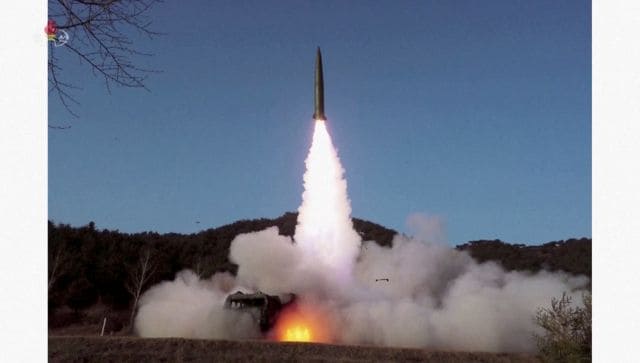 North Korea has been ramping up its nuclear arsenal since Kim Jong Un came to power in 2011. Reuters (Representational Image)[/caption]The nuclear test carried out in September 2017 was North Korea’s most powerful with the country claiming to have developed a hydrogen bomb.According to a South Korean lawmaker, it produced an approximate force or yield of 100 kilotons, reported WSJ. If the estimate is correct, it would make the test nearly five times more powerful than the atomic bomb dropped by the US on Japan’s Nagasaki in 1945.North Korea has the expertise to make nuclear bombs with weapons-grade uranium or plutonium. US intelligence officials estimated in 2017 that the East Asian country possesses adequate fissile material to produce up to sixty nuclear weapons, as per CFR.Fissile material is the core component of nuclear weapons.ALSO READ: After Russia, now N Korea unveils underwater nuclear drone: What we know about ‘Haeil’After 2017, North Korea halted testing of nuclear weapons and long-range missiles, however, it resumed missile tests after Kim’s denuclearisation talks with former US president Donald Trump failed in 2019.That year, North Korea’s missile tests included three new short-range ballistic weapons which were dubbed KN-23, KN-24 and KN-25 by outside experts, as per the NYT report.Unlike older missiles that require liquid fuel, these three new missiles used solid fuel and were easier to move, hide and fire, noted The Washington Post.Since then, North Korea has continued to reveal new ballistic missiles.In 2020, the US Army said North Korea is expected to have 20 to 60 nuclear bombs and the capability to produce six such bombs each year, reported WSJ.The next year, North Korea flaunted its newly-produced tactical guided missile at a military parade. The country claimed the missile is designed to carry a 2.5-tonne warhead. Analysts at the James Martin Center for Nonproliferation Studies said it seemed like "an improved variant" of KN-23, reported Reuters.In September 2021, North Korea test-fired “long-range cruise missiles”. Pyongyang also said it has started testing “ballistic missile with a detachable hypersonic” gliding warhead, as per the NYT report.North Korea also exhibited what are believed to be “two upgraded versions” of its Pukguksong submarine-launched ballistic missiles during military parades in 2020 and 2021, the report added.Recent developments
Kim vowed to expand North Korea’s nuclear arsenal “at the fastest possible speed” last year.The country continued to hit the headlines due to its frequent missile tests.On 24 March, North Korea launched a full-range intercontinental ballistic missile, again showing off its ability to strike the US mainland, if ever needed.In October 2022, Pyongyang test-fired what appeared to be the Hwasong-12 intermediate-range rocket, its first missile over Japan in about five years. As per BBC, the weapon has a range of 4,500km that puts the US island of Guam in the Pacific within reach.By November of that year, North Korea carried out 34 weapons tests, including 88 ballistic and cruise missiles, reported NYT.This year, North Korea has been firing an array of nuclear-capable weapons over the last two weeks.[caption id="attachment_12371162" align="alignnone" width="640"]
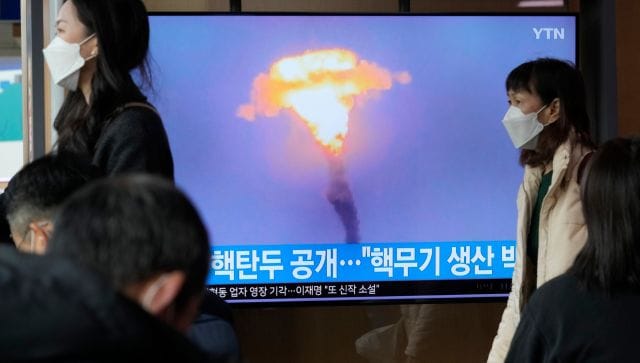 North Korea fired an array of nuclear-capable weapons over the last two weeks. AP[/caption]Just hours before South Korean president Yoon Suk Yeol was to meet Japanese prime minister Fumio Kishida in Tokyo for a two-day bilateral summit on 16 March, North Korea fired an ICBM – its fourth such launch in less than a year.Last week, Pyongyang carried out a nuclear counterattack simulation against the US and South Korea, reported Reuters.Earlier this month, the country claimed to have successfully tested an underwater nuclear attack drone, which it said was in response to the largest US-South Korea military exercises in five years.Dubbed “Haeil,” a Korean word for tsunamis, the drone can fire nuclear weapons under the sea to generate a "super-scale radioactive tsunami" and demolish enemy warships, BBC reported citing the North Korean leader.Pyongyang launched short-range ballistic missiles on Monday and its state media released pictures of smaller nuclear warheads the next day.These warheads could signal North Korea's “progress in miniaturising warheads that are powerful yet small enough to mount on intercontinental ballistic missiles capable of striking the US”, experts told Reuters.Kim Dong-yup, a former South Korean naval officer who teaches at Kyungnam University, told Reuters the pictures seem to depict "a miniaturised, lightweight and standardised warhead"."Now that the delivery vehicles are nearly ready, they would churn out warheads to secure second-strike capabilities - perhaps hundreds, not dozens - while running centrifuges even harder to get weapons-grade nuclear material," he added.A recent US intelligence report has warned Kim will "probably” test a nuclear device again as well as continue to launch nuclear-capable missiles in an effort "to normalise Pyongyang's missile testing”, reported AFP.Why is North Korea expanding its nuclear capabilities?Pyongyang’s uptick in nuclear arsenal has worried South Korea, Japan and their common ally America.Experts said last November that joint drills by South Korea and the US are what likely triggered North Korea to fire a record number of missiles early that month."North Korea really does not like these large combined air exercises, especially since they employ F-35s that can be used for decapitation strikes against the regime and are very difficult for North Korean air defences to pick up," Mason Richey, a professor at Hankuk University of Foreign Studies in Seoul, told Reuters at the time.Another reason for these frequent missile fires is that Kim wants to boost internal support for his government amid the country’s crumbling economy, Yang Moo-jin, a professor at the University of North Korean Studies in Seoul, told Reuters in November 2022."In terms of politics and diplomacy, Kim's focus is on pressing the United States ahead of its midterm elections into withdrawing hostile policies by emphasising to voters that the Biden administration's North Korea policy has failed," Yang said then.With inputs from agenciesRead all the Latest News, Trending News, Cricket News, Bollywood News,India News and Entertainment News here. Follow us on Facebook, Twitter and Instagram.
Sub-Editor at Firstpost. Writing Explainers on everything from politics to space.
First Published:Mar 29, 2023, 15:28:54 IST
Advertisement
Advertisement

Military drones & police check-ups: How Sri Lanka is fighting against worst dengue outbreak in a decade
Sri Lanka is fighting its most severe dengue outbreak in nearly a decade, with infections rising sharply across the nation. Military drones have been deployed to tackle the outbreak, which has claimed 56 lives. Health officials said the outbreak is being driven primarily by the DENV-2 variant of the virus
3 min read
How Facebook job ad lured 2 Karnataka men into Myanmar cyber scam camp
The Karnataka Cyber Command has rescued two youths from a scam compound in Myanmar operated by Chinese fraudsters. The duo from Karnataka were lured on the pretext of data-entry jobs. They were asked to work for 16 hours a day and were expected to sleep for six hours daily
4 min read
Why is India seeing 95% cloud cover despite a Super El Niño?
India is witnessing nearly 95 per cent cloud cover despite a Super El Niño, a climate event usually linked to weaker monsoons. Regional weather systems, cyclonic circulations, the monsoon trough and moisture from two seas are temporarily overpowering one of the world's strongest climate phenomena
5 min read
What is CJP’s fourth demand to the government as protests in Delhi intensify?
The protest by the Cockroach Janta Party at Delhi’s Jantar Mantar refuses to die down. The group have made a fourth demand to the Centre, asking that no FIRs are filed against the agitators and that no legal action be taken. The government has expressed willingness to speak to the protesters, but refused to accede on the resignation of Education Minister Dharmandra Pradhan
5 min read
The new geography of war: Why the Houthis can no longer be ignored
The rise of the Houthis marks the emergence of a new geography of war — one in which influence flows not only from capitals and conventional armies, but also from rugged mountains overlooking vital sea lanes
6 min read
Advertisement
Advertisement