
Advertisement


Sections
Nobel Prize: What is Nobel’s ‘rule of three?’ Why is it a problem?
One of the statutes of the Nobel Foundation, established in accordance with Alfred Nobel’s will, states that 'in no case may a prize amount be divided between more than three persons'. Experts say the ‘rule of three’ makes it difficult for the Nobel committees to honour truly collaborative efforts

On Tuesday, three scientists won the Nobel Prize for physics.Pierre Agostini, Hungarian-born Ferenc Krausz and French-born Anne L’Huillier won for their work examining electrons in atoms.L’Huillier is the fifth woman to receive a Nobel in physics.While their work on the atom – fundamental to virtually everything important to humanity including chemistry, physics, our bodies and our gadgets – could result in massive changes one day, the prize being awarded to three scientists has also turned the spotlight back on what some call Nobel’s ‘rule of three’.But what is it? And what’s the problem with it?Let’s take a closer look:What is it?First, let’s briefly examine the Nobel prize.The Nobel prize was created by Alfred Nobel, a 19th Century businessman and chemist from Sweden.Nobel, the inventor of dynamite, was an exceedingly wealthy man.He created the annual prize to honour “those who, during the preceding year, have conferred the greatest benefit to humankind.”[caption id="attachment_13199572" align="alignnone" width="640"]![]() A painting by Swedish artist Emil Österman depicting the founder of the Nobel Prize, Alfred Nobel. nobelprize.org[/caption]However, one of the statutes of the Nobel Foundation – established in accordance with Nobel’s will – states: “A prize amount may be equally divided between two works, each of which is considered to merit a prize. If a work that is being rewarded has been produced by two or three persons, the prize shall be awarded to them jointly.”
A painting by Swedish artist Emil Österman depicting the founder of the Nobel Prize, Alfred Nobel. nobelprize.org[/caption]However, one of the statutes of the Nobel Foundation – established in accordance with Nobel’s will – states: “A prize amount may be equally divided between two works, each of which is considered to merit a prize. If a work that is being rewarded has been produced by two or three persons, the prize shall be awarded to them jointly.”![(File) A file photo of a Nobel medal displayed during a ceremony in New York. AP]() A Nobel medal. AP[/caption]“We read all relevant literature, attend conferences and write reports also within the committee,” Brzezinski added. “With time, we often succeed in identifying a limited number of scientists who have made the discovery. If this is not possible, we are not able to propose a Prize to the Academy.”The Nobel Prize in medicine was awarded Monday to two scientists for discoveries that enabled the development of mRNA vaccines against COVID-19.The prizes in chemistry, literature, peace and economics will follow, with one announcement every weekday until 9 October.The first Nobel Prizes were presented in 1901, five years after Nobel’s death. In 1968, a sixth prize was created, for economics, by Sweden’s central bank.Though Nobel purists stress that the economics prize is technically not a Nobel Prize, it’s always presented together with the others.With inputs from agencies
A Nobel medal. AP[/caption]“We read all relevant literature, attend conferences and write reports also within the committee,” Brzezinski added. “With time, we often succeed in identifying a limited number of scientists who have made the discovery. If this is not possible, we are not able to propose a Prize to the Academy.”The Nobel Prize in medicine was awarded Monday to two scientists for discoveries that enabled the development of mRNA vaccines against COVID-19.The prizes in chemistry, literature, peace and economics will follow, with one announcement every weekday until 9 October.The first Nobel Prizes were presented in 1901, five years after Nobel’s death. In 1968, a sixth prize was created, for economics, by Sweden’s central bank.Though Nobel purists stress that the economics prize is technically not a Nobel Prize, it’s always presented together with the others.With inputs from agencies
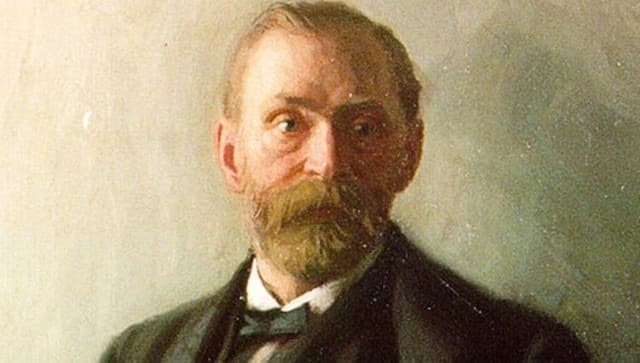 A painting by Swedish artist Emil Österman depicting the founder of the Nobel Prize, Alfred Nobel. nobelprize.org[/caption]However, one of the statutes of the Nobel Foundation – established in accordance with Nobel’s will – states: “A prize amount may be equally divided between two works, each of which is considered to merit a prize. If a work that is being rewarded has been produced by two or three persons, the prize shall be awarded to them jointly.”
“In no case may a prize amount be divided between more than three persons.”It is this above statute that has been labelled the Nobel’s ‘rule of three’.What’s the problem?The problem is that the days of one man or woman having a wondrous breakthrough – like Albert Einstein pioneering his Theory of Relativity or Sir Isaac Newton publishing the Philosophiae Naturalis Principia Mathematica in 1867 – are long past.As Martin Rees, British cosmologist and physicist and former president of the Royal Society, explained to CNN, a big problem for the Nobel committees is that scientific inquiry has more and more become a collective endeavour.Moreover, different teams can make the same scientific breakthroughs while working separately.“It may be a project where several people have done work in parallel, and they single out some and not others. It may be that there’s a team, and it’s not obvious that the ones they’ve singled from the team are the dominant figures,” Rees added.
Rees cited the example of the 2017 Nobel Prize in physics.The 2017 Nobel Prize in physics – which measured movements made by gravitational waves created in the last fifth of a second as two black holes spiraling together collided and whose detection confirmed predictions Albert Einstein made 100 years earlier about the fabric of space and time – was given to Thorne, Weiss and Barry.However, Rees stated that the two key papers noting the discovery had nearly 1,000 authors.David Pendlebury, head of research analysis at Clarivate’s Institute for Scientific Information, agrees with Reese.Pendlebury told CNN, “It really has become a huge transformation in science that it’s more and more team science — huge groups tackling more difficult problems, international collaborative networks.”“This rule of three does seem to be an impediment if they wanted to recognise a team.”But the Nobel Foundation seems in no hurry to change anything.Peter Brzezinski, the secretary of the committee for the Nobel Chemistry Prize, told CNN, “We start the process by asking a number of experts from around the world to write reports describing the field in which the discovery has been made, to outline the main discoveries in this field and also to mention individuals who have made the most important contributions.”[caption id="attachment_11406841" align="alignnone" width="640"]
 A Nobel medal. AP[/caption]“We read all relevant literature, attend conferences and write reports also within the committee,” Brzezinski added. “With time, we often succeed in identifying a limited number of scientists who have made the discovery. If this is not possible, we are not able to propose a Prize to the Academy.”The Nobel Prize in medicine was awarded Monday to two scientists for discoveries that enabled the development of mRNA vaccines against COVID-19.The prizes in chemistry, literature, peace and economics will follow, with one announcement every weekday until 9 October.The first Nobel Prizes were presented in 1901, five years after Nobel’s death. In 1968, a sixth prize was created, for economics, by Sweden’s central bank.Though Nobel purists stress that the economics prize is technically not a Nobel Prize, it’s always presented together with the others.With inputs from agencies
First Published:Oct 04, 2023, 08:42:56 IST
Advertisement
Advertisement

Military drones & police check-ups: How Sri Lanka is fighting against worst dengue outbreak in a decade
Sri Lanka is fighting its most severe dengue outbreak in nearly a decade, with infections rising sharply across the nation. Military drones have been deployed to tackle the outbreak, which has claimed 56 lives. Health officials said the outbreak is being driven primarily by the DENV-2 variant of the virus
3 min read
How Facebook job ad lured 2 Karnataka men into Myanmar cyber scam camp
The Karnataka Cyber Command has rescued two youths from a scam compound in Myanmar operated by Chinese fraudsters. The duo from Karnataka were lured on the pretext of data-entry jobs. They were asked to work for 16 hours a day and were expected to sleep for six hours daily
4 min read
Why is India seeing 95% cloud cover despite a Super El Niño?
India is witnessing nearly 95 per cent cloud cover despite a Super El Niño, a climate event usually linked to weaker monsoons. Regional weather systems, cyclonic circulations, the monsoon trough and moisture from two seas are temporarily overpowering one of the world's strongest climate phenomena
5 min read
What is CJP’s fourth demand to the government as protests in Delhi intensify?
The protest by the Cockroach Janta Party at Delhi’s Jantar Mantar refuses to die down. The group have made a fourth demand to the Centre, asking that no FIRs are filed against the agitators and that no legal action be taken. The government has expressed willingness to speak to the protesters, but refused to accede on the resignation of Education Minister Dharmandra Pradhan
5 min read
The new geography of war: Why the Houthis can no longer be ignored
The rise of the Houthis marks the emergence of a new geography of war — one in which influence flows not only from capitals and conventional armies, but also from rugged mountains overlooking vital sea lanes
6 min read
Advertisement
Advertisement