
Advertisement


Sections
Over 27 plane crashes in 30 years: Why Nepal's mountains aren't the only reason for its poor air safety record
Sunday's air crash involving Yeti Airlines is yet another black mark on Nepal’s air safety record. While the topography and wild weather make it difficult to fly in the Himalayan kingdom, the use of dated technology and lack of reforms in the aviation sector are also to blame for the tragedies

Nepal, the picturesque hill area, was once again the scene of a horrific air crash on Sunday. A Yeti Airlines passenger plane, crashed into a river gorge while landing at the newly-opened airport, built with Chinese assistance, in Nepal’s Pokhara. Seventy-two people, including five Indians, on board, are feared to be dead.According to data from the Aviation Safety Network, this is the country’s third-worst aviation accident.The plane was 18 minutes into its journey when it lost contact with a control tower in the central city of Pokhara. The aircraft had nearly finished its short journey from Kathmandu, the capital, to Pokhara, Nepal’s second-most populous city and a gateway to the Himalayas.The aviation disaster once again throws the spotlight on the issue of airline safety in Nepal; according to data, the mountainous country averages one flight disaster each year and since 2010, the area has witnessed 11 fatal plane crashes, including Sunday’s.Severe weather and airports perched on rugged mountains has made Nepal one of the most challenging countries to fly in.Nepal’s tricky topographyOne of the reasons why flying in Nepal is so risky is the topography of the area. Home to eight of the world’s 14 highest mountains, including Everest, and its beautiful rugged landscapes make it a popular tourist destination for trekkers.However, it is these conditions that also make Nepal dangerous and tricky to fly in. Captain Amit Singh, a commercial pilot and founder of Safety Matters Foundation, explained in an ANI report that Kathmandu is a valley, it is like a bowl and the airport is in between, surrounded by mountains, high mountains on all sides. So it is a very challenging airfield.Also read: UP man aboard crashed plane was visiting Pashupatinath Temple in Nepal after son's birthThe country’s civil aviation authority in a 2019 safety report had stated that the country’s “diversity of weather patterns together with hostile topography are the main challenges surrounding aircraft operations in Nepal due to which the number of accidents related to small aircraft… seems comparatively higher”.The country has several hard-to-access airstrips. For instance, the Tenzing-Hillary Airport in Nepal’s Lukla area is known as the world’s most dangerous airport — with a single runway that angles down toward a valley below.Wild weatherThe mountainous region of Nepal also means planes have to takeoff and land at high altitudes. The low air density decreases the performance of an aircraft and makes it more difficult to slow down.Moreover, Nepal often sees sudden changes in weather and visibility is often an issue for pilots flying in the region. In the past, pilots have spoken of the fact that the smaller aircraft used in the region aren’t equipped with the technology to detect the unpredictable conditions, making flying an even riskier proposition.[caption id="attachment_11991492" align="alignnone" width="640"]![]() Nepal's long list of air tragedies. Graphic: Pranay Bhardwaj[/caption]Dated technologyNepal, one of the poorer countries in the world, relies on ageing airplanes for its domestic flights. Many of these aircraft don’t have the necessary modern equipment such as radar and or GPS technology that can help mitigate problems with visibility or weather.For instance, Yeti Airlines whose plane crashed on Sunday began two decades ago and only operates ATR 72-500s. According to flight tracking website Flightradar24, the aircraft involved in the crash on Sunday was 15-years old.Before Sunday’s crash, Nepal had witnessed a horrific crash in May 2022 when an aircraft of Tara Air crashed shortly after take-off from Pokhara. That small plane was first flown in 1979 and was not equipped with modern technology that could have provided the pilot with vital information about the surroundings.Captain Bed Upreti had told The Guardian last year, “We can’t afford to keep flying aircraft that are 43 years old. The technology, or lack of, is dangerous to be flying in a place like Nepal.”Such is the condition of the aviation sector in Nepal that all airline carriers from Nepal have been refused permission to operate air services to the European Union since 2013 due to safety concerns.[caption id="attachment_11991502" align="alignnone" width="640"]
Nepal's long list of air tragedies. Graphic: Pranay Bhardwaj[/caption]Dated technologyNepal, one of the poorer countries in the world, relies on ageing airplanes for its domestic flights. Many of these aircraft don’t have the necessary modern equipment such as radar and or GPS technology that can help mitigate problems with visibility or weather.For instance, Yeti Airlines whose plane crashed on Sunday began two decades ago and only operates ATR 72-500s. According to flight tracking website Flightradar24, the aircraft involved in the crash on Sunday was 15-years old.Before Sunday’s crash, Nepal had witnessed a horrific crash in May 2022 when an aircraft of Tara Air crashed shortly after take-off from Pokhara. That small plane was first flown in 1979 and was not equipped with modern technology that could have provided the pilot with vital information about the surroundings.Captain Bed Upreti had told The Guardian last year, “We can’t afford to keep flying aircraft that are 43 years old. The technology, or lack of, is dangerous to be flying in a place like Nepal.”Such is the condition of the aviation sector in Nepal that all airline carriers from Nepal have been refused permission to operate air services to the European Union since 2013 due to safety concerns.[caption id="attachment_11991502" align="alignnone" width="640"]![]() Rescuers gather at the site of a Yeti Airlines plane crash in Pokhara. Yeti Airlines whose plane crashed on Sunday began two decades ago and only operates ATR 72-500s. AFP[/caption]Issues plaguing Nepal’s aviation bodyBesides the weather, hostile geographical conditions, and outdated technology, another issue plaguing Nepal’s skies is the aviation body itself.The Civil Aviation Authority of Nepal (CAAN) is both the service provider and regulator in Nepal. That has engendered a conflict of interest, especially when it comes to safety regulations. The European Commission and the United Nations International Civil Aviation Organisation (ICAO) have urged Nepal since 2009 to break up the aviation regulator with a clear demarcation of its powers and responsibilities because its dual functions gave rise to a conflict of interest. However, despite years of efforts to do the same, the problem persists.According to a report by the Kathmandu Post, there is politics from preventing the split of the body. Insiders told the newspaper that once the civil aviation body is separated, some top position holders will lose the dual benefits they have been receiving.The newspaper added that every successive tourism minister and political leaders have been pledging to bring in reform and change, but nothing has changed. As aviation analyst Hemant Arjyal said, “The problem lies in our system. No one cares about the country. The politicians are wise while making pledges and commitments. But this is the task that we should do. Pledges will not work.”As is written in The Diplomat, the path for the government could not have been more straightforward. However, vested interests have reigned over the common sense measure for more than 15 yearsWith inputs from agenciesRead all the Latest News, Trending News, Cricket News, Bollywood News,India News and Entertainment News here. Follow us on Facebook, Twitter and Instagram.
Rescuers gather at the site of a Yeti Airlines plane crash in Pokhara. Yeti Airlines whose plane crashed on Sunday began two decades ago and only operates ATR 72-500s. AFP[/caption]Issues plaguing Nepal’s aviation bodyBesides the weather, hostile geographical conditions, and outdated technology, another issue plaguing Nepal’s skies is the aviation body itself.The Civil Aviation Authority of Nepal (CAAN) is both the service provider and regulator in Nepal. That has engendered a conflict of interest, especially when it comes to safety regulations. The European Commission and the United Nations International Civil Aviation Organisation (ICAO) have urged Nepal since 2009 to break up the aviation regulator with a clear demarcation of its powers and responsibilities because its dual functions gave rise to a conflict of interest. However, despite years of efforts to do the same, the problem persists.According to a report by the Kathmandu Post, there is politics from preventing the split of the body. Insiders told the newspaper that once the civil aviation body is separated, some top position holders will lose the dual benefits they have been receiving.The newspaper added that every successive tourism minister and political leaders have been pledging to bring in reform and change, but nothing has changed. As aviation analyst Hemant Arjyal said, “The problem lies in our system. No one cares about the country. The politicians are wise while making pledges and commitments. But this is the task that we should do. Pledges will not work.”As is written in The Diplomat, the path for the government could not have been more straightforward. However, vested interests have reigned over the common sense measure for more than 15 yearsWith inputs from agenciesRead all the Latest News, Trending News, Cricket News, Bollywood News,India News and Entertainment News here. Follow us on Facebook, Twitter and Instagram.
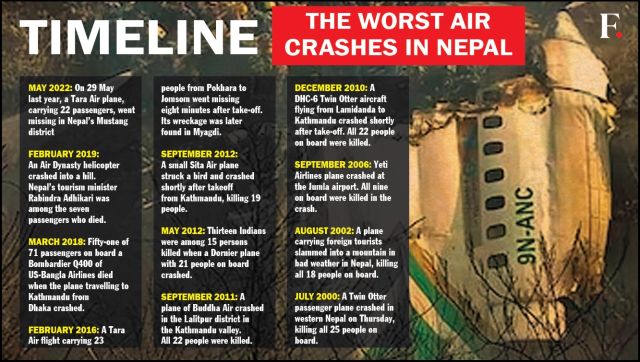 Nepal's long list of air tragedies. Graphic: Pranay Bhardwaj[/caption]Dated technologyNepal, one of the poorer countries in the world, relies on ageing airplanes for its domestic flights. Many of these aircraft don’t have the necessary modern equipment such as radar and or GPS technology that can help mitigate problems with visibility or weather.For instance, Yeti Airlines whose plane crashed on Sunday began two decades ago and only operates ATR 72-500s. According to flight tracking website Flightradar24, the aircraft involved in the crash on Sunday was 15-years old.Before Sunday’s crash, Nepal had witnessed a horrific crash in May 2022 when an aircraft of Tara Air crashed shortly after take-off from Pokhara. That small plane was first flown in 1979 and was not equipped with modern technology that could have provided the pilot with vital information about the surroundings.Captain Bed Upreti had told The Guardian last year, “We can’t afford to keep flying aircraft that are 43 years old. The technology, or lack of, is dangerous to be flying in a place like Nepal.”Such is the condition of the aviation sector in Nepal that all airline carriers from Nepal have been refused permission to operate air services to the European Union since 2013 due to safety concerns.[caption id="attachment_11991502" align="alignnone" width="640"]
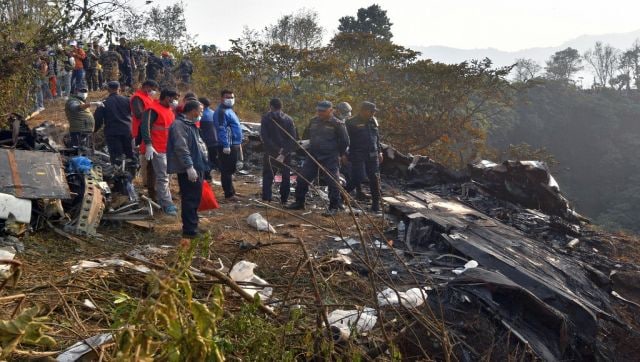 Rescuers gather at the site of a Yeti Airlines plane crash in Pokhara. Yeti Airlines whose plane crashed on Sunday began two decades ago and only operates ATR 72-500s. AFP[/caption]Issues plaguing Nepal’s aviation bodyBesides the weather, hostile geographical conditions, and outdated technology, another issue plaguing Nepal’s skies is the aviation body itself.The Civil Aviation Authority of Nepal (CAAN) is both the service provider and regulator in Nepal. That has engendered a conflict of interest, especially when it comes to safety regulations. The European Commission and the United Nations International Civil Aviation Organisation (ICAO) have urged Nepal since 2009 to break up the aviation regulator with a clear demarcation of its powers and responsibilities because its dual functions gave rise to a conflict of interest. However, despite years of efforts to do the same, the problem persists.According to a report by the Kathmandu Post, there is politics from preventing the split of the body. Insiders told the newspaper that once the civil aviation body is separated, some top position holders will lose the dual benefits they have been receiving.The newspaper added that every successive tourism minister and political leaders have been pledging to bring in reform and change, but nothing has changed. As aviation analyst Hemant Arjyal said, “The problem lies in our system. No one cares about the country. The politicians are wise while making pledges and commitments. But this is the task that we should do. Pledges will not work.”As is written in The Diplomat, the path for the government could not have been more straightforward. However, vested interests have reigned over the common sense measure for more than 15 yearsWith inputs from agenciesRead all the Latest News, Trending News, Cricket News, Bollywood News,India News and Entertainment News here. Follow us on Facebook, Twitter and Instagram.
First Published:Jan 16, 2023, 10:26:27 IST
Advertisement
Advertisement

Military drones & police check-ups: How Sri Lanka is fighting against worst dengue outbreak in a decade
Sri Lanka is fighting its most severe dengue outbreak in nearly a decade, with infections rising sharply across the nation. Military drones have been deployed to tackle the outbreak, which has claimed 56 lives. Health officials said the outbreak is being driven primarily by the DENV-2 variant of the virus
3 min read
How Facebook job ad lured 2 Karnataka men into Myanmar cyber scam camp
The Karnataka Cyber Command has rescued two youths from a scam compound in Myanmar operated by Chinese fraudsters. The duo from Karnataka were lured on the pretext of data-entry jobs. They were asked to work for 16 hours a day and were expected to sleep for six hours daily
4 min read
Why is India seeing 95% cloud cover despite a Super El Niño?
India is witnessing nearly 95 per cent cloud cover despite a Super El Niño, a climate event usually linked to weaker monsoons. Regional weather systems, cyclonic circulations, the monsoon trough and moisture from two seas are temporarily overpowering one of the world's strongest climate phenomena
5 min read
What is CJP’s fourth demand to the government as protests in Delhi intensify?
The protest by the Cockroach Janta Party at Delhi’s Jantar Mantar refuses to die down. The group have made a fourth demand to the Centre, asking that no FIRs are filed against the agitators and that no legal action be taken. The government has expressed willingness to speak to the protesters, but refused to accede on the resignation of Education Minister Dharmandra Pradhan
5 min read
The new geography of war: Why the Houthis can no longer be ignored
The rise of the Houthis marks the emergence of a new geography of war — one in which influence flows not only from capitals and conventional armies, but also from rugged mountains overlooking vital sea lanes
6 min read
Advertisement
Advertisement