


Nasa wants to live on the Moon. How that could pan out
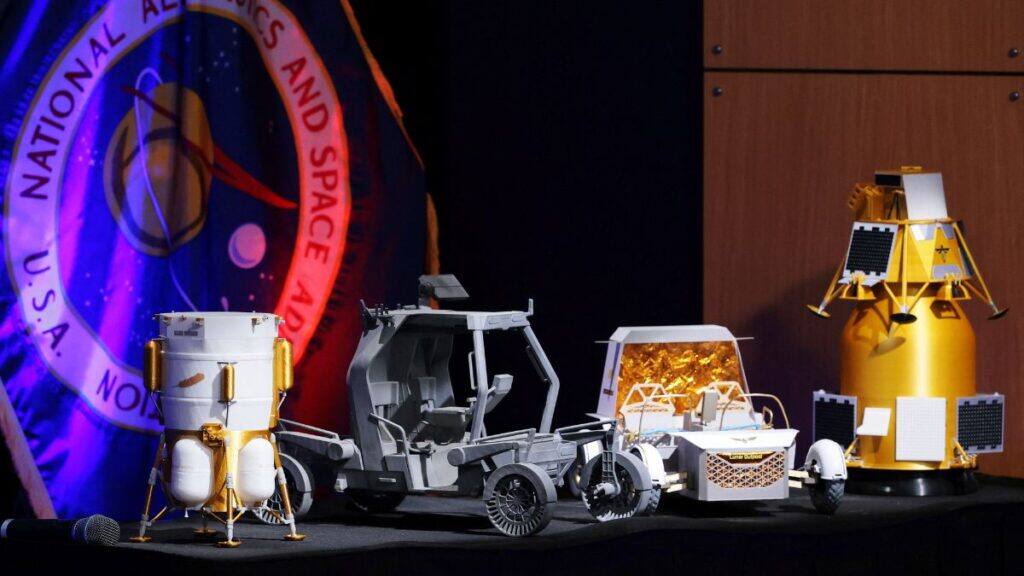
Nasa has unveiled its plan to construct a Moon base involving robotic landers, moon buggies and hopping drones. The US space agency has envisaged a permanent lunar base sprawling over hundreds of square miles in the south polar region. Here’s what it will take to build the outpost

The National Aeronautics and Space Administration (Nasa) is planning to not just land but stay on the Moon. The United States space agency has unveiled its roadmap to build a permanent lunar base.
Under its Artemis programme, Nasa has awarded hundreds of millions of dollars in contracts to four US companies to acquire robotic landers, hopping drones and vehicles to develop the moon base. But why has Nasa’s focus turned towards the Moon?
We take a look.
Nasa’s Moon base
On Tuesday (May 26), Nasa released details to construct a permanent Moon outpost, involving robotic landers, moon buggies and hopping drones.
"The Moon base will be America's and humanity's first outpost on another celestial world," Nasa administrator Jared Isaacman said at a press conference.
Laying out the first phase of its Moon base plans, the US space agency said it has awarded contracts to four American companies, including Amazon founder Jeff Bezos's Blue Origin.
 More from Explainers
Blue Origin, which got a $188 million contract, will provide a pair of landers to transport moon buggies to the lunar surface near the Moon's south pole, as per Associated Press (AP).
The lunar terrain vehicles will be built and delivered by Astrolab and Lunar Outpost.
Firefly Aerospace will build the spacecraft to deliver drones from Earth's orbit to the Moon for its MoonFall mission.
Nasa hopes all this hardware will be ready before the first Artemis astronauts land on the moon as early as 2028.
The project will span decades as Nasa aims to establish a lunar base to support future Moon exploration missions.
In March, Nasa announced a $20 billion programme to build a permanent base powered by nuclear and solar energy at the Moon's south pole by 2032.
The Nasa administrator said that Tuesday's announcements show that the US will "never give up the Moon again".
How Nasa Moon base programme will unfold
Nasa has envisaged a Moon base sprawling over hundreds of square miles in the south polar region.
The current plan comprises a series of habitats, power systems, vehicles and laboratories to support astronauts for weeks or months at a time, as per the Australian Broadcasting Corporation (ABC).
Nasa's Moon base programme executive, Carlos Garcia-Galan, said the lunar base will have a perimeter monitored by drones, dubbed MoonFall, stationed at various points.
According to Nasa administrator Isaacman, these territory markers would be designed to avoid interfering with other countries' spacecraft and equipment that might be nearby.
Spread over the next decade and beyond, the Ignition Moon Base programme will unfold in three phases.
The focus of the first phase is on landing astronauts and transporting the first robotic systems near the Moon's south pole.
Artemis III is planned for next year, during which astronauts will practice docking Nasa's Orion capsule in orbit around Earth. Lunar landers for crews are being developed by Blue Origin and Elon Musk's SpaceX.
Under the Artemis IV mission, two astronauts could land on the Moon as soon as 2028.
"For those waiting patiently, the grand return is close at hand and we will not slow down," Isaacman said. "We are really just getting started."
The second phase, taking place between the late 2020s and early 2030s, will entail constructing infrastructure, such as power systems, transport networks and resource extraction technologies.
The third phase, expected to kick-start after 2032, would focus on establishing a longer-duration habitation using more advanced permanent structures. The US space agency is hoping humans will be able to reside on the Moon in "semi-permanent" housing by 2032.
"Then we'll be able to say, 'Hey, we're permanently here, and we're not giving it up,'" Garcia-Galan said.
Why Nasa wants a Moon base
It is not just Nasa that has shifted its focus to the Moon for deep-space exploration. The US is facing stiff competition from China to return humans to the lunar surface.
The Asian giant plans to land humans on the Moon by 2030. It also aims to set up its own International Lunar Research Station in the 2030s with Russia.
The renewed significance of the Moon in global space ambitions was visible when, in February, Elon Musk announced that his SpaceX is centering its settlement plans on the Moon, directing its focus away from Mars, at least for the time being.
"For those unaware, SpaceX has already shifted focus to building a self-growing city on the moon, as we can potentially achieve that in less than 10 years, whereas Mars would take 20+ years," the billionaire wrote on February 8 on X.
For Nasa, the Moon is a training ground for human missions to Mars, as per ABC. Astronauts and engineers would be able to test habitats, life-support systems and survival technologies while living on the lunar surface. This experience would be beneficial when attempting far longer journeys into deep space.
A lunar base would enable the US to conduct scientific experiments, potentially mine valuable resources, and travel to Mars more easily, reported BBC.
Nasa's Isaacman underlined that the aim to develop the Moon base is to create a lunar economy while conducting scientific research and preparing for a Mars expedition.
The plan to build this permanent base on the Moon's South Pole is important as the region, scientists believe, contains frozen water that could be used for drinking water or producing oxygen.
Nasa's plan hinges on a spacecraft that can safely transport humans to the Moon. Musk's SpaceX is contracted to develop the craft called Starship Human Landing System. However, it has faced several setbacks and delays.
With inputs from agencies
Tags

Military drones & police check-ups: How Sri Lanka is fighting against worst dengue outbreak in a decade
How Facebook job ad lured 2 Karnataka men into Myanmar cyber scam camp
Why is India seeing 95% cloud cover despite a Super El Niño?
What is CJP’s fourth demand to the government as protests in Delhi intensify?
The new geography of war: Why the Houthis can no longer be ignored