


Mystery of Green Boots on Everest solved: Inside the ‘high risk’ mission to bring his body back after 30 years
After 30 long years, the identity of unknown Mount Everest climber dubbed ‘Green Boots’ has been solved, with official verification confirming him to be ITBP Lance Naik Dorje Morup. Now, India plans to launch an expedition to retrieve his body. A tender document states that the mission should include at least six sherpas and complete it by October

The "Green Boots" died on Mount Everest on May 10, 1996, after being hit by a sudden storm near the peak, in one of the deadliest ever witnessed on the world's highest peak. For nearly 30 years, his identity remained unknown, until now.
Indian authorities have recently released their plan to retrieve Green Boots, which also contains information about the climber's identity. The plan identifies Green Boots/recovery subject as Lance Naik Dorje Morup.
Since 1996, Morup's identity was assumed to be that of the body of Tsewang Paljor, an Indian climber who had also died on the same day in the same blizzard. It was often reported but never confirmed.
However, the long-standing mystery was solved after official verification confirmed that the remains belonged to Indo-Tibetan Border Police (ITBP) Morup, who was an Indian soldier. The government is setting up an incredibly difficult recovery process to bring back the body of Morup, who was remembered by his footwear for three decades.
 More from Explainers
We take a closer look.
Who was Green Boots?
It was never fair to identify him through his footwear. But in the aftermath of the tragedy, the body of the man wearing distinctive lime-green boots immediately became his only identifying aspect.
The world called him "Green Boots" for decades while he was a soldier, a mountaineer, and an Indo-Tibetan Border Police (ITBP) climber. His name is Dorje Morup, and he was part of ITBP, a force with a deep-rooted connection to the Himalayas.
According to Sainik Welfare News, Morup’s name also appeared in an older ITBP mountaineering record. In 1973, he was among the mountaineers who successfully summited Kakstet, a 6,442-metre peak in the Pangong range, marking its first recorded ascent.
Therefore, before the world called him "Green Boots", he already had mountaineering records, not a novice to Everest, nor a nameless figure on Everest. Morup, a trained Indian soldier-climber who had witnessed challenging Himalayan terrain long before the tragedy.
What happened to him?
According to reports, as many as eight climbers perished in the storm in 1996. A six-member ITBP team was attempting to summit, but a deadly blizzard struck just below the summit.
On May 10, the team was above Camp 6- moving through some of the most dangerous ground on Everest. They were climbing in the altitude zone where even well-trained bodies begin to give way.
Three turned back near the first step; however, 47-year-old Morup, 28-year-old Tsewang Paljor, and Tsewang Samanla chose to continue. They cleared the second step and headed toward the summit.
By 1900 hrs, a fierce storm was raging on the summit ridge, and they lost radio contact. Around 1930 hrs, two head torches were spotted moving through the darkness, but then the lights disappeared too, the report noted.
Eventually, all three, including Morup, succumbed to extreme weather and never made a comeback.
How did Morup become 'Green Boots'?
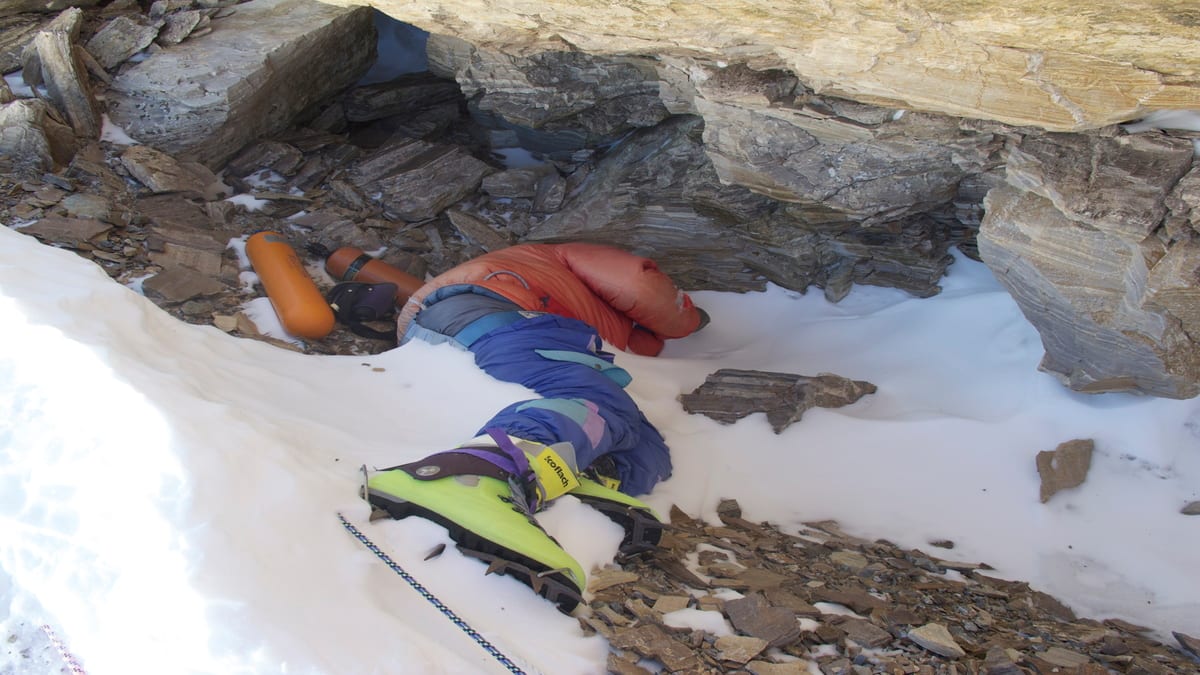
In the aftermath of the tragedy, Morup's body beneath the snow on Everest’s north-east ridge route became famous for his distinctive visible green boots.
The most distressing part is that, over time, climbers started using those visible green boots as a route marker. It became a landmark for climbers tackling the tricky north-east ridge route.
Since 1996, Green Boots has served as a grim waypoint for climbers ascending Everest’s 8,848 metres. People radioed to the base camp, saying, "They have reached Green Boots," using the landmark to gauge their progress and time, the Guardian reported.
It was as if the mountain not only took Morup's life, but also took his identity from public memory.
The "Green Boots" lie fully clothed beneath a small rocky alcove at an altitude of around 8,500 metres, barely 350 metres below Everest’s summit, the report noted.
How is India preparing to bring 'Green Boots' home?
The battle to bring the climber home involves an incredibly difficult recovery process.
A tender document of India's plan, accessed by the Guardian, seeks companies to bid for the mission. A proven track record in high-altitude recoveries is a must.
The team of specialists should include at least six Sherpas, Tibetan people known for their mountain-climbing skills, preferably experienced in summiting Everest multiple times.
They must give evidence of the mission and transport Morup's body to Delhi by October, the document said. It also mentioned that the identification of Morup, called the Green Boots, “has been confirmed through a prior verification process conducted under a technical assessment earlier."
Why would the recovery plan be gruelling?
Tshiring Jangbu, the founder of Everest Sherpa Expedition, who has been part of body recovery efforts, called the Green Boots retrieval "arduous and dangerous" even for an experienced Sherpa team, the news outlet reported.
At a third of the oxygen available at sea level, any attempt or activity above 8,000 metres would require a tremendous amount of effort. There is a possibility of difficulty in decision-making.
According to Jangbu, a body encased in ice and still wearing climbing gear can weigh up to 200 kg. With limbs frozen rigid in awkward positions, dragging the remains or lowering them over rocky, icy terrain becomes an exhausting, painstaking and highly perilous task.
"One of the most technically demanding recovery operations ever tried on Everest. Double the danger of normal climbing," Jangbu told CBS News.
He added that it might take a highly trained 10-person team up to a week to recover Green Boots' body. In his opinion, the recovery operation would be impossible until spring due to weather conditions, leaving a question about the Indian authority's June-October timeframe noted in the document.
However, according to him, the recovery plan is necessary as it brings the deceased back home. "My opinion is we must bring them down," he told the publication.
With inputs from agencies

Military drones & police check-ups: How Sri Lanka is fighting against worst dengue outbreak in a decade
How Facebook job ad lured 2 Karnataka men into Myanmar cyber scam camp
Why is India seeing 95% cloud cover despite a Super El Niño?
What is CJP’s fourth demand to the government as protests in Delhi intensify?
The new geography of war: Why the Houthis can no longer be ignored